
National shutdown
Timeline:
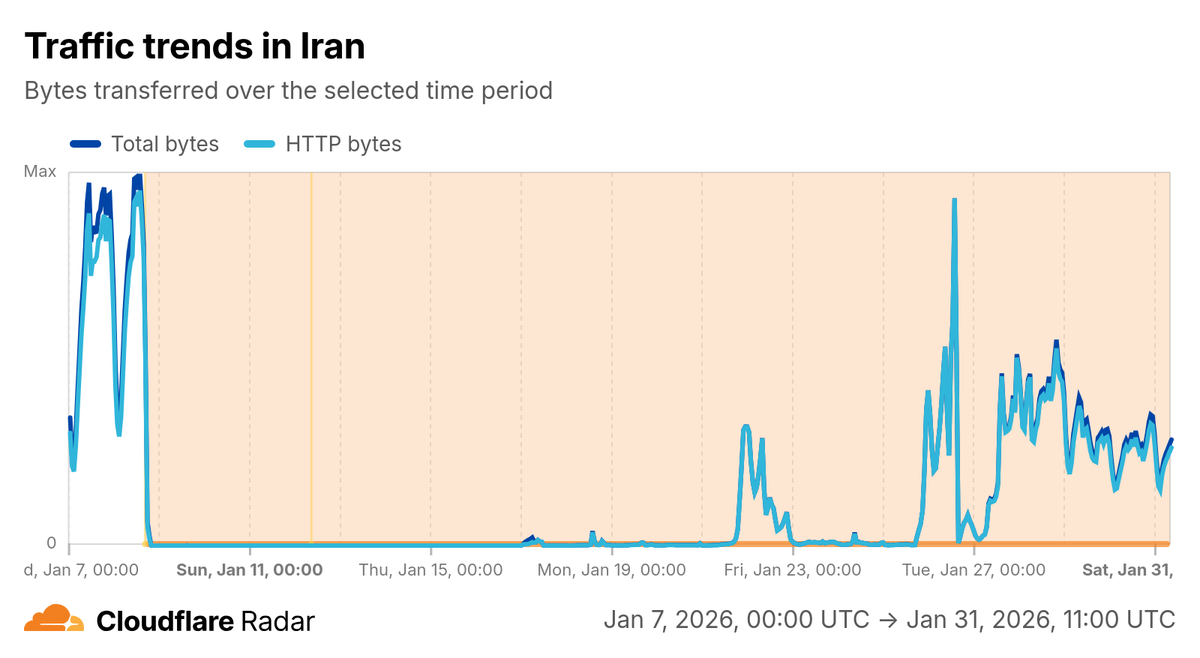
* 8 January 2026 — Nationwide shutdown begins: Iran imposes a near-total internet blackout on the 12th day of nationwide protests. Many local websites also became unreachable, including those of the main local news agencies.
* 28 January 2026 — Partial, uneven restoration: Authorities relax some restrictions, but connectivity returns only in a patchwork and heavily filtered form.
* Mid-February 2026 — Degraded and unstable connectivity: National internet traffic recovers only to ~50–60% of normal levels; VPN services remain erratic and unreliable.
* 28 February 2026 — New shutdown during hostilities: Following U.S.–Israel airstrikes, Cloudflare Radar confirms traffic in Iran drops to nearly zero, indicating a fresh, state-enforced blackout.
- Total Duration 89 days, 18 hours
 Iran
Iran
- Population
- 91,567,738
Freedom House rates Internet freedom as Not Free
Local impact
Iran has experienced one of its most extensive and prolonged internet shutdowns since 8 January 2026, coinciding with nationwide protests. Disruptions affected both international connectivity and—unusually at times—the domestic National Information Network (NIN), reflecting an escalatory approach to digital isolation. [theguardian.com], [securityaffairs.com]
While authorities appeared to ease some restrictions around 28 January, the restoration was fragmentary and highly controlled. Analysts documented a shift toward a whitelist‑style model and increased reliance on state‑sanctioned platforms, rather than a full return to open connectivity. [techcrunch.com], [blog.cloudflare.com]
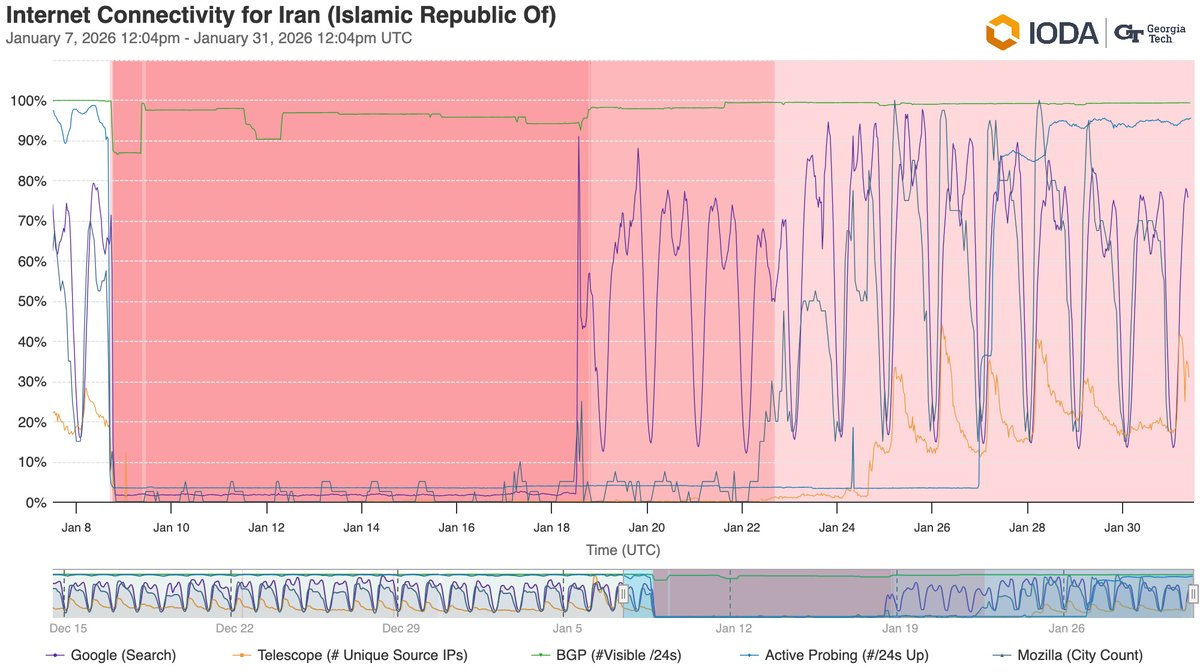
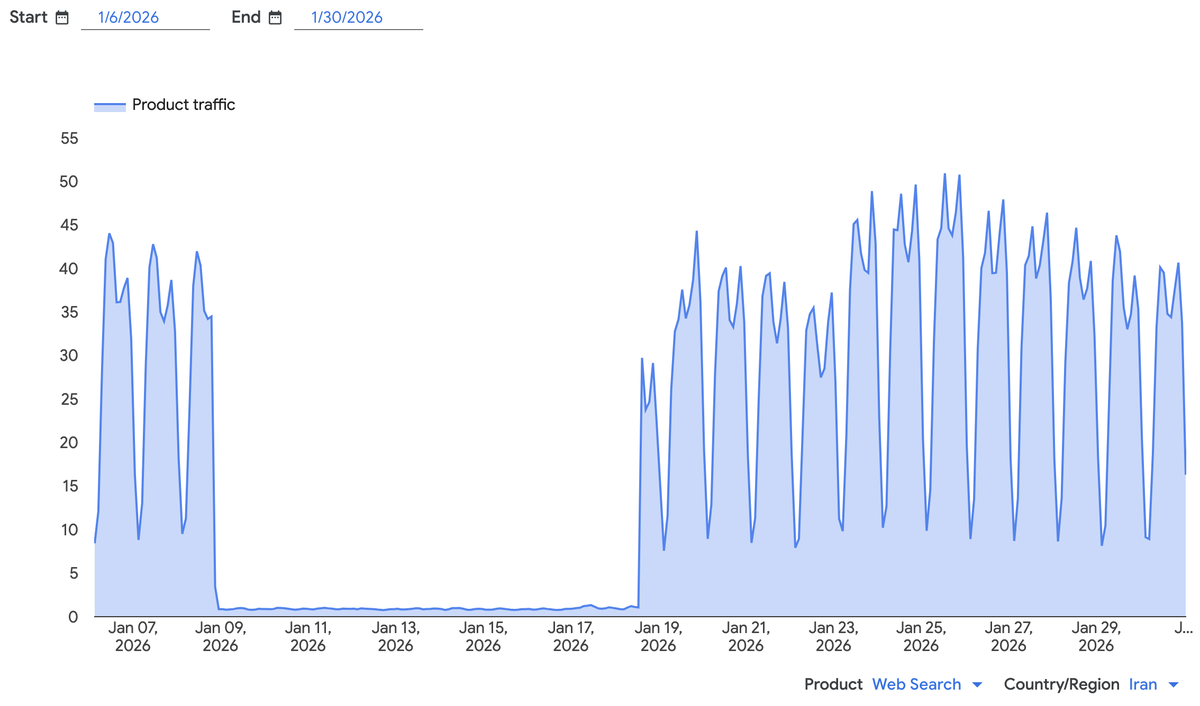
As of 13:00 UTC 18 January, access to Google web search appears to have been restored, while traffic to other Google services and traffic monitored by Cloudflare and IODA appear to be at levels similar to those during the full blackout.
Local reports from 17 January indicated that access to Iranian messaging applications will be made available for authorized and verified channels on Eitaa, iGap, Rubika, and Soroush Plus.
By late January and through mid‑February, connectivity remained degraded and unstable. Measurements from Cloudflare/Kentik cited by major media showed national traffic recovering only to ~50–60% of normal levels, with jagged peaks indicating ongoing throttling and filtering. Users reported that even when the network was “on,” VPNs worked unpredictably and inconsistently across cities, neighborhoods, and devices. [techcrunch.com], [techradar.com]
Even though the service is not officially available in the country, IranWire reported that the Iranian government managed to interfere with the Starlink service as well.
The significant Internet disruption is characterized by widespread access limitations and periods of instability. The incident affected daily life across the country, disrupting work, education, healthcare coordination, and economic activity.
Impact
- Economic losses & markets. Local reporting compiled by Al Jazeera estimates 50 trillion rials/day (≈ US$33M/day) in losses during the January shutdown, online sales down ~80%, and the Tehran Stock Exchange shedding ~450,000 points over four days. [blog.cloudflare.com]
- SMEs & essential services. Iranian small businesses reported being unable to operate—e.g., a Tehran travel agency “lost most of its income” and laid off staff as bookings and payments failed under prolonged restrictions. [blog.cloudflare.com]
- Safety & communications. Even prior to today’s renewed blackout, activists and analysts highlighted severe degradation of mobile data, SMS, and VPNs, undermining coordination and emergency communications; today’s escalation compounds those risks. [ppc.land]
While authorities acknowledged the impacts and announced plans to restore access, connectivity was re‑enabled unevenly, with selective access provided to certain sectors and organizations. Independent network measurement organizations observed sharp declines in traffic and connectivity, followed by partial and asymmetric restoration rather than a full return to baseline conditions.
Alongside restoration efforts, officials announced mitigation measures and compensation plans, while parallel policy discussions continued around national Internet infrastructure and managed access frameworks.
By late January and through mid‑February, connectivity remained degraded and unstable. Measurements cited by major media showed national traffic recovering only to ~50–60% of normal levels, with jagged peaks consistent with throttling and ongoing filtering during an uneven restoration. Users reported that even when the network was “on,” VPNs worked unpredictably and inconsistently across cities, neighborhoods, and devices. [filter.watch], [techcrunch.com]
Related documentation
In an interview with AlJazeera, Abbas Araghchi, the foreign minister of Iran, admitted that shutting down access to the Internet came following what he called terrorist attacks on 8 January. However, in the same interview, he mentioned that the terrorists were arrested and the country is now calm and at peace, but the Internet is still cut as of 13 January.
Internet disruptions in Iran during this period had wide‑ranging social and economic consequences. Local media reported significant impacts on daily life, including workers being unable to perform online tasks and students facing difficulties submitting coursework and participating in virtual examinations due to unstable or restricted connectivity (source).
Access limitations also affected public spaces and shared facilities. Reports from public libraries described prolonged periods without Internet access, highlighting challenges for students and residents who rely on such spaces as their primary means of connectivity (source). In parallel, some media outlets published guidance to help individuals and businesses manage essential activities during Internet shutdowns (source).
Several government bodies publicly acknowledged the effects of the disruptions on employment and economic activity. The Minister of Communications stated that efforts were underway to restore full Internet access as soon as possible and addressed concerns about losses incurred during the disruption period (source; source). Official estimates cited direct economic losses of approximately 500 billion toman per day, while acknowledging that indirect losses were likely significantly higher. For comparison, the Internet Society’s NetLoss Calculator estimates the daily economic cost of an Internet shutdown in Iran at approximately USD 1.27 million.
Professional groups also raised concerns regarding Internet access. Medical professionals reportedly called for the rapid restoration of connectivity, citing impacts on healthcare coordination and service delivery (source). Additional reporting documented broader effects on employment and young workers (source).
During the disruption period, access to the global Internet was selectively restored for certain sectors. Officials announced that stable connectivity had been enabled for specific groups, including approximately 180 shipping and logistics companies in three cities (source). Authorities also described technical measures intended to support managed restoration, such as assigning fixed IP addresses to companies and allowing these to be added to access allow lists (source).
To mitigate economic impacts, the government announced financial support measures, including loans to knowledge‑based companies intended to cover up to three months of salaries as compensation for Internet shutdown‑related losses (source). In parallel, members of parliament called for compensation related to mobile Internet packages purchased during periods of service disruption (source).
Alongside discussions of restoration and compensation, some officials reiterated plans to expand national Internet infrastructure initiatives, including renewed emphasis on a domestic Internet framework and the development of a national search engine (source; source). Other officials reportedly raised questions about delays in implementing shutdown orders during the incident, indicating continued internal scrutiny of shutdown execution and governance (source).
Other supporting information
- Routing‑level withdrawal (BGP). On 8 January, Cloudflare observed a 98.5% drop in announced IPv6 address space from Iranian networks, effectively removing large portions of the country from the global routing table; several hours later, overall traffic declined rapidly as full shutdown conditions took hold. [cybersixt.com]
- Throttling & DPI‑based filtering. During partial “restorations,” Kentik’s Doug Madory (as cited by The Guardian) noted jagged, non‑linear traffic peaks and region‑by‑region inconsistencies—signatures of throttling, filtering rule changes, and trials of content‑blocking configurations. [filter.watch]
- Toward whitelisting (“barracks internet”). Monitoring organizations and expert commentary describe a trend toward whitelisting enforced via DPI and centralized gateways, granting broader access only to vetted users while limiting the public to a narrow set of approved services. [digiato.global], [glasswings.com.au]
- Cross‑validation sources. Kentik’s outage chronology for 8 January aligns with Cloudflare’s protocol‑level observations (IPv6 withdrawals followed by country‑wide traffic collapse). [cybersixt.com]
Data from Cloudflare Radar and IODA indicated traffic drops from 8 January at 16:30UTC, following a short drop in IPv6 earlier in the day, while data from Google Transparency Report indicate similar pattern, but with traffic returning to pre-shutdowns levels as of 18 January.
Partial restoration and selective access
Measurement platforms also reported that connectivity was partially and unevenly restored, rather than returning immediately to pre‑shutdown conditions. Observations indicated that restoration was sector‑specific, protocol‑specific, and geographically uneven, reflecting a managed approach to access rather than a full rollback of restrictions.
IODA signals showed that national‑level Internet activity recovered only gradually and remained below baseline levels for an extended period. This pattern suggested that while some networks or user groups regained connectivity, large segments of the population continued to experience reduced or no access (source).
Cloudflare’s traffic data similarly reflected partial recovery, with some Internet services and application categories showing improvement while overall request volumes from Iran remained suppressed compared to normal levels. This implied that access was not uniformly restored across platforms or users (source).
Kentik’s routing and traffic analysis indicated that international connectivity resumed along selected paths, while other routes remained constrained. These findings were consistent with reports of access being restored through controlled gateways or allow‑listed connections rather than broad, consumer‑level Internet access (source).
OONI measurements further documented continued anomalies in reachability and application access following the initial restoration announcements. In some cases, users were able to reach domestic services or specific international endpoints, while access to a wider range of global services remained impaired, pointing to ongoing filtering and traffic management (source).
Taken together, these findings suggest that the restoration phase involved selective reestablishment of connectivity, prioritizing specific sectors and use cases, rather than a full restoration of open Internet access. This aligns with official statements describing technical measures such as fixed IP assignments and allow‑listing as part of the recovery process.
IODA and other researchers and news agencies started reporting on the instability of the Internet connectivity in the country in the days prior to the shutdown.
Iranians have experienced significant instability and disruption in Internet access since nation-wide protests started Dec 29. IODA's view of the Internet interference is most visible in Active Probing. Our Active Probing signal has shown abnormal drops Jan […] [Original post on mastodon.social]
— IODA @ Georgia Tech (@ioda.mastodon.social.ap.brid.gy) January 8, 2026 at 11:19 PM
[image or embed]
As of 18:45 UTC (10:15 PM local), traffic to Iran has stopped as the country has completely severed itself from the global internet. https://t.co/iPzTpRcODL pic.twitter.com/9TXqbl4lt1
— Doug Madory (also on Bluesky) (@DougMadory) January 8, 2026
The nationwide #IranProtests2026 mark a critical moment — triggered by a collapse of the Rial and surging inflation, the demonstrations quickly moved beyond economic grievances to challenge the political system itself.https://t.co/VF6UN3WM3R #factchecking #IranRevolution
— IranWire (@IranWireEnglish) January 7, 2026