

Understanding Your Rights Starts With Measuring What's Wrong

We measure things for many reasons, one of which is to establish a baseline and then see how this changes when we implement new policies, standards, technologies, systems, or infrastructure.
Last month, I participated in a panel session at the 2025 Digital Rights in Asia Pacific (DRAPAC) Assembly in Kuala Lumpur, Malaysia, where we discussed the need for local Internet measurement data to validate and enhance current measurements related to Internet resilience, availability, and consumer and digital rights.
Measuring to Strengthen Resilience
Outages are natural and regular occurrences on the Internet. However, their impact depends on how resilient the underlying systems and technologies are.
Given the Internet’s multifaceted supporting landscape, we need to take a holistic perspective to fully understand its resilience. The Pulse Internet Resilience Index (IRI) offers one framework for this, tracking a range of indicators related to infrastructure, performance, security, and market readiness.
Malaysia has a relatively strong resilience index score of 54% (ranked 9th in Asia and 54th globally).
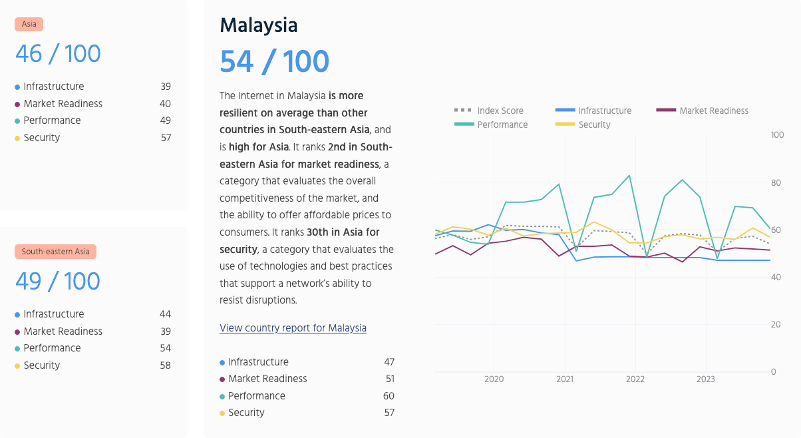
Note how its performance score varies considerably each year. This variation is one of several limitations of international measuring systems that we and many decision makers rely on. This is not to say that these measurements aren’t useful, as they provide standardised data. However, local data can increase the definition and smooth out these variations, or more quickly identify sudden performance issues.
Measuring to Enhance Transparency
My co-panelist, Siti Nurliza Samsudin, presented on the Sinar Project’s use of open data, technology, and applications, such as OONI, IODA, MLab, and Censored Planet, to identify and publicise artificial Internet limitations, such as targeted and enforced Internet shutdowns, throttling, and service-blocking events.
Their aim is to improve governance and encourage greater citizen involvement in the nation's public affairs by making governments more open, transparent, and accountable.
Siti discussed the Sinar Project’s Internet Monitoring Action Project (iMAP), which aims to establish regional and in-country networks that monitor network interference and restrictions to the freedom of expression online in 10 countries: Cambodia, Hong Kong (China), India, Indonesia, Malaysia, Myanmar, Philippines, Thailand, Timor-Leste, and Vietnam. She noted an important aspect of this project was to develop capacity in these countries to increase local measurements, as well as working with local partners to understand the context of what to test for.
Siti also discussed the importance of making localised data open and standardized to enable transparency. The Sinar Project is making this available to Malaysians by developing tools to combine unstructured data into open data standard formats, which are then joined up with local and global data.
Measuring to Uphold Consumer Rights
I’ve recently become interested in how we can make Internet measurement data tools more readily available for netizens to support their consumer rights claims.
One platform we recently featured on the Pulse Blog, myspeed.site, is helping in this respect in rural regions of Malaysia. This open-source platform measures and publicly shares data on network performance, allowing:
- Regulators to independently monitor the performance of rural infrastructure remotely
- Policy makers to make decisions more effectively on where to spend public money to improve connectivity.
- Consumers to monitor the performance of and make informed decisions about which mobile and Internet Service Provider (ISP) to choose.
Regarding the latter, we welcomed Professor Nazura Abdul Manap from the Malaysia Cyber Consumer Association to discuss the importance of independent Internet performance measurement data to defend consumers’ rights.
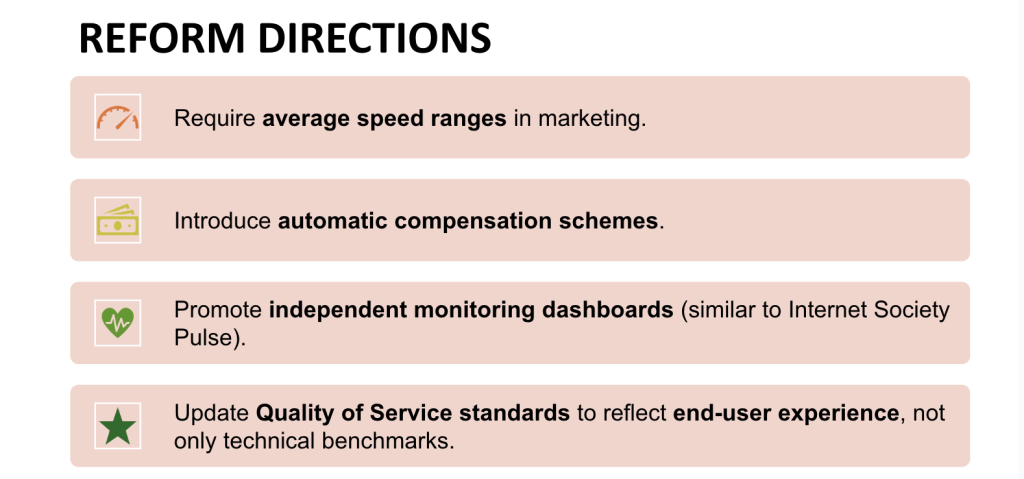
Nazura noted that many ISPs in Malaysia were taking advantage of legal loopholes, particularly around ”Up to” speed disclaimers, and quality of service benchmarks did not always reflect actual user experience. She called on Malaysian lawmakers to review other countries' laws, particularly the EU, UK, and USA, which require ISPs to disclose accurate, comparable, and up-to-date information on actual speeds.
Measuring to Protect Digital Rights
Finally, Pavel Farhan from the IO Foundation discussed the need for improved local qualitative and quantitative data to enhance the context of localized digital rights violations.
Pavel explained that such localised evidence made obscured digital rights violations visible, strengthening Internet consumers’ overall rights. To move towards this goal, he suggested local measurement projects align with global efforts to increase their resolution while taking advantage of the capacity and tools that they’ve developed.
He left the audience with this final message: “Measurements are only as powerful as the reforms they bring.”
Tell Your Own Data-Driven Stories With the Pulse API.
Photo by EngageMedia