

Internet Resilience Index: Ranks and Trends

In short
- 112 countries experienced a 1 to 7-point increase in their resilience score between 2023 and 2024, while 30 experienced no significant change.
- 58 Small Island Developing States (SIDS) and Landlocked Developing Countries (LLDCs) are among those to experience gains, including Rwanda, Nepal, and Trinidad and Tobago, which experienced the greatest gains.
- Understanding the resilience of the Internet at a country and regional level can help decision makers to make better data-driven decisions about development.
Iceland has returned to the top of the Pulse Internet Resilience Index (IRI), scoring 84 out of 100. Its recent 4-point increase—equal highest gain for Europe—is attributed to improved mobile performance and resilience against security threats.
Internet resilience globally increased by 1 point since the last IRI ratings and has increased by 3 points since 2019, largely due to improvements in Internet security and Internet performance that have offset two-point decreases in market readiness and a four-point decrease in infrastructure.
Nine European countries continue to rank among the top ten globally, with Singapore retaining its position at number four. Australia (17th), Canada (18th), Mauritius (35th), and Chile (36th) are the highest ranked in Oceania, North America, Africa, and South America, respectively.
What is the Pulse Internet Resilience Index
The Pulse IRI draws from a range of trusted data sources to track some of the key building blocks that underpin the Internet. It enables comparison between countries, regions, and sub-regions since 2019, with a balanced set of metrics that accounts for the Internet’s complex ecosystem and varied landscape.
Each country is assigned an Internet Resilience Score, calculated on a scale of 0 to 100. It reflects four broad pillars—infrastructure, fixed and mobile Internet performance, network security, and market readiness—each representing a range of different components that contribute to the overall resilience of the Internet. Scores are weighted, so a drop or a rise in one indicator can mean an improvement in this country, or that others are over- or under-performing in that area. Full details of the process employed to generate the Pulse Internet Resilience Index are provided on our methodology page.
112 Countries Experience Resilience Gains
Of the 180 countries included in the index, 112 countries experienced a 1 to 7-point increase in their resilience score between 2023 and 2024, while 30 experienced no significant change.
African countries (n = 33) experienced the most significant increases, followed by Asia (n = 29), Europe (n = 21), North America (n = 15), South America (n = 13), and Oceania (n = 3).
Rwanda experienced the greatest increase (7 points) among all countries, largely due to its DNSSEC validation rate increasing from 23% to 80% as well as significant improvements in its fixed and mobile performance, affordability and market diversity.
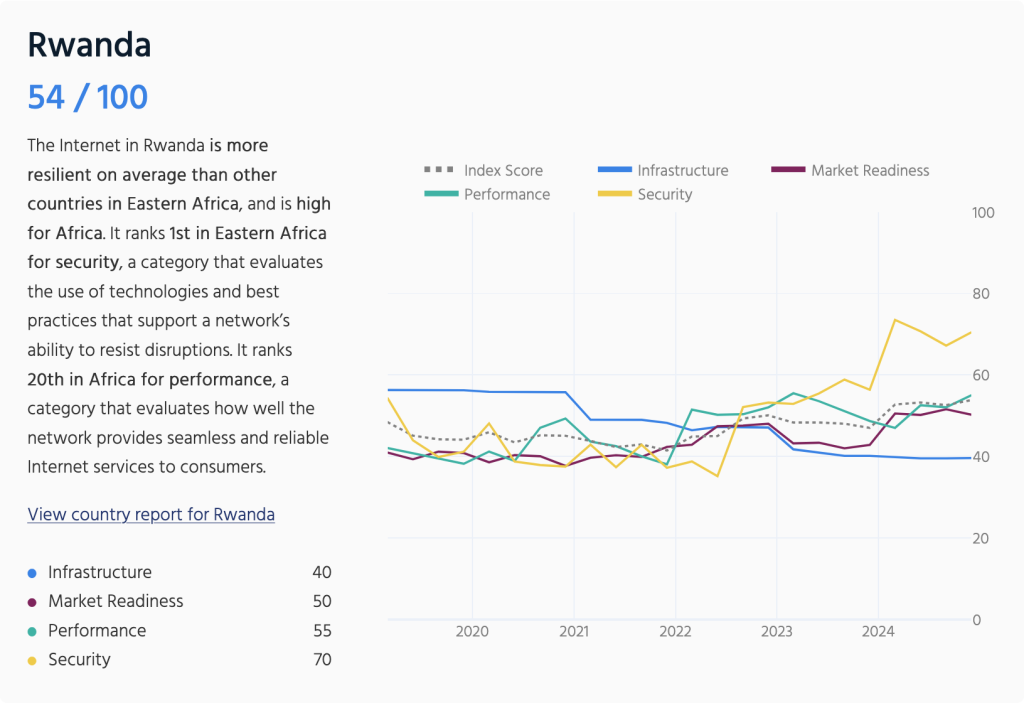
Nepal and Trinidad and Tobago (6 points) experienced the next largest increases, which, like Rwanda, translated to significant improvements in their ranks (Table 1).
| Country | Increase in ranking from 2023-2024 |
|---|---|
| Rwanda | 25 |
| Bahamas | 20 |
| Ghana | 17 |
| Trinidad and Tobago | 16 |
| Saint Kitts and Nevis | 16 |
| Guyana | 16 |
| Guatemala | 16 |
| Belize | 15 |
| Dominican Republic | 15 |
| Nepal | 14 |
The Central African Republic experienced the largest decrease in resilience (-7 points)—one of 17 African countries that recorded a decline in resilience between 2023 and 2024— followed by Saint Vincent and the Grenadines (-6 points), and Venezuela and Vanuatu (-4 points), all of which experienced significant slides in rankings (Table 2).
| Country | Decrease in ranking from 2023-2024 |
|---|---|
| Saint Vincent and the Grenadines | -34 |
| Grenada | -25 |
| Venezuela | -25 |
| Maldives | -24 |
| Benin | -17 |
| Cameroon | -17 |
| Lebanon | -16 |
| Vanuatu | -16 |
| China | -15 |
| Cape Verde | -15 |
Resilience Growing Among Small Island Developing States and Landlocked Developing Countries
Small Island Developing States (SIDS) and Landlocked Developing Countries (LLDCs) experience some of the most difficult conditions when it comes to developing a resilient Internet ecosystem. In most cases, this is due to their geographic isolation, relatively small populations, and limited resources, which restrict economic diversification, increase costs, and heighten their vulnerability to environmental and external shocks.
Currently, there are 71 countries classified as SIDS or LLDCs, 25 of which are also classified as least developed.
Encouragingly, more than half of the 58 SIDS and LLDCs we measure experienced a 1-7 point increase in their Internet resilience between 2023 and 2024 (n = 33), led by Rwanda.
Read: How Resilient is the Internet in LLDCs?
Furthermore, eleven of these countries have experienced increases in their Internet resilience of 9 to 23 points since 2019, including Saint Vincent and the Grenadines, which experienced a significant decrease in its IRI score between 2023 and 2024—evidence of the fragile environment in which these countries operate.
| Country | Region | Change in IRI score 2023-2024 | Change in IRI score since 2019 |
|---|---|---|---|
| Suriname | South America | 4.03 | 22.63 |
| Guyana | South America | 4.14 | 19.26 |
| Saint Kitts and Nevis | Caribbean | 4.64 | 15.75 |
| Burkina Faso | Africa | -1.41 | 14.96 |
| Uzbekistan | Asia | 0.22 | 13.82 |
| Antigua and Barbuda | Caribbean | 0.1 | 12.76 |
| Mali | Africa | -2.36 | 11.41 |
| Maldives | Asia | -3.33 | 10.33 |
| Saint Vincent and the Grenadines | Caribbean | -5.74 | 9.31 |
| Lesotho | Africa | 3.64 | 9.08 |
| Nepal | Asia | 5.89 | 8.58 |
Read: How Will Guiana’s Economic Sliding Doors Impact Region’s Internet Resilience?
Identify Weaknesses to Make Data-Driven Decisions
The IRI was developed to help decision-makers and Internet advocates get a snapshot of the resilience of the Internet in their country and region.
As such, it’s based on a mixture of composite and proxy measurement sources, and local advocates should conduct investigations to validate the results. Areas of relative weakness can be targeted through technical interventions, such as encouraging operators to deploy DNSSEC validation, or by adopting specific policies to create a more diverse and competitive ISP market.
Stay tuned for further analysis as we dig deeper into the data from the last five years.
In the meantime, if you have any questions or comments about the IRI, please get in touch with the Internet Society Pulse team and subscribe to the Pulse monthly newsletter to get updates and insights into changes to Internet resilience.
All of our historical IRI data is also available via our API.