
Are Research and Education Networks Critical Infrastructure?

In short
- Research and Education (R&E) networks are foundational cornerstones of today's Internet.
- Despite operating outside traditional regulatory frameworks, R&E networks perform functions widely regarded as critical infrastructure.
- The challenge for policy makers is to recognize and protect these networks without imposing rigid regulatory frameworks that could undermine their cooperative foundation.
Policy emerged in the early days of the Internet as a property of network engineering. Decisions about topology, resource allocation, and interconnection agreements among research universities laid the foundations for governance frameworks that favored openness, innovation, and shared resources. Network architecture became social architecture.
As Research and Education (R&E) networks have evolved far beyond their academic origins, however, defining or cataloging them comprehensively has become increasingly challenging. We set out to better understand the composition of U.S. R&E networks—their customers, infrastructure, functions, funding, and organizational models—and to explore whether their expanded roles warrant recognition as critical infrastructure.
Commercial vs Cooperative Governance
Today's R&E networks serve 12 million people across 38,000 locations in 107 countries. They underpin critical research infrastructure such as the $9 billion Large Hadron Collider (LHC), enable testbeds for networking innovation, and connect Community Anchor Institutions (CAI), including schools, libraries, museums, hospitals, and government agencies.
What distinguishes R&E networks from commercial providers isn't just their mission, it's their governance. While commercial networks optimize for profit, R&E networks operate through diverse, cooperative models. We found that 24% are state-run, 27% are nonprofit organizations, 24% are university-run, and 24% function under informal agreements such as consortia or memoranda of understanding (MOUs).
There are multiple examples of cooperative economics, but two common ones are:
- A consortium that pools resources across multiple states to secure fiber rights that individual institutions couldn't afford
- An R&E exchange at which universities share networking equipment under a simple "be a good netizen" agreement rather than complex usage monitoring. These agreements work because they're optimized for community needs rather than profit maximization.
Other Sectors Can Provide a Suitable Regulatory Framework
Despite operating outside traditional regulatory frameworks, R&E networks perform functions widely regarded as critical infrastructure, including supporting Next Generation emergency communication services, election infrastructure, and essential Internet operations like hosting DNS root name servers, eduroam wireless federation, InCommon identity management, Routeviews, and network telescopes. Yet, they don’t fit neatly into existing regulatory categories, suggesting we may need new terminology.
We can look to other sectors for precedent. Financial institutions whose failure could trigger widespread disruptions are characterized as Global Systemically Important Financial Institutions (G-SIFI). Similarly, the U.S. government identifies Systemically Important Entities (SIE) whose disruption would negatively impact national security, economic security, or public safety.
Given their vital and expanded roles, R&E networks may warrant recognition as Systemically Important Network Infrastructure (SINI).This term would acknowledge this importance but protect the collaborative governance model.
Community Involvement is Vital to Preserving Collaborative and Resilient Internet
The challenge for policy makers is to recognize and protect these networks without imposing rigid regulatory frameworks that could undermine their cooperative foundation. R&E networks demonstrate remarkable resilience precisely because their diverse governance structures, technical and social approaches, and funding sources are optimized across multiple dimensions.
One of our study’s goals is to re-energize the R&E community to actively participate in policymaking, just as they did during pivotal moments such as the establishment of DMCA safe harbors and early Internet governance. John Curran, CEO of ARIN, has highlighted how the technical and research communities must remain active participants in shaping Internet infrastructure governance, security, and stability. We agree that community involvement is vital to preserving the collaborative and resilient nature of Internet resources in the R&E community and beyond.
Read our paper for further details.
Anita Nikolich is a Research Scientist at the University of Illinois-Urbana Champaign. She works in cybersecurity and is a co-founder of the Internet2 Tech Policy Group with Andrew Gallo.
Contributors: Andrew Gallo
The views expressed by the authors of this blog are their own and do not necessarily reflect the views of the Internet Society.
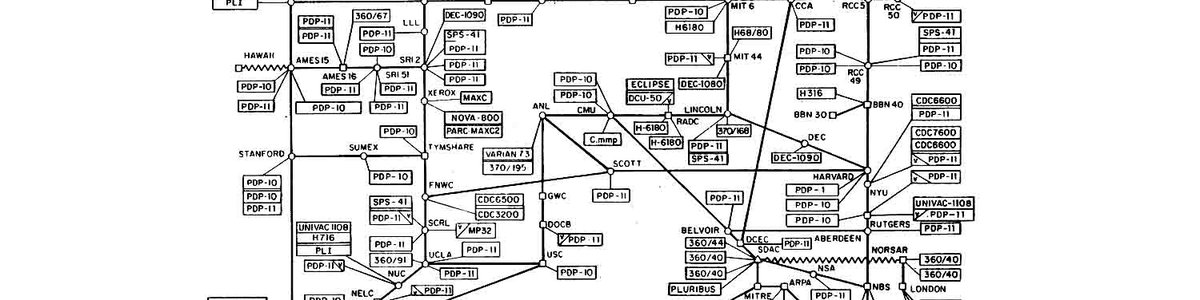
Image: The banner image is a network diagram of the original Internet (ARPANET), which was made up predominantly of US university networks. Source: The Computer History Museum via Wikimedia Commons.
