

Why Satellites Won’t Close the Digital Divide

In short:
- Analysis shows that while LEO networks can expand Internet access, current offerings alone cannot easily deliver universal, meaningful connectivity.
- Even with existing government subsidies, over 65% of unserved households remain unable to afford reliable Starlink service.
- LEO-based approaches should be viewed as one component that plays its own unique role within the broader connectivity ecosystem.
Low Earth Orbit (LEO) satellite networks, such as Starlink and Amazon Leo, are increasingly presented as a cost-efficient alternative to traditional terrestrial infrastructure for providing universal, meaningful Internet connectivity to bridge the digital divide, which governments and institutions, such as the United States’ National Transportation and Information Administration (NTIA), commit billions of dollars to.
These networks deliver clear benefits, including widespread coverage, low latency, and rapid deployment, to use cases poorly served by traditional networks (such as aviation, RVs, and rural locations). However, these advantages must not deflect from the concrete limitations of these networks.
Past high-profile, innovative connectivity efforts (such as Google’s Project Loon, Meta’s Project Aquila, and even OLPC XO laptops) showed similar promise but struggled to deliver on their universal, meaningful connectivity goals. Though recent work has begun to ask the question, it remains unclear if and how LEO networks fall short of their connectivity goals.
The risk in misjudging the capabilities of LEO networks isn’t just about hype. It’s making long-term decisions—such as allocating billions of dollars in public funds—based on incomplete mental models of what these systems can deliver.
With this in mind, our team of researchers from Virginia Tech, INRIA-Lyon, and UC Berkeley took a first-principles approach to evaluating the limitations of LEO access networks for providing the universal, meaningful connectivity required to close the digital divide. The analysis presented in this blog post is from a paper recently published at ACM Workshop on Hot Topics in Networks.
LEO’s Key Structural Constraint: Peak Demand
Our work is rooted in the observation that LEO networks scale differently from terrestrial networks. Satellite constellation size (a primary driver of system cost and capacity) is determined by where demand is densest, not by the total number of users. While policy choices such as spectrum allocation or co-frequency limits can move the needle on system capacity, they do not fundamentally change this peak-demand–driven scaling behavior. This is not a shortcoming of any one company, but rather a key structural constraint of LEO access networks.
From this insight, we built a model to estimate the capacity of a LEO access network based on key parameters, including spectrum availability, the number of antennas per satellite, and satellite density. We then used publicly available data to estimate whether Starlink has adequate capacity to provide reliable broadband to all unserved locations in the United States.
We used the NTIA’s own definition of “reliable broadband” – that is, 100 Mbps x 20 Mbps speeds – and data from the FCC’s National Broadband Map to do this. We chose these because these are the target performance levels and areas where US federal broadband funding, through programs like BEAD, is financing the deployment of LEO constellations instead of terrestrial technologies.
Current LEO Offerings Struggle to Provide Universal Service at Affordable Prices
We find that even under optimistic assumptions, Starlink’s current deployment struggles to serve all unserved households at acceptable broadband quality. Scaling to cover the long tail of unserved households requires either degraded user performance during periods of high network use or the construction of a much larger satellite constellation—on the order of 40,000 satellites (Starlink’s current deployment is ~8,000). Further details of the capacity analysis can be found in our paper.
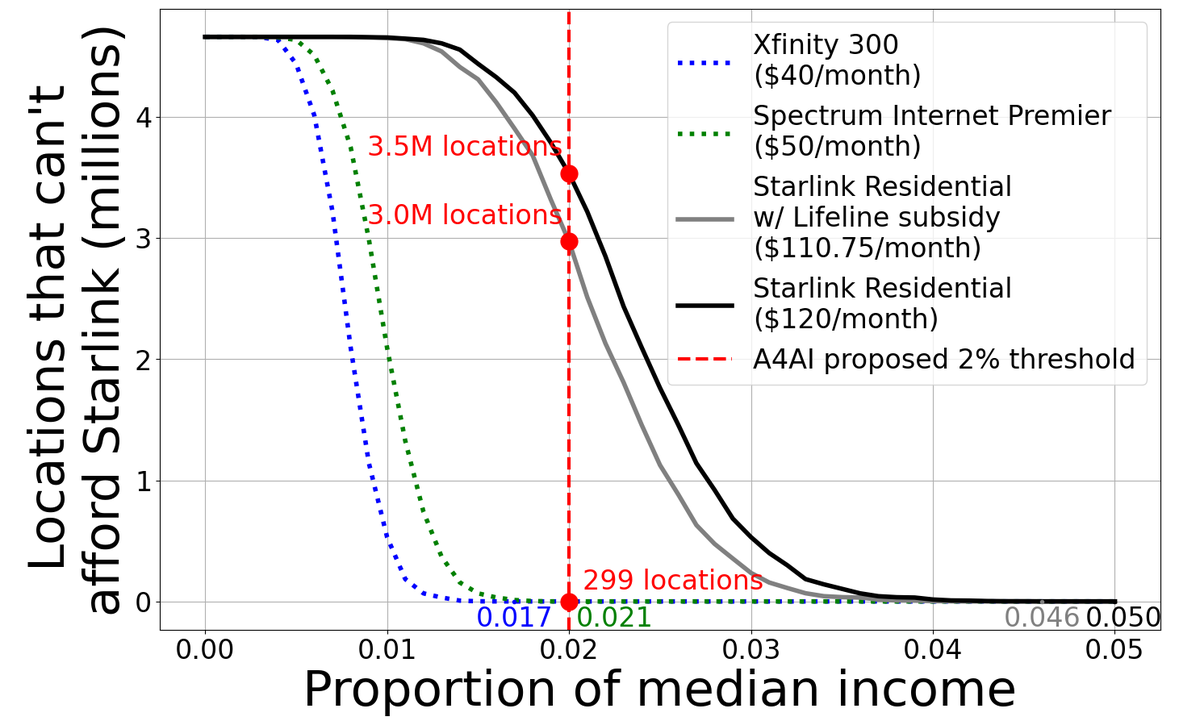
Our work also examines whether Starlink’s service is likely affordable at these unserved households. We find that current pricing makes service unaffordable for most unserved households under widely used affordability benchmarks. Even with existing government subsidies, over 65% of unserved households remain unable to afford reliable Starlink service.
What Is the Path Forward for Policy and Public Investment?
Our analysis suggests that while LEO networks can certainly expand access, current offerings alone cannot easily deliver universal, meaningful connectivity. So what does that mean for the disbursement of funds dedicated to subsidizing the construction of Internet infrastructure in unserved regions?
We identified the following guidelines as natural implications of our work:
- Don’t treat LEO satellites as a drop-in replacement for terrestrial access.
LEO systems scale based on peak demand density, with strong disincentives to serve the last unconnected communities at high quality. Funders should recognize this difference in scaling behavior and strive to identify funding “inflection points” at which traditional terrestrial technologies can more reliably deliver higher-quality service at competitive deployment costs. - Coverage alone is not a sufficient measure of an approach’s success.
LEO service can reach everywhere, yet still fails to deliver reliable, usable service to everyone. That is, it does not appear to be a path to providing universal broadband access. Providers must be able to prove not only that they can provide high-quality coverage to a single location, but also that they can sustain coverage as their networks scale to cover locations across multiple regions. - Affordability must be assessed independently of availability.
In many locations without any connectivity, current US LEO service plans are unaffordable without substantial and sustained subsidies. Funders should ensure that providers can serve subscribers within these footprints – either through low-cost plans or direct subsidies.
Treating LEO Internet services as a substitute rather than a complement to existing approaches for providing universal, meaningful connectivity risks crowding out investment in other necessary technologies and approaches. LEO-based approaches should instead be viewed as one component (or one stone) that plays its own unique role within the broader connectivity ecosystem.
Wesley Woo is a PhD student advised by Shaddi Hasan at Virginia Tech. His work focuses on designing networked systems for bridging the digital divide in rural and marginalized communities.
The views expressed by the authors of this blog are their own and do not necessarily reflect the views of the Internet Society.