

When the Lights Went Out: What the Iberian Blackout Taught Us About Internet Resilience

In short:
- Measuring the impact of large-scale power outages like the one that hit Spain, Portugal, Andorra, and parts of France in 2025 shows how reliant the Internet is on power and how much redundancy it has to keep functioning.
- A recent peer-reviewed study shows how traffic to core Internet infrastructure during the Iberian blackout dropped by up to 70%, but did not stop.
- The study shows a second, previously unreported power failure inside a major data center shortly after disrupted global Internet routing even more than the large-scale outage itself.
When a nationwide blackout struck the Iberian Peninsula in April 2025, it stopped trains, shut down traffic lights, and cut power to millions of homes and businesses for up to ten hours. It also made headlines in the tech world: companies like Cloudflare and Kentik quickly published talks, blog posts, and social media threads showing sharp drops in Internet traffic across Spain and Portugal, and the IODA network observability platform flagged the disruption in near real time.
The fact that the blackout affected the Internet was never really in question. What was missing was a rigorous, independent, peer-reviewed look at how it affected the Internet core. Our study, published in ACM SIGCOMM Computer Communication Review, set out to answer exactly that.
How the Power Outage Impacted the Internet’s Core at IXPs
By studying traffic profiles at four of the largest Internet exchange points (IXPs) on the peninsula, along with active network probing and global Border Gateway Protocol (BGP) routing data, we built a detailed picture of how the power outage affected the core of the Internet at the IXPs.
We found that traffic at these IXPs dropped by 33% to 70% within minutes of the blackout— a striking, near-instantaneous effect (Figure 1). Yet traffic never vanished entirely; It settled at levels typically seen overnight, showing that while millions of people lost the ability to be online, the core plumbing of the Internet—the routers and data centers that keep networks talking to each other—kept functioning throughout.
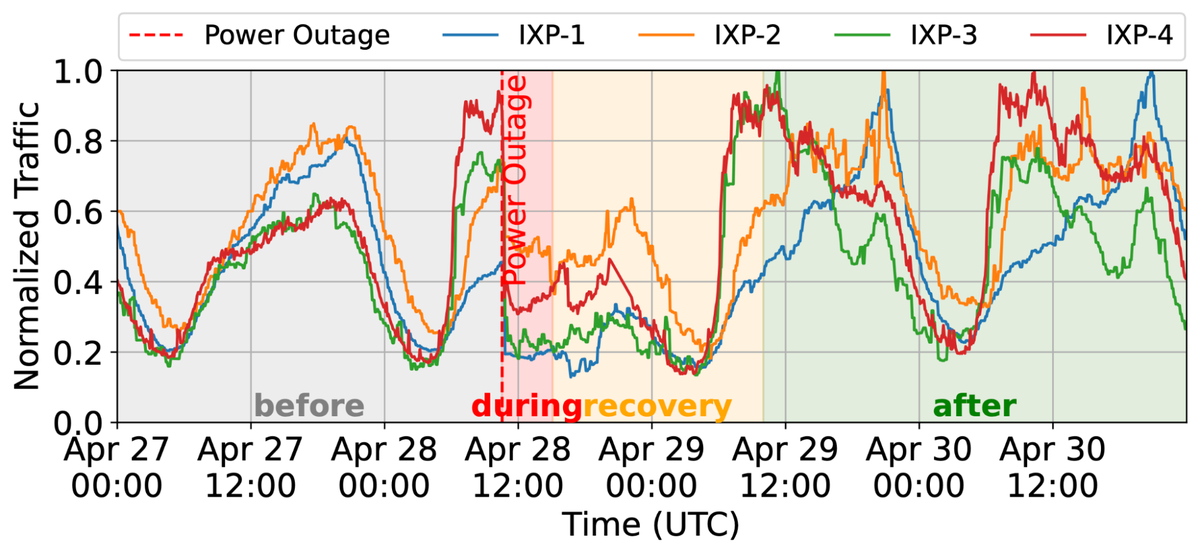
That resilience is worth appreciating: the region's networking infrastructure, largely backed by generators and battery systems, held up remarkably well under a decade-defining stress test.
To add a human dimension to this network-level story, we also looked at data (Figure 2) from PSKReporter, a signal-reporting platform used by amateur radio operators.
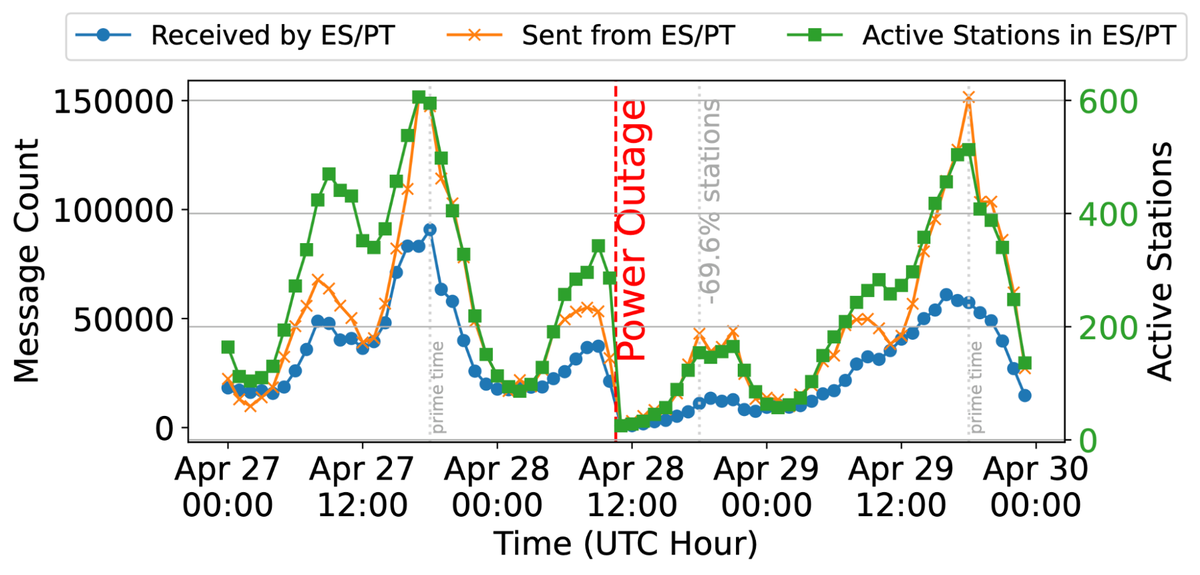
Because radio operators need electricity to transmit, but not necessarily an Internet connection, their activity lets us separate "who had power" from "who had Internet" — and we found that some operators regained power and came back online even before our network measurements showed broader signs of recovery. This shows an early, independent signal of restoration.
A Second, Unreported Event
While confirming the broader narrative, our research also revealed something no one had reported before: a second disruption (Figure 3), a partial power outage within a major data center that followed hours after the start of the power outage.
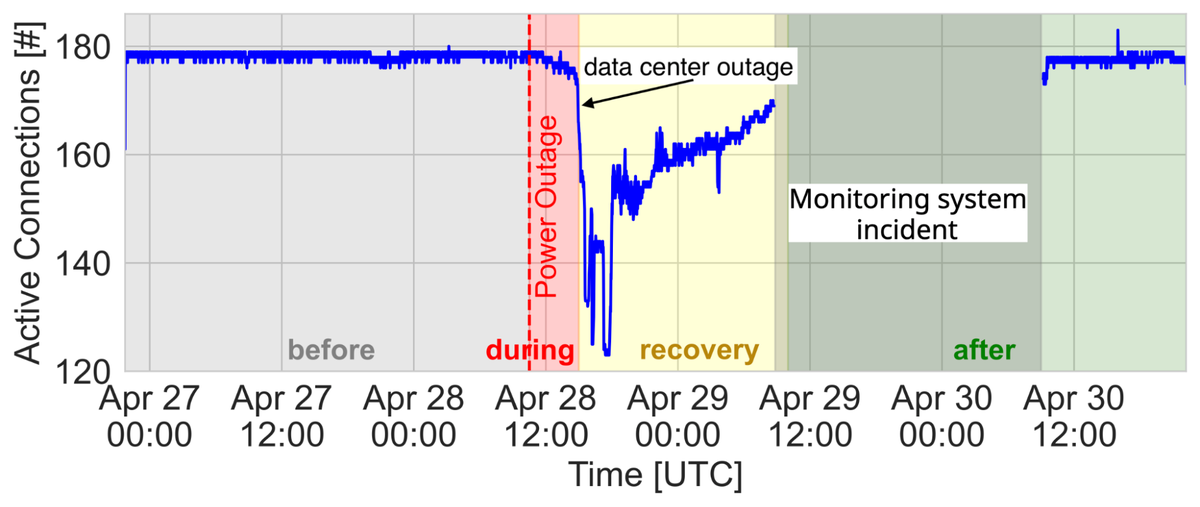
Hours into the blackout, backup diesel generators at this facility began to fail, cutting power to parts of the building. The result was a second, distinct drop in Internet traffic — and, remarkably, this data center incident had a larger effect on global Internet routing stability (measured through BGP, the protocol that lets networks find paths to each other) than the nationwide power failure itself. Routing instability triggered by this single facility rippled outward and was visible in routing data collected from monitors around the world.
This finding is a reminder that resilience isn’t just about keeping the lights on at the national level. Concentrated digital infrastructure — a handful of large data centers and exchange points — can become single points of failure whose problems ripple far beyond their physical footprint, even as the wider power grid recovers.
Why This Matters Beyond Spain and Portugal
Large-scale power failures are not going away. As more of daily life, business, and public services depend on connectivity, understanding exactly how the Internet behaves under this kind of stress becomes a matter of public interest, not just network engineering.
Our study shows two things clearly: first, that core Internet infrastructure can be more resilient to national power failures than many assume; and second, that the resilience of concentrated infrastructure, like data centers, deserves just as much attention and independent scrutiny as the power grid itself.
Read our full peer-reviewed paper, published in ACM SIGCOMM Computer Communication Review 2026.
Oliver Hohlfeld is a professor at the University of Kassel, Germany. His research focuses on Internet Measurement with a focus on understanding and improving network operation and Internet Resilience.
Contributors: Yasin Alhamwy (University of Kassel), Tobias Striffler (DE-CIX), Daniel Wagner (DE-CIX / MPI-INF), Matthias Wichtlhuber (DE-CIX)
The views expressed by the authors of this blog post are their own and do not necessarily reflect the views of the Internet Society.
Image by Seoane Prado via Wikimedia Commons
