

Cost of Access: When the Internet Goes Dark, People Become the Network

On 23 July 2026, central Delhi became an unexpected experiment in communications resilience.
As students protested examination irregularities at Jantar Mantar, the Ministry of Home Affairs suspended mobile Internet within a 1.5-kilometer radius, citing public safety and public order.
Internet Society Pulse recorded the disruption from 23 to 25 July, lasting approximately 2 days and 7 hours, as well as an unacknowledged event on 22 July. The matter subsequently reached the Delhi High Court, with a petition alleging that the shutdown violated constitutional protections under Articles 14, 19, and 21.
The effects travelled beyond the protest site. Metro access was disrupted, app-based transport faltered, and navigation became difficult. Near Jantar Mantar, tea seller Ravi Prakash said most of his customers normally paid through UPI; without Internet, many simply could not pay.
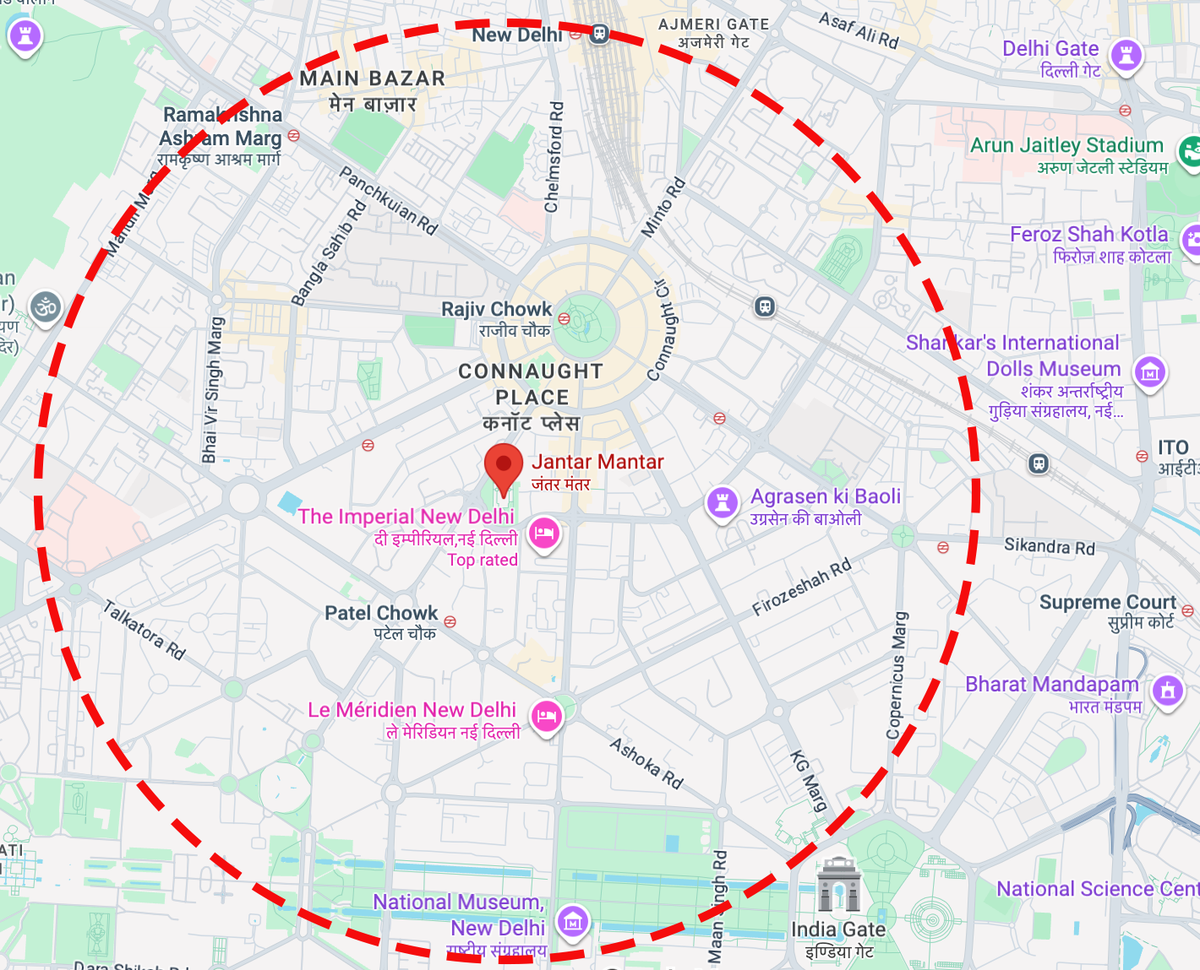
Internet shutdowns disrupt far more than social media and messaging apps. They cut into payments, mobility, access to information, disaster response, and even the ordinary reassurance of staying connected.
Yet communication did not disappear. In an unlikely turn, the network itself began to move into the crowd.
The Network Shrank Into People’s Pockets
Students interviewed for this article at Jantar Mantar said that some protesters turned to Bluetooth-based messaging applications, particularly Bitchat, Bridgefy, and Briar.
Unlike Signal, Telegram, or WhatsApp, these applications do not necessarily require every message to travel through the Internet to a distant server and back again. Instead, nearby devices can communicate directly, passing messages from one phone to another, almost like whispers moving through a crowd.
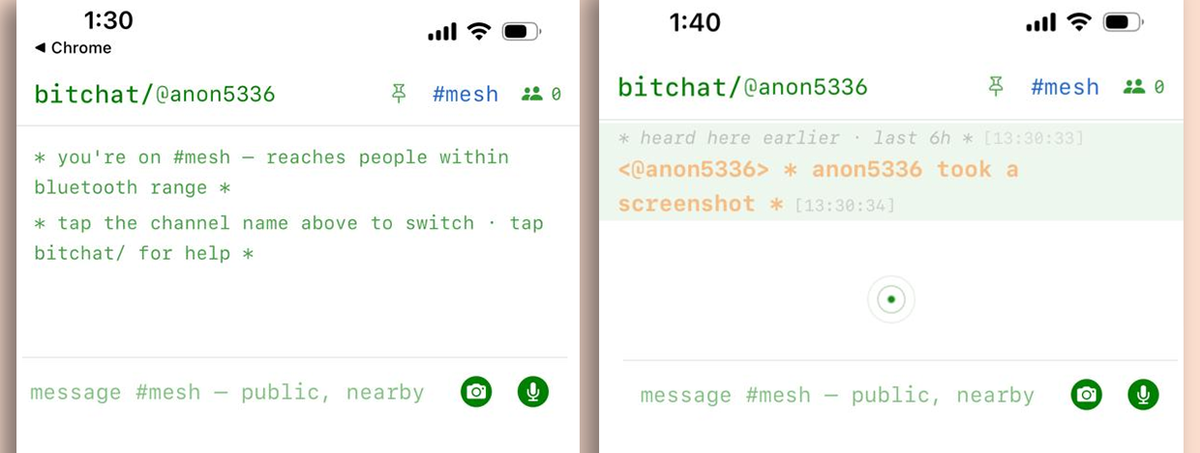
Bitchat uses Bluetooth Low Energy (BLE) to create an ad-hoc mesh between devices. Smartphones within reach can exchange information and, depending on the network, relay messages onwards to other phones. The present Bitchat protocol also allows Internet connectivity to supplement the local network when connectivity exists.
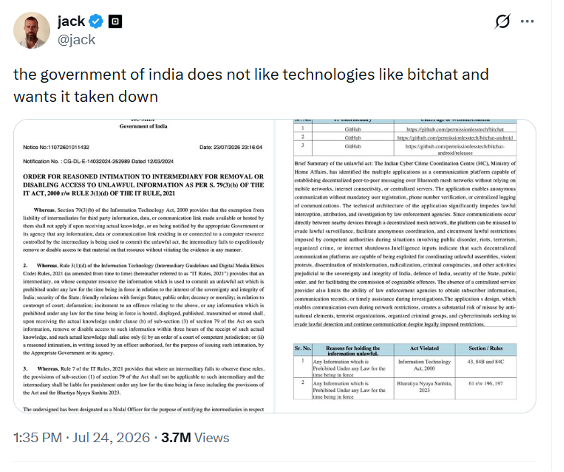
Bitchat's architecture soon drew government attention. On 23 July, the Indian Cyber Crime Coordination Centre (I4C), under the Ministry of Home Affairs, directed GitHub to disable access to repositories hosting Bitchat, arguing that its ability to communicate during network restrictions could impede lawful interception and be misused by criminal or terrorist groups. Jack Dorsey—Twitter's co-founder and former CEO, and a developer behind Bitchat—shared the notice on X, writing “the government of india [sic] does not like technologies like bitchat and wants it taken down.”
Bridgefy and Briar take slightly different routes to offline resilience. Briar synchronizes messages directly between users and can continue communicating through Bluetooth or WiFi when the Internet is unavailable, while online traffic can be routed through Tor. Bridgefy relies primarily on Bluetooth, linking nearby smartphones and relaying messages across a dense group of devices; individual connections can reach roughly 100 meters under favorable conditions, with the network extending farther as more phones participate.
The underlying principle is deceptively simple: instead of relying entirely on infrastructure above users, make users part of the infrastructure.
A mobile tower can be switched off. Access to an Internet service provider (ISP) can be suspended. A website can be blocked. But two phones standing close enough to communicate by radio do not necessarily require the public Internet in between.
That architectural difference became politically important remarkably quickly.
“We realized the mobile Internet had gone, and nobody quite knew what would still work. Then someone suggested Bitchat,” said Neha Mukherjee, a Delhi University student. “What surprised me was how quickly people adapted. We could still exchange short messages with those nearby, check where friends were, and pass on small bits of information such as which side the police were on, or which side the food van was available, or where one could charge their phones.”
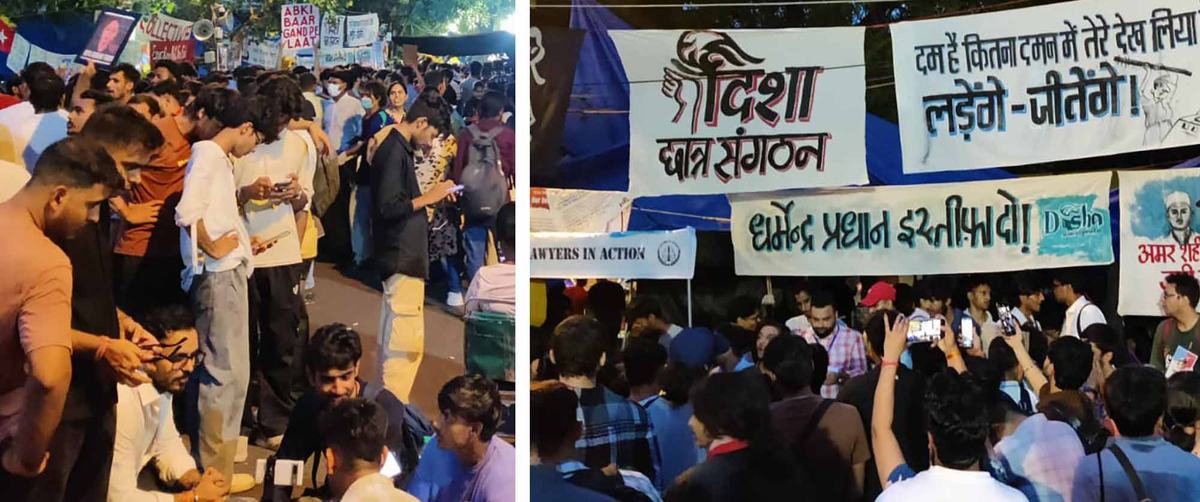
Her friend Sneha agreed, “It was obviously no substitute for the Internet. We could not upload large videos, use maps normally, or depend on UPI, but there was something almost playful about discovering that the phones could still talk to each other. In a strange way, the shutdown made us understand the network differently. We made reels using visuals/posters and photos of others shared through these easy apps. The idea was to set Instagram-like platforms on fire when we connected to the Internet again.”
The same behavior was visible elsewhere. Arnab, a BTech student at Jadavpur University who participated in Jantar Mantar and a similar protest in Kolkata, said protesters had downloaded the app in advance. “People exchanged messages such as, ‘Police barricade near Sealdah Station’, ‘meet at the metro entrance’, or ‘ambulance needed here,’ recounted Arnab. “They also shared photographs of the police lathi charge, short voice notes, and instructions that could travel across several Bluetooth hops.
“But the network becomes truly useful only when enough people are physically present with participating phones; the strength of the mesh depends on the density of the crowd.”
Another student protester, Shiba Karmakar, added, “Imagine the police shut down the Internet and you are standing there, witnessing horrifying actions by armed personnel. What would you do? The assumption was that once connectivity disappeared, people outside would not know what was happening in different pockets of a large protest. But protesters found a way around that. Through mesh networks, they shared photographs, locations, information about injured people, and even directions on how to reach them in times of need.”
First, the Internet was Restricted. Then the Workaround Attracted Attention.
Indian media reported that Delhi Police found these communications difficult to approach using conventional telecommunications interception methods because messages could move locally between devices rather than through an ISP or telecommunications gateway.
Following the Bitchat notice, Digital rights organizations contested both the legal reasoning and the process. According to the Internet Freedom Foundation (IFF), the order invoked Section 79(3)(b) of the Information Technology Act and Rule 3(1)(d) of the IT Rules and required three repositories, including Android release files, to be disabled within three hours. IFF argued that possible misuse of a general-purpose communications technology should not by itself justify prohibiting access to the technology.
There is an important technical distinction here: removing a software repository is not equivalent to switching off the network created by copies of the application already on users' phones. Nor does blocking one application eliminate Bluetooth, WiFi peer-to-peer communication, or the broader concept of mesh networking. It restricts one route to obtaining and developing the software.
This distinction matters because communications resilience increasingly resides not in a single product but in an architecture.
When Restriction Drives Discovery
The Delhi episode produced another striking development.
Bitchat downloads surged. According to Appfigures data cited by The Economic Times, India recorded roughly 65,462 Bitchat downloads in the 30 days ending 24 July 2026, with 65,435 of those downloads occurring in the preceding seven days.
It would be premature to call this a straightforward “Streisand effect,” since much of the download surge had already begun as news of the protests and shutdowns spread, before the GitHub direction became public. But the broader lesson remains that attempts to restrict an unfamiliar communications technology can also publicize it. Thousands of Indians who may never have considered Bluetooth mesh communication suddenly knew it existed. The shutdown had, inadvertently, become a public tutorial in Internet-independent networking.
Not Every Communications Failure is the Same
There is also a danger in treating “the Internet is down” as a single technical condition.
A government may suspend mobile data while leaving voice calls and SMS functioning. A particular mobile provider may fail while competitors continue operating. Fixed broadband may remain available while cellular services disappear. A network may technically remain online but be overwhelmed by congestion. Individual websites or applications may be blocked while the wider Internet remains reachable. Power failure creates an entirely different problem.
Each condition calls for different resilience.
If mobile data alone is unavailable, ordinary SMS or telephone calls may still be the simplest option. If public telecommunications fail altogether, nearby peer-to-peer technologies become more useful. WiFi can provide an alternative path when local infrastructure remains available. Bluetooth mesh can help dense groups communicate over relatively short distances.
The correct question during a shutdown is therefore not merely, “Do I have Internet?” It is: “Which parts of the communications stack still work?”
Offline Does not Mean Invisible
Mesh messaging also needs to be understood without mythology.
Removing central servers can reduce points of failure, but mesh communication does not make users invisible or invulnerable. Bluetooth still relies on physical devices, stored data, battery power, and nearby participants, and different applications offer different levels of security. Most importantly, a mesh needs sufficient device density to work well. Resilient communication is therefore best understood as redundancy, not invulnerability.
How Should People Navigate a Communications Shutdown?
The first requirement is surprisingly analogue: prepare for the possibility that the digital layer may fail. Keep essential numbers and maps offline, agree on meeting points, carry some cash and a charged power bank, and install and test alternative communication apps in advance. Discovering a mesh app only after the network needed to download it has disappeared defeats the purpose.
Technological preparedness is only half the challenge. The other half is information integrity.
Internet shutdowns are often justified as a way to curb rumors, misinformation, and incitement, yet they can also remove the very tools people use to verify information—news reports, official accounts, search, maps, and trusted contacts.
In that vacuum, uncertainty can deepen, making disciplined communication essential: distinguish eyewitness accounts from hearsay, add time and location to urgent messages, and avoid forwarding unverified claims. When bandwidth becomes scarce, trust becomes part of the network architecture.
The Larger Policy Question
India’s legal framework permits temporary telecom suspensions under the Telecommunications Act, 2023, and the 2024 Suspension Rules. The Supreme Court’s Anuradha Bhasin judgment requires such restrictions to be published, proportionate, temporary, and open to judicial review.
But the Delhi protest raises a newer problem: what happens when communication no longer depends on conventional telecom infrastructure?
Mesh networks and device-to-device protocols increasingly distribute networking across people and devices, making technological whack-a-mole an inadequate policy response. A more durable approach requires narrowly tailored, transparent restrictions, demonstrable necessity, safeguards for essential digital services, and clarity about what is being suspended, where, and for how long.
The Delhi experience points to a simple principle: removing one network does not necessarily remove communication. Sometimes it merely teaches people to build another one.
Saadia Azim is the author of Forwarded as Received: How Misinformation Turns Viral, Violent and True (Simon & Schuster India) and a public policy expert researching the digital divide and Internet rights. She also serves as Vice President for Publicity at the Internet Society Kolkata Chapter.
Cost of Access is a new blog series where we will share innovative stories from people who find networking solutions to connect with others during Internet outages and shutdowns. If you have a similar story to share, email us at [email protected]