

Community Networks: Critical Infrastructure For Rural Connectivity In India

In short:
- Traditional centralized models led by governments or private companies often fail in remote areas because they do not account for local geography or community-specific needs.
- Community networks serve as a vital solution for rural India, where traditional fiber and Wi-Fi infrastructure are significantly less accessible compared to urban areas.
- Successful community networks are built on principles of local ownership, inclusive design, and shared responsibility, which helps build the digital trust and skills necessary for meaningful use.
In India, access to reliable digital connectivity increasingly determines who can learn, work, access public services, and participate fully in society. Yet for millions of people in rural and remote regions, fast, reliable Internet access remains out of reach.
As the country accelerates its push toward digital-first governance and services, this gap is no longer just about access: it is about infrastructure. Community networks (CNs) offer a practical, people-centered model for closing that gap and should be recognized as critical digital infrastructure.
Digital Connectivity as Critical Infrastructure
Today, ‘digital infrastructure’ has emerged as a significant infrastructure necessity, comparable to traditional necessities such as power, water, and roads. Post-COVID, digital infrastructure emerged as a core utility for citizens in emerging economies, enabling access to a variety of services, from online banking to accessing educational content.
Yet, being online remains an urban privilege. 1 in 6 rural homes (16.7%) is unconnected. Twice that of the urban households, where only 1 in 12 (8.4%) remain offline. Where connections exist for rural communities, they are slower.
Only 3.8 per cent of rural households have access to fibre connections compared to 15.3 per cent of urban households – making urban households four times more likely to access fibre-based broadband.
A similar gap exists for fixed broadband shared over Wi-Fi: 24 per cent of urban households have access, compared to just 9.1 per cent of rural households.
As a result, mobile Internet access has become the near-universal form of connectivity for rural regions. The critical infrastructure for fast and reliable broadband remains concentrated in urban areas, further perpetuating the digital divide and impacting rural users’ ability to access Internet services and fully benefit from them.
Why Traditional Connectivity Models Fall Short
Traditionally, network infrastructure has been built by government and private stakeholders through centralized top-down models, such as installing mobile and network towers or laying fiber. While effective in many urban contexts, these approaches often fail to account for the realities of rural and remote communities where connectivity needs, geography, and capacity differ significantly.
As a result, networks are frequently misaligned with local priorities and largely unaccountable to community governance and knowledge. True development requires more than physical infrastructure alone: it demands affordable, reliable connectivity embedded in local communities, building trust, developing skills, and enabling meaningful use of digital services. In this context, community-led and owned network infrastructure meets the requirements of rural communities, where network infrastructure is not merely about providing Internet access but also about developing the trust and skills to access Internet services effectively.
Community Networks as an Infrastructural Alternative
Addressing connectivity infrastructure gaps left by the state and private bodies, community-owned and operated networks play an important role in providing last-mile connectivity. Framed as an infrastructural solution, CNs are focused on the specific needs of the community and enable decentralized, decolonialized approaches to technology that don’t follow such hierarchical systems, infrastructure, and governance models. CNs are also referred to as ‘Communal Infrastructure,’ and are designed based on four principles:
- People-centered: establishing and embracing human connections.
- Inclusive design: different network designs matter for different communities.
- Co-responsibility: every stakeholder in the community takes responsibility for the network.
- Community ownership: local ownership to establish, operate, and manage the network democratically, and focus on people-centered rights and privacy.
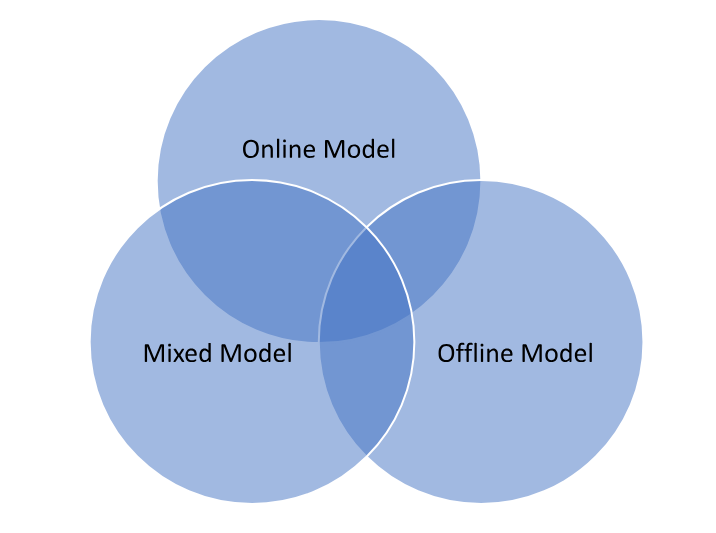
Community-owned infrastructure is designed through a set of agreements and relationships that support the provision of hardware, software, required applications, and local space needed to provide Internet-based services requested by the community. Based on local needs and use cases, CNs adapt their network infrastructure design accordingly. Three types of CNs that are operating across the globe, including India (Figure 1)
- Online model: Uses backhaul from the traditional ISPs to distribute Internet services to the community.
- Offline model: Created local network infrastructure and applications that operate on the local network to connect two or more communities.
- Mixed model: Combines Internet access and local networks, using each interchangeably based on community needs and the availability of existing resources.
Community Networks in Practice: Examples from India
Indian CNs have adopted different approaches while providing Internet-based services. Technologists, academic researchers, civil society organizations, and social enterprises in India have deployed community-owned wireless networks and experimented with various technologies and models, offering alternatives to the existing Internet regimes.
One example is the ‘HEALTH’ community network, deployed by a team from the National Institute of Technology Karnataka (NITK), Surathkal, in Agumbe village in Karnataka’s rainforest region. The project draws fibre cables from existing electrical poles and connects them to WiFi access points in individual houses or public spaces. HEALTH, short for healthcare, education, agriculture, livelihood, technology, and heritage, adapts fibre-to-home technology to local conditions and needs.
Today, the HEALTH community network connects the Gram Panchayat office, conservation research institutions, police stations, local schools, homestays, and other public spaces. More than 100 Internet access points have been deployed across Agumbe, demonstrating how locally adapted infrastructure can support diverse community institutions.
A similar need-driven approach can be seen in the remote villages of Dhadgaon block in Nandurbar district, Maharashtra, where residents often struggle to receive one-time passwords (OTPs) on their mobile phones, which are necessary for e-KYC (know-your-customer) verification. In some cases, locals must walk hours through difficult terrain simply to access a mobile network. In response, Nitesh Bhardwaj established the Aadiwasi Janjagruti community network, which provides hyper-local content that empowers tribal communities to access their rights, opportunities, and entitlements, while promoting sustainable development.
Women-centered CNs have also emerged as powerful models of connectivity. eDost, a women-centric community network under BAIF’s Pathardi Community-Centered Connectivity initiative, operates across seven villages in Palghar district of Maharashtra, and is supported by APC's Community Network Learning (Pathfinder) grant. Women are trained to use digital tools and manage services, enabling the network to support livelihoods and provide access to government and financial services.
Using connectivity provided by wireless networks or open BTS deployments in shared public spaces, eDoST provides financial services such as cash withdrawals, balance enquiries, and e-governance services. By centering women as operators and intermediaries, the network embeds digital skills and trust directly within the community.
CNs have also been deployed to enhance resilience in disaster-prone regions. IEEE Philanthropy India has connected 205 disaster-prone villages across rural Karnataka and Kerala by using local schools as access points for neighboring communities. It is estimated that over 1,500 people have directly benefited, and the project has emphasized sustainability by training over 500 young students as wireless network technicians. IEEE Philanthropy plans to continue this community network model and expand to other rural schools across the country.
In contexts where bringing Internet backhaul is costly or impractical, hybrid community network models have proven particularly effective. Community Reach (CR) Bolo, an initiative of Jadeite Solutions with support from the IEEE SA, established a community network using the existing infrastructure of the community radio station, Radio Bulbul, in the Bhadrak district of Odisha.
The project repurposed the radio tower, local server space, computers, and bandwidth to create a wireless point-to-point network connecting schools and self-help group centers within a 7-kilometer radius. Recognizing that many community members are more comfortable with voice-based services, CR Bolo integrated an Interactive Voice Response (IVR) system that operates on both the Global System for Mobile Communications (GSM) network and the local network. This enabled Radio Bulbul not only to distribute information and services, but also to collect feedback and strengthen community participation.
It is imperative to note that community network operators do not adopt a single model; they are defined based on the needs of the community. The supply-chain model of these networks is quite simple, with connectivity provided based on local requirements. The social and economic architecture of CNs is, by design, multi-stakeholder, as their operations are managed by a variety of stakeholders, including local authorities to school teachers, enterprises, radio stations, women-centric groups, and communities living in the region.
Their community-driven design, adaptability, and multi-stakeholder governance make them unique and well-suited for bringing connectivity where traditional systems are failing to deliver Internet services. As the country increasingly relies on digital access–based services across sectors, recognizing and supporting CNs as a critical infrastructure is both a practical and moral imperative. By institutionalizing CNs within national and state-level policies and making it a universal requirement, India can build a more inclusive, resilient, and people-centered digital future.
Adapted from the original post, which first appeared on Internet Exchange.
Ritu Srivastava is an experienced professional and entrepreneur exploring the concepts of meaningful connectivity, its sustainability, and impact studies that highlight the social, economic, and gender aspects of connectivity.
The views expressed by the authors of this blog are their own and do not necessarily reflect the views of the Internet Society.
Photo by Internet Society India Chennai Chapter.