

A First Look at Starlink’s Impact on Internet Equity

In short
- Starlink does not consistently meet regulatory performance goals in the US and EU with only 24.7% and 13.6% of samples above 100 Mbps, respectively.
- There is little difference in Starlink throughput between the top 10% and bottom 10% when ranking samples according to their county's median income.
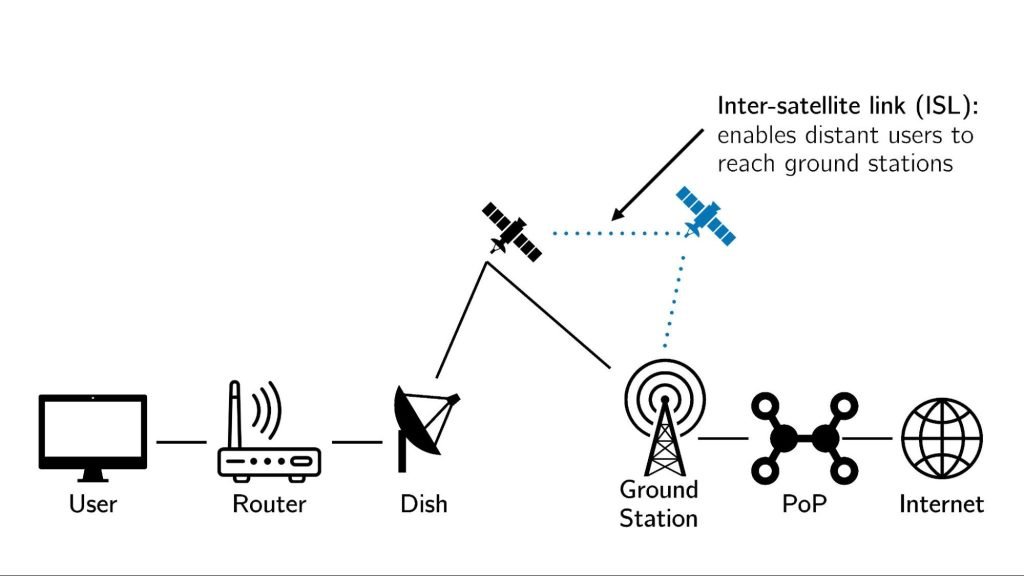
- The larger service radius of LEO networks have the potential to improve overall performance and assist remote, underserved users in reaching LEO satellite network routing infrastructure.
Global Internet access is an important challenge. Beyond social barriers such as user education and affordability, the monumental task of physically connecting everyone to the Internet remains an unsolved technical puzzle due to remoteness, natural disasters, and other physical obstacles.
Low-earth orbiting (LEO) satellite networks are poised to help solve a part of this connectivity puzzle because they bypass physical obstacles by routing data directly to satellites in space.
Given the potential of LEO networks, it’s natural to wonder how governments, who are incentivized to connect all their constituents, should respond to LEO deployments like Starlink. So far, we’ve seen two main paths that governments are exploring:
- Subsidizing commercial LEO networks
- Investing in national LEO infrastructure
As technologists, our goal in studying this topic is not to address all the complexities of government policy or advocate for any particular strategy, but to provide technical data to nuance how policymakers consider these approaches. In this post, we explore the first question about subsidies, but you can read more about the second in our TPRC paper.
Subsidizing Commercial LEO Networks
When considering the need to subsidize commercial LEO networks, we believe that it is first important to consider whether LEO Internet networks
- Meet regulatory standards of quality
- Perform as well for low-income users as for high-income users.
To answer these questions, we studied Starlink’s performance since it is currently the only widely deployed LEO network, although others are planned (e.g., Project Kuiper, IRIS^2). For throughput analysis, we used real-world speed test data from Google’s M-Lab dataset. Our TPRC paper provides more details about the methodology.
Does Starlink meet Regulatory Standards of Quality?
We explore three major initiatives in Australia, Europe, and the US with distinct eligibility criteria that may lead to subsidies for LEO operators like Starlink:
- The Broadband Equity Access and Deployment (BEAD) Program in the US
- The Connecting Europe Broadband Fund (CEBF) in the EU
- The Statutory Infrastructure Provider (SIP) regime in Australia.
For each policy, we analyzed the download throughput and calculated the percentage of samples that meet their respective eligibility criteria. We used 100 Mbps for Australia since regulators are currently considering increasing minimum legislated speeds from 25 Mbps to 100 Mbps to match those in the EU and the US.
We observed that Starlink does not consistently meet performance goals across the board, with only 24.7%, 13.6%, and 42.2% of samples above 100 Mbps in the US, EU, and AU, respectively. However, we find that these conclusions are dependent on the interpretation of proposed standards, as peak throughput measurements seem to tell a different story with most samples above 100 Mbps.
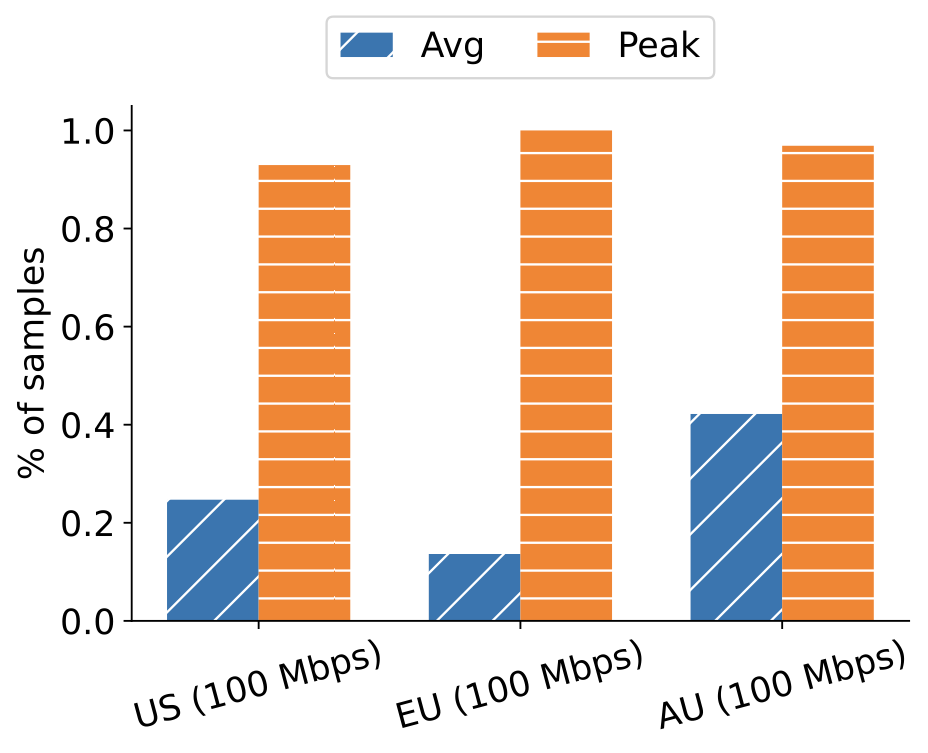
These findings suggest that existing performance goals, written in the context of more stable fibre connectivity (where the disparity between peak vs. average throughput is smaller), may need reframing to account for the inherently volatile nature of LEO networks.
Does Starlink perform as well for low-income users as for high-income users?
We know that infrastructure deployments have historically been biased towards higher-income regions. Thus, if Starlink exhibits the same bias as existing platforms, it may not be useful to policy objectives like BEAD, which intend to reach under-resourced users.
For this analysis, we sorted US speed test data according to the corresponding median household income of the sample’s county and analyzed the bottom and top 10% of the distribution. We observed that for a random sample of non-Starlink providers, the median throughput of samples in the top 10% is roughly 30% higher than that of samples in the bottom 10%. On the other hand, Starlink samples show little difference in throughput, with the median throughput actually lower for samples in higher-income counties.
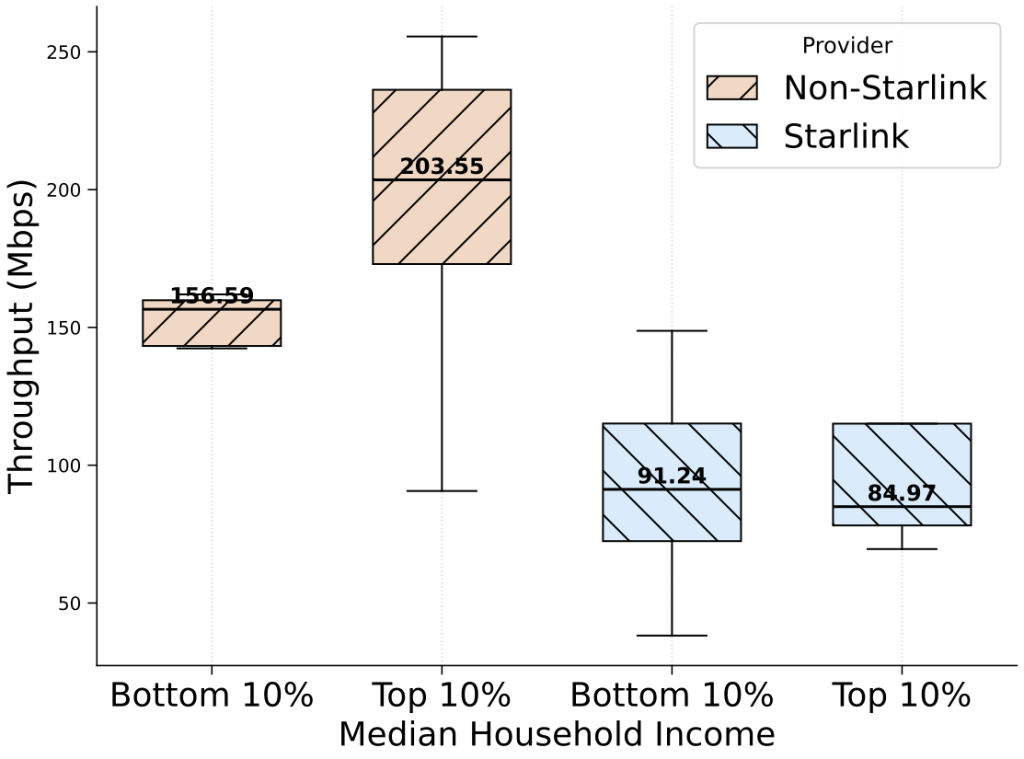
Thus, Starlink shows great promise in terms of equity. We hypothesize that its larger service radius enables users in lower-income regions to benefit from infrastructure in more affluent areas. We call this the neighbor effect, which we describe in further detail in our paper.
Our data shows the promise of LEO networks in overcoming physical Internet access barriers. At the same time, it adds complexity to the regulatory landscape by pushing us to refine our standards for broadband quality. We expect this to be a rapidly developing space as Starlink continues to develop new technologies to improve access and quality and as new entrants such as Kuiper and IRIS2 see wider deployment and adoption.
Isabel Suizo is a PhD student at Carnegie Mellon University. Her interests lie in improving Internet access by using wide-scale empirical measurements to design networks better tailored to a region’s technical needs.
Photo by Hunter Masters on Unsplash