
The Hidden Carbon Cost of Internet Traffic

In short:
- Estimating the carbon footprint of the Internet network traffic has been challenging.
- A new method combines information from routers and public carbon intensity APIs to estimate network emissions at the level of individual traffic flows.
- Without standardized methodologies, organizations may calculate network emissions in fundamentally different ways.
Every day, billions of digital activities take place online—from streaming videos to gaming, cloud computing, and AI applications. While many people are becoming more aware of the environmental impact of technology, one important question remains surprisingly difficult to answer: What is the carbon footprint of a specific online activity?
Researchers and companies have made significant progress in understanding emissions from data centers and computing infrastructure. Yet the network that connects users to digital services—the routers, links, and Internet providers that move data around the world—remains largely invisible to carbon accounting.
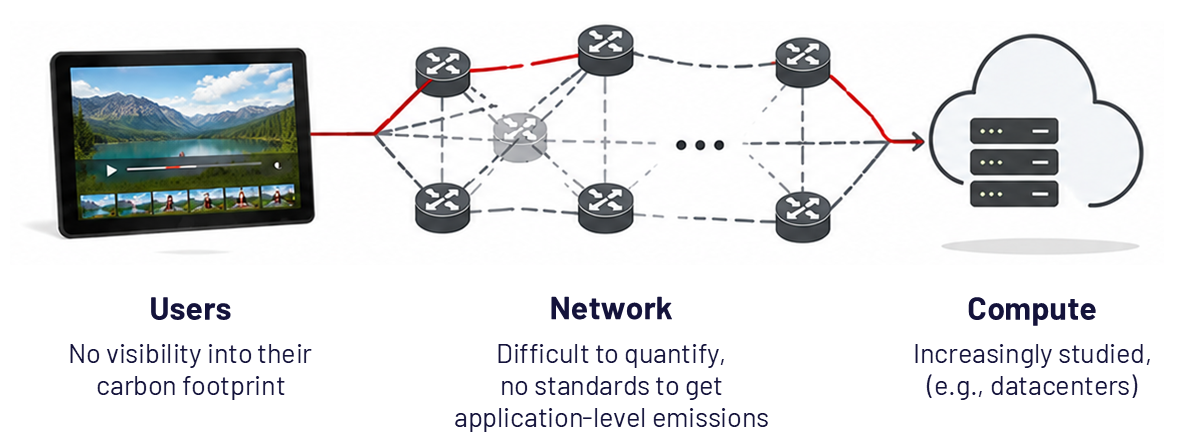
My colleagues and I recently sought to explore whether it is possible to estimate the carbon emissions associated with individual Internet traffic flows using tools that already exist in today’s networks.
Why Network Emissions Are Difficult to Measure?
Unlike a single device plugged into a wall socket, Internet traffic travels through many different networks and routers before reaching its destination. Along the way, that traffic may pass through equipment with varying levels of energy efficiency and through regions powered by very different energy sources.
At the same time, network devices process thousands—or even millions—of traffic flows simultaneously. This makes it challenging to determine how much of a router’s energy consumption should be attributed to any one user, application, or service.
As a result, users, policymakers, and organizations currently have very limited visibility into the network-related emissions of digital activities.
Turning Existing Network Data into Carbon Estimates
The good news is that much of the information needed for carbon accounting already exists.
Modern routers routinely collect statistics about the traffic they process, including data volumes and packet counts. Meanwhile, regional carbon-intensity data—which measures the greenness of electricity generation in a given location—is increasingly available via public APIs.
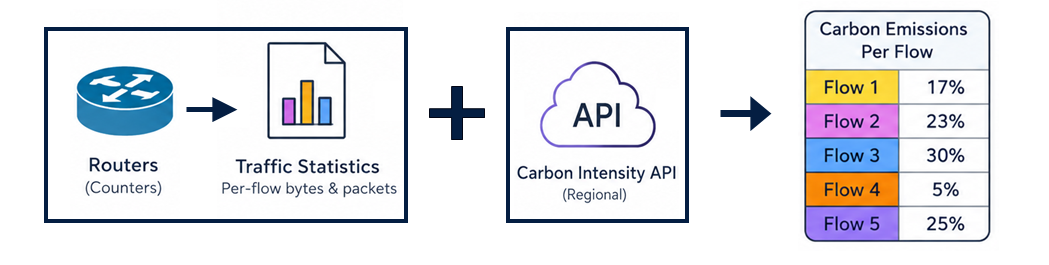
Our research combines these two existing sources of information to estimate network emissions at the level of individual traffic flows, without requiring new hardware or major changes to network infrastructure.
Estimating the carbon footprint of an Internet activity requires more than measuring the power consumption of individual network devices. The first challenge is translating device-level telemetry into flow-level emissions by determining how much of a router's energy consumption should be attributed to each traffic flow. Once emissions can be associated with individual flows at a given device, these per-flow contributions can in principle be collected and aggregated across the sequence of routers that carry the traffic. Together, these steps provide a path from infrastructure-level measurements to end-to-end user carbon footprints.
What We Learned About Router Energy Consumption
To understand how network devices consume power, we conducted an experimental study using three different routers designed for different environments, including data centers, carrier networks, and AI workloads.
One key finding was that router power consumption depends not only on traffic volume but also on its structure. For example, given a fixed amount of data (/file), sending in small packets will consume more energy than sending in large packets.
We also observed that certain packet sizes create unexpected increases in power consumption due to hardware-level inefficiencies.
Despite these complexities, we found that router power can be modeled accurately using a simple formula based on two measurements that routers already expose today: throughput and packet rate. This approach achieved more than 96% accuracy in our experiments.
From Device Power to User Carbon Footprints
Once router power consumption can be estimated, the next challenge is deciding how much of that energy use should be assigned to a particular user or application. This turns out to be as much a policy question as a technical one.
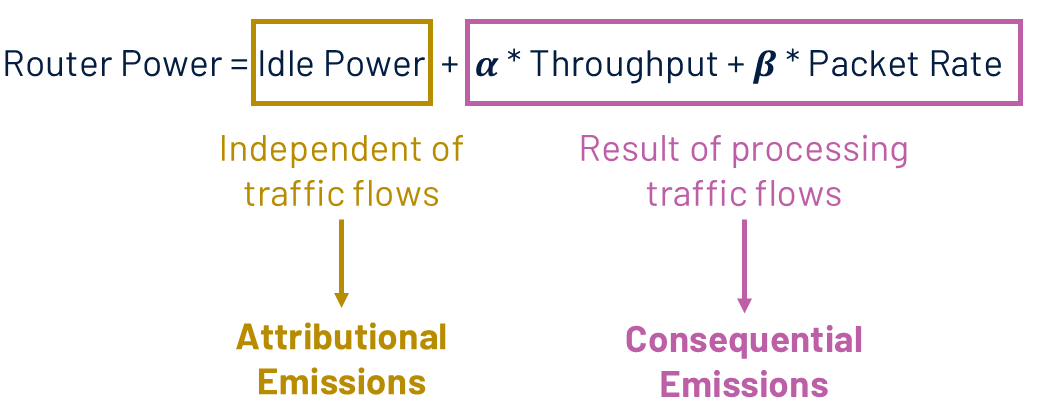
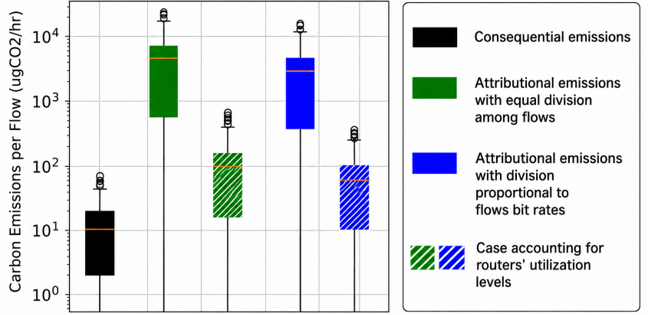
Consequential emissions answer the question: How much additional carbon was caused by my activity?
In this approach, we consider only the extra energy required to process a specific flow. If your video stream increases a router's power consumption slightly, only that increase counts towards your emission responsibility.
Attributional emissions, on the other hand, answer another question: What share of the network's existing emissions should be assigned to my activity?
Imagine a router consuming a base amount of electricity all day, even when your video stream is not present. Routers are kept on and ready to process users’ traffic, meaning that users are also responsible for the base energy consumed. Attributional accounting allocates a portion of that router's base energy consumption to your traffic. The challenge is deciding how to divide that baseline energy use. Should every flow receive an equal share? Should larger flows receive a larger share? Different answers lead to different carbon estimates.
In fact, when we evaluated a large-scale video streaming scenario using a model of a national telecommunications network, we found that different allocation methods could produce carbon estimates that differed by as much as 120 times for the same traffic flow.
This highlights an important policy challenge: without standardized methodologies, organizations may calculate network emissions in fundamentally different ways.
Why Standards Matter
Our findings suggest that accurate flow-level carbon tracing is technically feasible today using existing network counters.
However, our research also demonstrates that methodology matters. The difference between various accounting approaches can be much larger than the underlying emissions being measured.
As governments, companies, and consumers increasingly seek transparency around digital sustainability, the networking community has an opportunity to establish common frameworks for measuring and reporting network-related emissions.
Reliable standards would help organizations make meaningful comparisons, support sustainability reporting, and ultimately provide users with a clearer understanding of the environmental impact of their online activities.
The Internet has become a critical part of modern life. Understanding its carbon footprint is an important step toward building a more sustainable digital future.
The measurement benchmark and simulation codes used in this research (read the paper) are available as open-source to support further work on network carbon accounting.
Sawsan El Zahr is a PhD student in Engineering Science at the University of Oxford.
The views expressed by the authors of this blog post are their own and do not necessarily reflect the views of the Internet Society.