

Internet Censorship in Iraq and Its Impact on Useful Content

In short:
- Certain censorship methods appeared inconsistent across Iraqi ISPs.
- The lack of standardization is unintentionally affecting critical sectors, including education, business infrastructure, research platforms, and public services.
- If governments require filtering, implementation should be transparent, proportionate, and accountable.
Internet censorship is often discussed in terms of politics, law, or national security. But there is an important technical question that is often overlooked: what happens when blocking unintentionally restricts useful online services?
My colleagues and I recently published a study in Computers & Security, examining how Internet filtering is applied across residential Internet Service Providers (ISPs) in Iraq.
Iraq is an important case because its Internet infrastructure is, in practice, decentralized. Although the Ministry of Communications sets regulatory requirements for many ISPs in the federal region, many providers do not route traffic through the ministry-mandated control point. Instead, some route traffic through Kurdistan-based providers or use direct international connections. At the same time, the Kurdistan region operates under its own policy framework and is not required to route traffic through the federal choke point.
Together, these factors create a fragmented network environment in which censorship rules may be applied unevenly across ISPs.
To understand what users actually experience, we conducted active measurements from four Iraqi residential networks in 2025: three fixed-line ISPs and one mobile operator. We tested two large sets of domain names: 50,000 popular domains from the Majestic Million list and more than 100,000 domains from a private list obtained from the Iraqi Ministry of Communications. This allowed us to compare the filtering of widely used websites with that of an official blocking list.
DNS Filtering Most Common Censorship Technique; IP-level Blocking Implemented Inconsistently
DNS-based filtering is the most common and consistent censorship technique across the tested ISPs.
The Domain Name System (DNS) is often described as the Internet’s phonebook: when users type a website name, DNS translates it into the numerical address needed to reach that site. By interfering with this process, an ISP can prevent users from reaching a website before a connection is even established.
In our measurements, DNS interference appeared across all tested networks and affected even highly ranked websites. However, it was not implemented in the same way by every provider. Some ISPs returned responses suggesting that the domain did not exist, while others returned empty or failed responses. For users, the result may look similar: the website does not load. For researchers, journalists, and policymakers, these differences matter because they show that enforcement is not technically standardized.
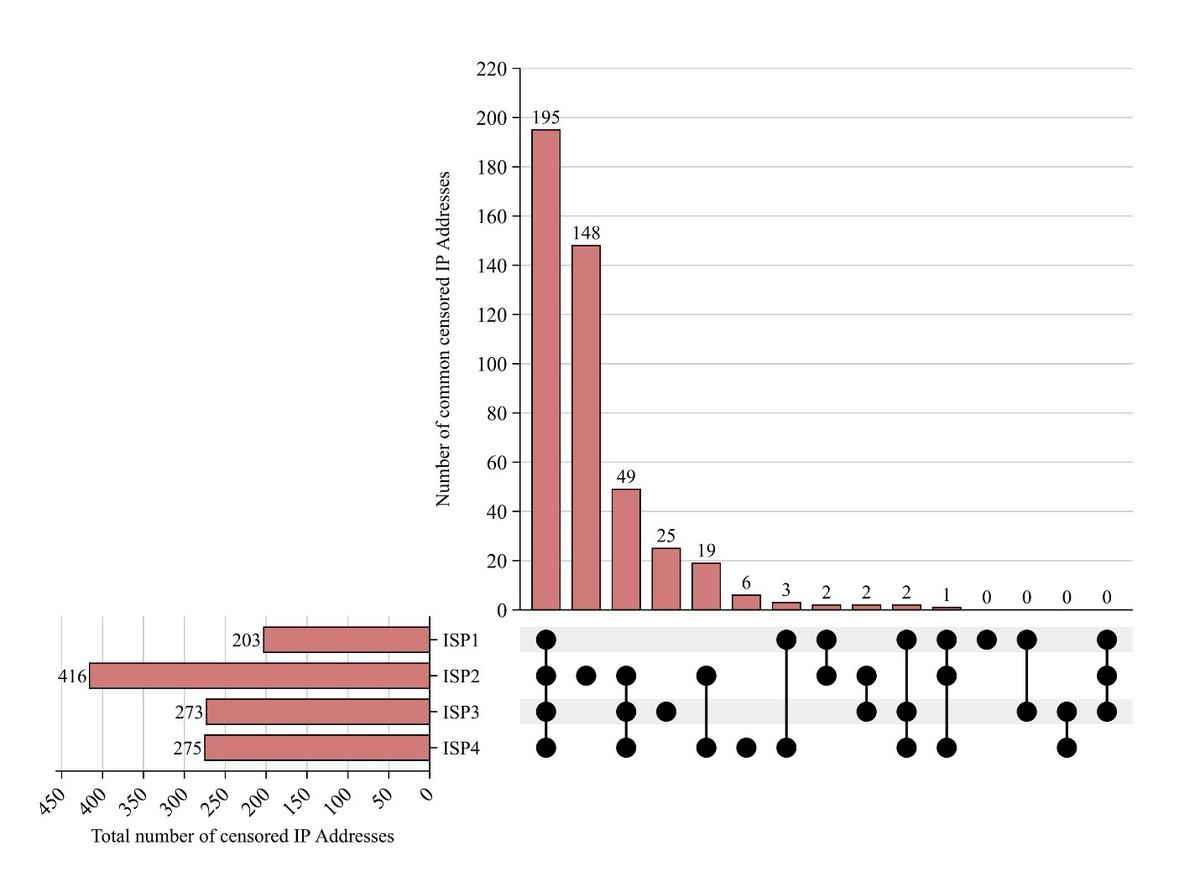
Our second major finding was that IP-level blocking is less consistent and more likely to create collateral damage. IP-level blocking prevents users from reaching a numerical Internet address directly. The problem is that one IP address can host many unrelated websites. Blocking that address may therefore block not only the intended target, but also legitimate websites hosted on the same infrastructure.
What is the Impact of Internet Censorship on Useful Content?
In our study, IP-level blocking affected domains in important categories such as business, information technology, and education. These sectors are essential for economic activity, access to knowledge, research, and public services. When filtering unintentionally restricts these resources, censorship becomes more than a content-control issue; it becomes a connectivity, productivity, and development issue.
The variation between ISPs is also important. Some blocking was common across all tested networks, suggesting compliance with central policy directives. But other blocking appeared only on specific providers, indicating that individual ISPs may apply additional or stricter rules. This creates an uneven Internet experience: a website may be accessible to one Iraqi user but blocked for another, depending on their provider.
What Should Regulators Do?
If governments require filtering, implementation should be transparent, proportionate, and accountable.
Regulators should require ISPs to publish periodic transparency reports explaining what is blocked and why. IP-level blocking should be used only with strong justification because of its high risk of collateral damage. Where possible, more precise domain-level controls should be preferred. Critical sectors such as education, business infrastructure, research platforms, and public services should be protected through review mechanisms. Affected users and organizations should also have a clear appeal process when lawful services are blocked.
Internet filtering is not only a technical operation. It is a public policy choice with social and economic consequences. Iraq’s experience shows that when policy directives are issued into a fragmented routing environment, without a unified technical enforcement mechanism or clear transparency requirements, the result can be inconsistent filtering, unnecessary over-blocking, and reduced trust.
Ameer Khudhur Al-Dujaily received the B.Sc degree in Electronics & Communications Engineering from the Faculty of Engineering, University of Kufa in 2021. He previously worked at the National Internet Project (NIP) as a portal administrator.
Contributor: Bahaa Al-Musawi
The views expressed by the authors of this blog post are their own and do not necessarily reflect the views of the Internet Society.