

The 5G Digital Divide in the Non-Contiguous US is Real. Are LEO Satellites the Solution?

In short:
- A new study shows a clear 5G digital divide between non-contiguous areas and the mainland US, mainly driven by spectrum and geography.
- LEO Internet services can only complement, but not replace, cellular networks, as they also face their own distinct challenges in non-contiguous regions.
- The most promising path forward is multipath transport, which combines the best of cellular and Starlink to deliver better coverage and performance than either network alone.
When you step off the plane in Anchorage or Maui, your phone still shows the familiar "5G" icon. But does that icon deliver the same as in Los Angeles or Omaha?
These non-contiguous regions face unique challenges that the mainland does not, including rugged terrain, reliance on long-distance cables, and limited fiber backhaul and spectrum availability. Yet reliable connectivity matters just as much there for millions of residents and visitors who depend on it for emergency services, navigation, and everyday life.
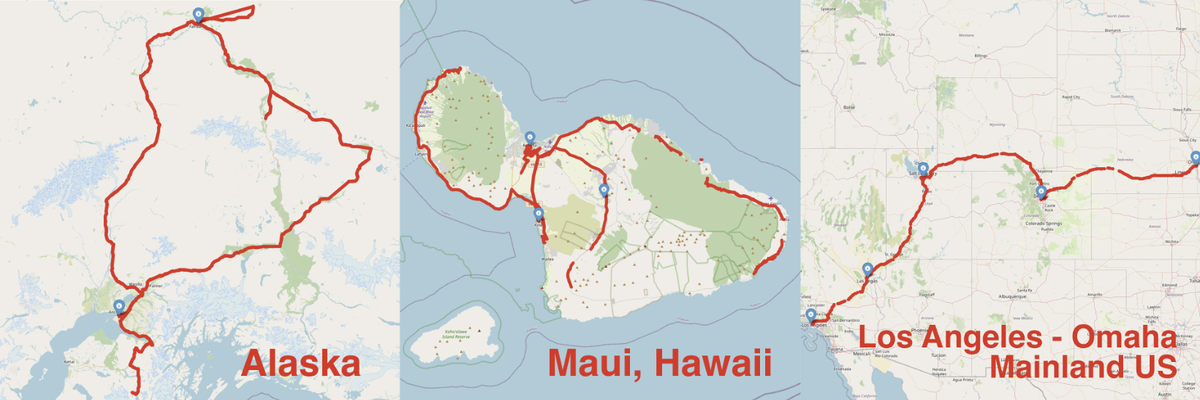
Our team at Northeastern and Purdue University set out to measure what 5G actually delivers in 2024 in Alaska, Hawaii, and the West Coast of mainland USA, and how it compares to Starlink's Internet services.
A Real and Measurable 5G Digital Divide
The coverage gap is stark. On our mainland route, T-Mobile delivered 5G across 93% of the miles we drove, with AT&T and Verizon each around 40% (Figure 2c).
In Alaska (Figure 2a), Verizon offered no 5G coverage, AT&T managed 30%, and T-Mobile had no native service, relying entirely on roaming.
In Hawaii (Figure 2b), T-Mobile led with 63% 5G coverage, while AT&T reached 55% and Verizon just 16%. What's even worse: complete no-service zones were common in rural areas.
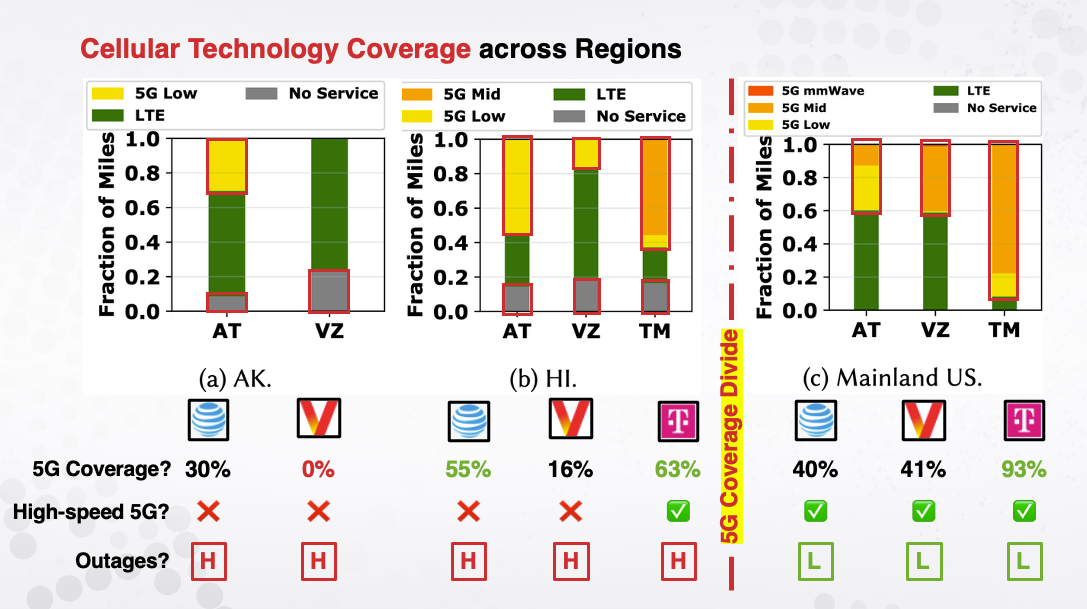
Why such a gap? The spectrum that enables high-speed 5G simply is not licensed in these states the way it is on the mainland. In both Alaska and Hawaii, the key spectrum bands for AT&T and Verizon's 5G are reserved for incumbent satellite services. T-Mobile in Alaska offers only a roaming option because its spectrum is licensed to the Alaska Tribal Network.
Speed and Latency Data Drive the Point Home
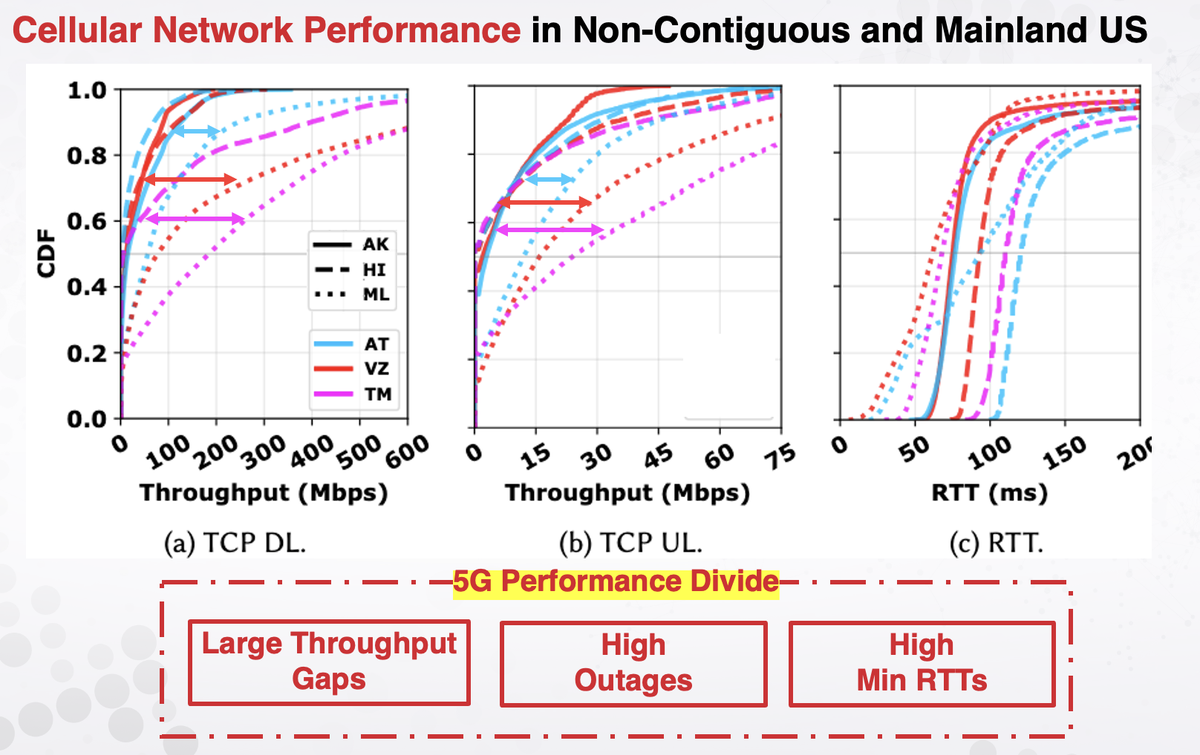
In Alaska (solid lines in Figure 3a), median downloads for AT&T and Verizon were just 15 and 11 Mbps, compared to 57 and 77 Mbps on the mainland (dotted lines in Figure 2a). In Hawaii (dashed lines in Figure 3a), T-Mobile's 5G delivered a median of only 6 Mbps compared with 184 Mbps on the mainland.
Uploads were barely usable (Figure 3b): 2–3 Mbps at the median in Alaska, and effectively 0 Mbps in Hawaii for all three carriers. In Figure 3c, both regions suffer from higher latency compared to the mainland (by 14 ms in Alaska and 26-42 ms in Hawaii in the median case), largely because of the long-distance cables to mainland servers.
Can Starlink Fill the Gap?
LEO satellites are often pitched as the great equalizer for remote regions. In the non-contiguous US, Starlink beat cellular on downloads most of the time (Figure 4a), but cellular delivered higher upload speeds (Figure 4b), though Starlink was more reliable. On latency (Figure 4c), Starlink's round-trip times were higher than cellular in Alaska, but fell somewhere in between the best and worst cellular carriers in Hawaii.
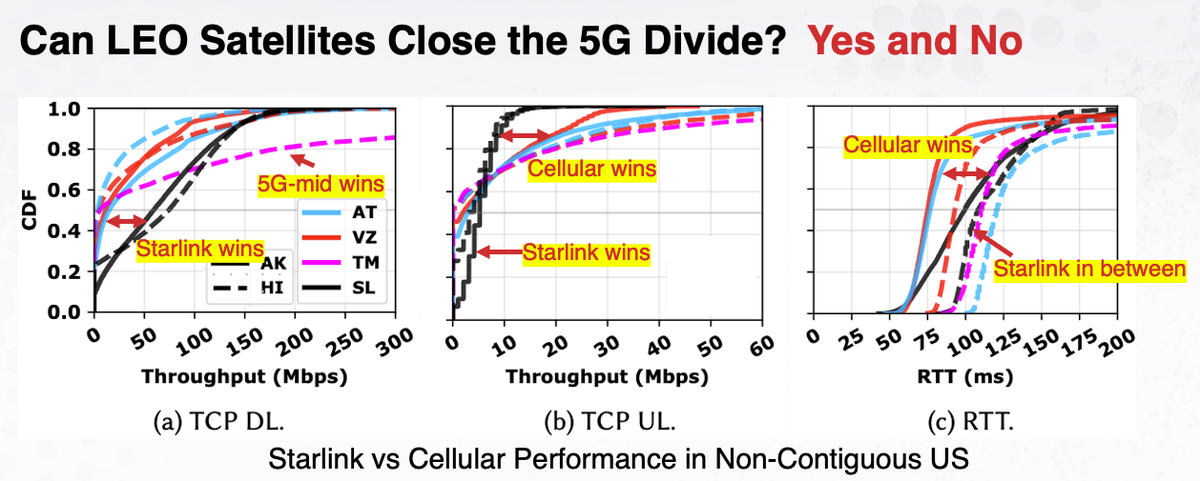
Notably, Starlink also faced its own challenges in these regions. Alaska sits at such high latitudes that fewer satellites pass overhead at any given moment, leaving longer connection gaps. On Maui's famous Road to Hana, the dense rainforest canopy blocks Starlink’s line of sight, causing repeated service interruptions.
In short, Starlink can only complement, but not replace, cellular networks.
What This Means, and a Path Forward
Our measurements show that the 5G era has not arrived equally across the United States. The gap is shaped by a combination of spectrum availability, geography, and infrastructure investment. What is clear is that in the non-contiguous regions, no single network, either cellular or Starlink, consistently delivers fast and reliable service in all scenarios.
The most encouraging finding is that cellular and Starlink show strong spatial and temporal diversity in those non-contiguous regions — where one loses connection, the other often holds. That opens a practical possibility: what if your smartphone could pull from both at once, say cellular from nearby towers and WiFi from a Starlink dish mounted on your car? Technologies like multipath transport could make this feasible by combining two imperfect connections into a single connection that is faster and more reliable than either alone, a concrete step toward closing the divide.
Read our ACM SIGMETRICS 2026 paper and review our dataset.
Sizhe Wang is a third-year PhD candidate at the Institute for Intelligent Networked Systems (INSI) at Northeastern University, supervised by Professor Dimitrios Koutsonikolas. His research focuses on experimental studies of 5G and LEO satellite networks, aiming to design next-generation wireless networks that coexist with terrestrial cellular and satellite networks.
Contributors:
- Northeastern University: Moinak Ghoshal, Yufei Feng, Imran Khan, Phuc Dinh, Zhekun Yu, and Professor Dimitrios Koutsonikolas.
- Purdue University: Omar Basit and Professor Y. Charlie Hu.