

Mobile vs Fixed Fiber Internet: Which is Most Sustainable

In short:
- Mobile networks are essential complements to fixed infrastructure, but they are not necessarily energy-efficient substitutes for high-capacity broadband access.
- Although fiber deployment requires considerable upfront investment, its operational efficiency becomes increasingly advantageous as data demand continues to grow.
- As Europe continues to expand next-generation connectivity, the long-term sustainability of network architectures will become an increasingly important issue for telecommunications, industrial, and climate policy.
Can mobile networks replace fiber-optic broadband networks in a sustainable way, particularly in rural areas, where low population density makes fiber rollout particularly costly?
Using a detailed bottom-up model for Germany, my colleagues and I sought to answer this question by comparing the operational energy consumption and CO₂ emissions of modern fiber-to-the-home (FTTH) networks with current mobile access networks across different regional structures.
The central finding from our study was that fiber-based fixed networks are substantially more energy-efficient and climate-friendly than mobile networks across all regional settings.
Why are Fixed Fiber Networks More Energy Efficient Than Mobile Networks?
While mobile technologies are indispensable for mobility and flexible access, they require significantly more energy to deliver comparable broadband capacity. A key reason lies in the structure of mobile networks themselves. Most energy consumption originates from antenna sites, whose base power requirements remain high regardless of the number of connected users.
Fiber networks, by contrast, rely more heavily on network equipment with lower base energy consumption and considerably better scalability, which is particularly relevant in sparsely populated areas.
To reach these conclusions, our study developed highly granular municipal-level models of telecommunications infrastructure. It combined geographic and demographic information with technical data on network architecture, equipment capacities, and electricity consumption.
Rather than relying on broad averages, the analysis estimated the number and type of network elements required to provide broadband connectivity under realistic regional conditions. This allowed us to quantify operational electricity demand and resulting CO₂ emissions across different regional structures.
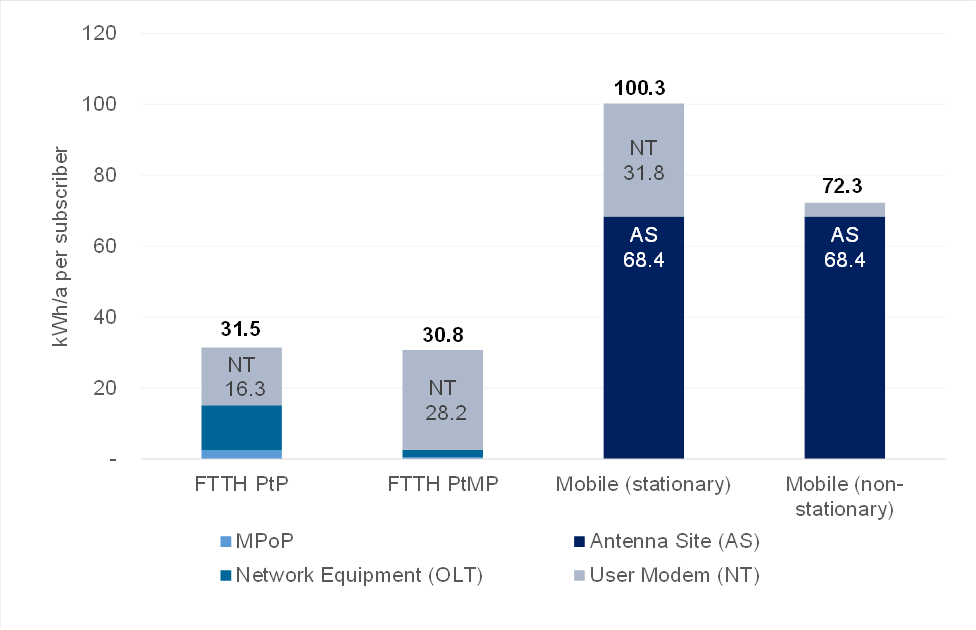
Fixed Fiber Networks and Mobile Networks Should Not Be Viewed as Interchangeable Technologies
Mobile networks are essential complements to fixed infrastructure, but they are not necessarily energy-efficient substitutes for high-capacity broadband access. The findings suggest that relying too heavily on mobile-only strategies in rural regions could lead to substantially higher long-term energy consumption and emissions.
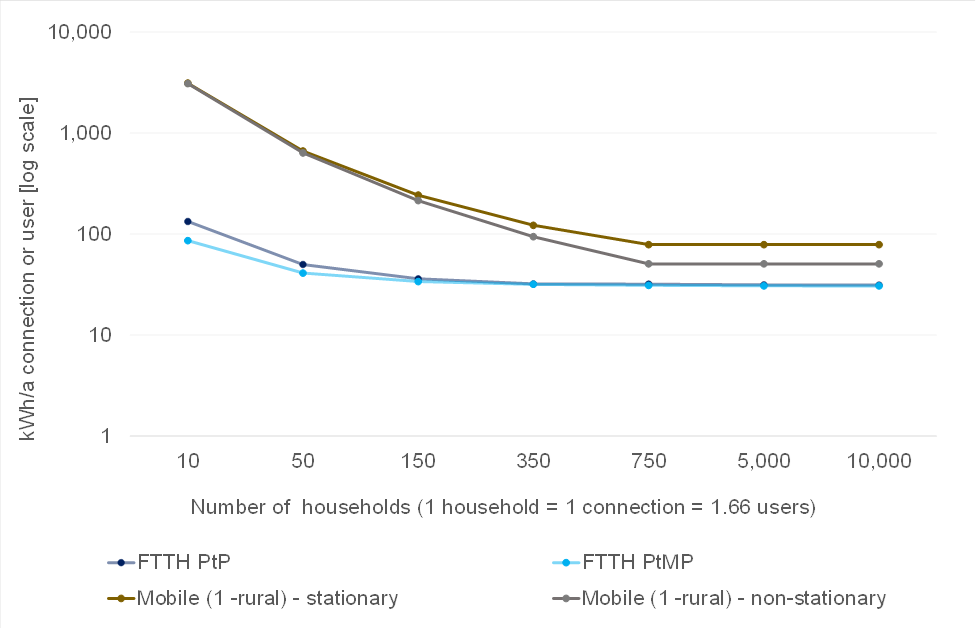
Although fiber deployment requires considerable upfront investment, its operational efficiency becomes increasingly advantageous as data demand continues to grow.
The study is also relevant for public funding and state-aid programs aimed at closing connectivity gaps. Broadband policy has traditionally focused on coverage and speed targets, while energy efficiency has played only a secondary role.
The results indicate that energy-related criteria could be given greater weight in funding decisions, particularly in light of rising electricity demand from digital technologies, growing geopolitical uncertainty in energy markets, and the expected expansion of energy-intensive AI applications. Even when electricity is produced in an environmentally friendly way, such green energy is a scarce resource that ought to be handled carefully.
Aligning Digital Transformation with Climate Objectives
More broadly, the paper contributes to the debate on the “twin transition,” aligning digital transformation with climate objectives.
Digital infrastructure is often viewed primarily as an enabler of sustainability in other sectors, such as transport or energy. However, the study highlights that digital networks themselves have a significant environmental footprint that must be carefully assessed and managed. As Europe continues to expand next-generation connectivity, the long-term sustainability of network architectures will become an increasingly important issue for telecommunications, industrial, and climate policy.
At the same time, the analysis reflects the current state of network technology.
Mobile infrastructure is continuously evolving, and future improvements, including advanced sleep modes and AI-driven optimization, could further improve its energy efficiency.
Nevertheless, the underlying physical properties of transmission technologies remain important. Unlike fiber, mobile signals weaken over distance, reducing transmission capacity and requiring either additional antenna infrastructure or higher transmission power to maintain performance, both of which increase energy consumption. Particularly in the context of rapidly growing data demand, driving a continued densification of mobile networks with smaller 5G cells and higher transmission capacities, further increasing overall energy requirements.
Fiber networks, by contrast, offer higher and more future-proof transmission capacity with comparatively lower operational energy demand, making them particularly well-suited for the long-term growth of digital connectivity.
Gonzalo Zuloaga is a Senior Economist at WIK, Germany, specializing in digital infrastructure and regulatory policy. His work combines econometric analyses, large-scale data modeling, and evidence-based policy research to support the sustainable development of digital networks, connectivity, and investment across telecommunications and digital markets.
The views expressed by the authors of this blog post are their own and do not necessarily reflect the views of the Internet Society.