
Recapping West African Internet Resilience Workshop
Last year, my friend Kehinde Adegboyega and I participated in Pulse Internet Measurement Forum, Nigeria, to discuss the challenges and opportunities to improve the country’s and region’s Internet resilience.
Inspired by the discussion, we reached out to the Internet Society to propose running a similar event at the Digital Rights and Inclusion Forum (DRIF), which brings together representatives from the government, legislature, civil society, non-governmental organizations, activists, academia, the technical community, and the private sector to address various topics centered on digital inclusion and rights.
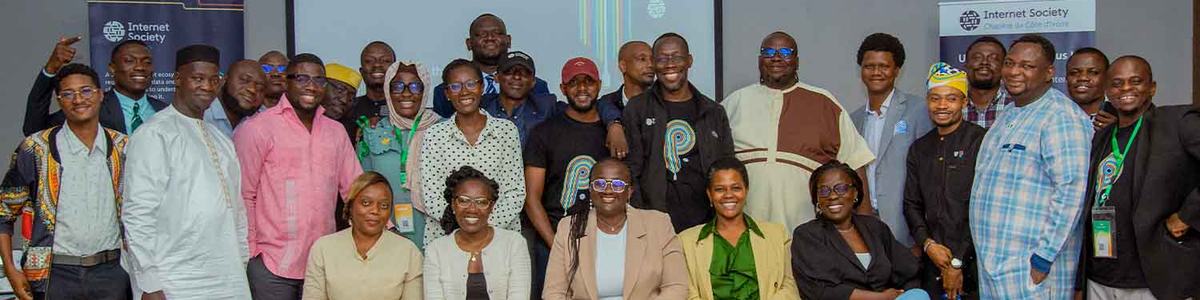
Last month, I assisted Internet Society Pulse and West African Digital Rights Defenders Coalition to co-organize and facilitate an interactive two-day workshop in Abidjan, Côte d'Ivoire, as a precursor to DRIF 2026.
Thirty-one invitees from Mali, Nigeria, Sierra Leone, and Côte d'Ivoire—representing government, academia, civil society, and the private sector—convened to share their experience and challenges surrounding Internet resilience and critically think about viable solutions.
The group engaged in several deep, interactive discussions, strongly anchored in data and lived realities, that particularly focused on:
- Infrastructure gaps: Including first‑mile, middle‑mile, and especially last‑mile challenges, limited local compute capacity, and uneven distribution of infrastructure.
- Affordability: High mobile data costs, dependence on mobile broadband, and limited access to fixed broadband across the region.
- Power and energy constraints: Unreliable electricity supply and the need for more resilient and renewable energy solutions to support Internet infrastructure.
These discussions created a shared sense of urgency and a call to action on strengthening Internet resilience across the region and the continent at large.
The presentations and discussion provided the context and inspiration for participants to work in multistakeholder groups to identify gaps in current data and logistics needed to enhance Internet connectivity, reliability, and affordability.
| Challenges | Proposed solutions |
|---|---|
|
|
|
|
|
Conduct a pilot comparative study targeting isolated areas (Target Communes: Abidjan and Freetown) to quantify the impact of "last mile" infrastructure quality on the availability and cost-effectiveness of Mobile Money services to prioritize high-impact investments. |
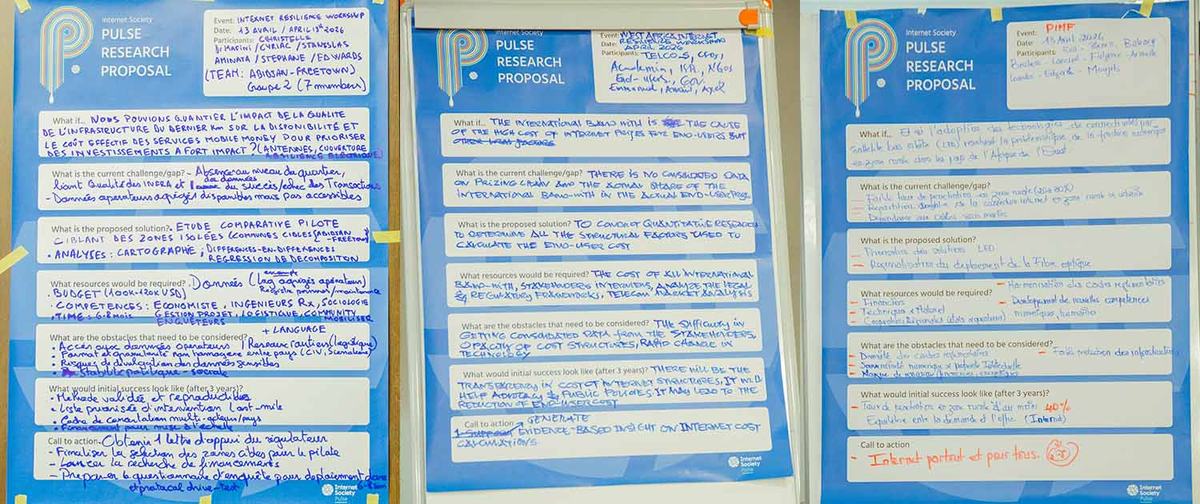
Although many of the core challenges discussed are well known to stakeholders, this research proposal development exercise allowed the participants to draw on their varied experiences and cultures to start to conceptualize how they can collectively validate and/or viably solve them.
To test the proposals, we also shared them with participants during a session at DRIF 2026 ‘Advocating for Greater Internet Resilience in West Africa.’ Those who participated agreed on the need for all proposals, though two particularly engaging discussion threads emerged from this hour-long session:
- How critical services can remain online during major outages, particularly submarine cable cuts, with a focus on local content hosting, regional interconnection, and policy coordination.
- How can we bolster our Internet infrastructures, as 4G and 5G networks are far from the reality of their speed test results.
The Internet Society plans to work with local partners to discuss the feasibility of implementing at least one of these proposals and to conduct a project, with a view to reporting the results and holding the workshop again at DRIF 2027.
It is hoped that we can create a flywheel effect of research development and interest surrounding Internet resilience within this community to support its mission to build tangible solutions that address major digital rights and inclusion concerns.
Finally, I’d like to thank my co-facilitators, Kehinde Adegboyega and Jean Baptist Millogo, as well as Paradigm Initiative, for their assistance and for welcoming us at DRIF. Also, a special shout-out to the Internet Society Côte d'Ivoire Chapter and the representatives from the Mali, Sierra Leone, and Togo Chapters. It was clearly evident from on‑the‑ground coordination to contextual insights that anchored the discussions firmly in regional realities. Their leadership and commitment played a critical role in ensuring strong participation and the relevance of the conversations.
Email [email protected] if you’re interested in hosting, partnering, sponsoring, or presenting opportunities at future Pulse events. And stay tuned to the Pulse events page for upcoming events.
Israel Olatunji Tijani is a Data Scientist and Founder of ChatVE.
The views expressed by the authors of this blog post are their own and do not necessarily reflect the views of the Internet Society.