
A Journey Towards Implementing Internet Resilience in Africa

In short:
- The Africa Telecommunications Union (ATU) has released a model framework for building and sustaining Internet resilience in Africa.
- The framework introduces a six-step resilience process that includes stakeholder engagement, identification of critical assets, assessment of vulnerabilities and gaps, and integration of resilience solutions into national strategies.
- It is expected that the adoption of this framework will lead to measurable improvements in national Internet resilience.
Internet resilience is increasingly referenced as a critical component of maintaining and improving Internet access.
The Internet Society’s Pulse Internet Resilience Index was developed from the Measuring Internet Resilience in Africa (MIRA) project, which sought to assess a country's ability to maintain an acceptable level of Internet connectivity at all times.
Building on the success and collaborative efforts of this project, the Africa Telecommunications Union (ATU) engaged the Internet Society and the African Network Information Centre (AFRINIC) to develop a model framework to build and sustain Internet resilience in Africa.
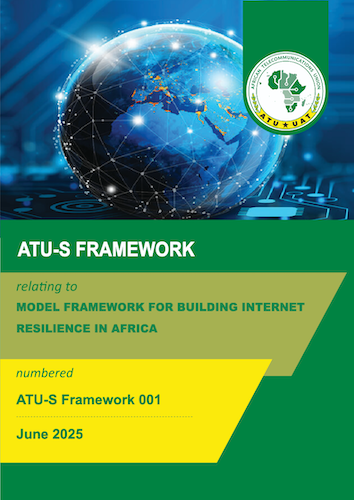
Released in June last year, this framework is designed to help African countries improve their Internet ecosystems and reduce risks that could magnify the impact of disruptions such as submarine cable cuts, Internet infrastructure failures, and design flaws that may create single points of failure at a national level.
The framework, which is targeted primarily at regulators, ICT ministries, and policy makers, focuses on three interdependent areas:
- Critical Infrastructure: hardware and software systems essential to Internet operations, including undersea cable infrastructure, Internet Exchange Points (IXPs), and country-code Top-Level Domain (ccTLD) infrastructure.
- Network/Internet Service Provider Resilience: The networks that interconnect and provide Internet services to citizens, including redundancy, routing, and operational best practices.
- Market Resilience: This refers to the local Internet market's ability to self-regulate, maintain diversity, and ensure affordability.
The framework introduces a six-step resilience process that includes stakeholder engagement, identification of critical assets, assessment of vulnerabilities and gaps, and integration of resilience solutions into national strategies. This process supports decision makers in implementing measures to anticipate, withstand, recover, and adapt to disruptions, ensuring Internet services remain stable even during major incidents.
Delivering Quick, Measurable Wins
The next phase of the project involves implementing the framework.
The ATU, Internet Society, and AFRINIC will continue to promote the framework document in various fora this year, with an interest in working with interested stakeholders to implement the guidelines. The expected outcomes in the region include:
- Increasing the number of operational Internet Exchange Points (IXPs).
- Expanding and diversifying terrestrial, Low Earth Orbit, and subsea cable Internet access infrastructure.
- Improving routing resilience and redundancy of ISPs and network operators.
- Implementing regulatory policies that promote competition to improve affordability and investment in new technologies, including 5G.
It is expected that the adoption of this framework will lead to measurable improvements in national Internet resilience over the coming months and years — something we will track via the Pulse Internet Resilience Index and Pulse Country Reports.
By strengthening infrastructure, improving network operations, and enabling resilient market conditions, Africa can move toward an Internet that is more affordable and accessible, as well as reliable, secure, and capable of supporting long-term digital development.
Photo by Internet Society / Nyani Quarmyne / Panos Pictures