

Measuring Rural Internet Access Across Starlink

In short:
- For rural Internet connectivity decisions, Starlink's value depends entirely on what alternative connectivity and locally cached content exist.
- Policymakers considering Starlink subsidies should recognize that it works best as a complement to terrestrial broadband, not a replacement for it.
- As the constellation matures and more ground infrastructure is built, performance may improve.
Low-Earth Orbit (LEO) satellite-based internet services like Starlink are often touted as a solution to bridge the digital divide—connecting remote communities where fiber cables and cell towers are impractical or too expensive. However, does Starlink actually deliver on this promise?
Recently, our research group sought to answer this question. We tracked three key metrics that matter to users: latency (responsiveness), download speeds, and packet loss (connection reliability). This allowed us to compare Starlink against existing broadband providers in each region.
Having analyzed over 20 million crowdsourced Internet speed tests over 18 months (January 2024–June 2025) from rural and remote regions worldwide, our study showed that Starlink excels in some places but underperforms in others.
Starlink Works Best Where Alternatives Are Scarce
In remote Pacific islands like Fiji and Samoa, Starlink delivers speeds of 40–80 Mbps—often outperforming existing satellite and submarine cable services.
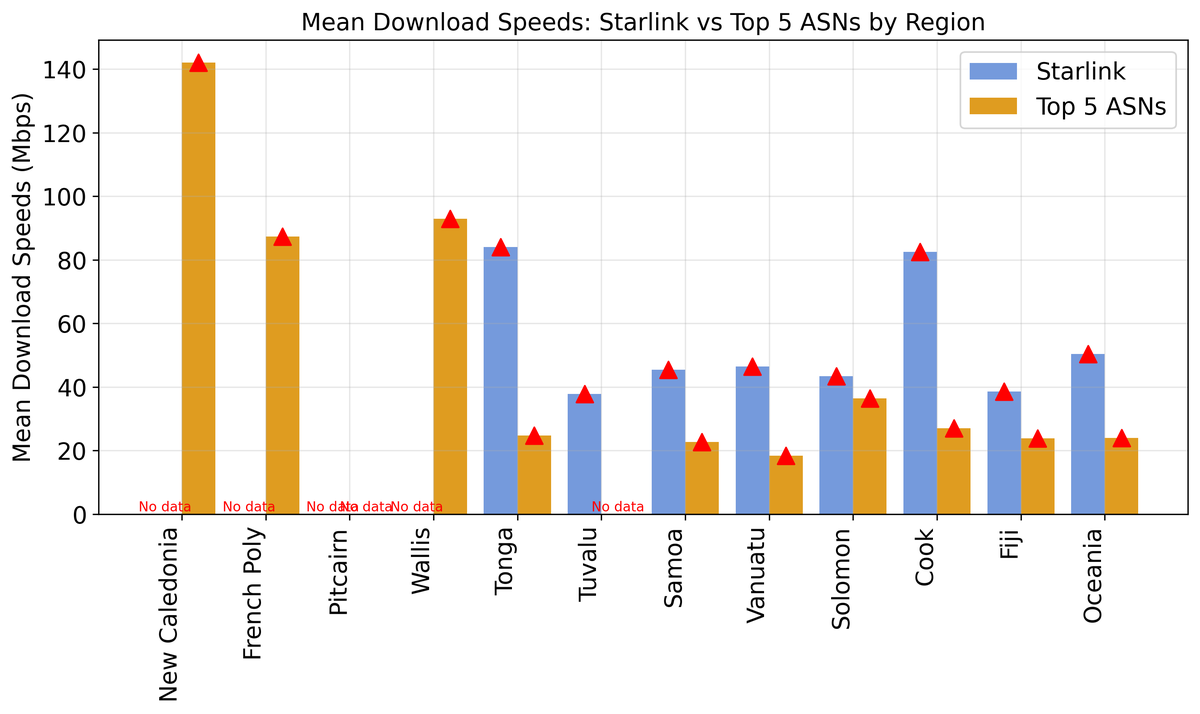
In rural Haiti, devastated by recent hurricanes and floods that disrupted cell networks, Starlink offered lower latency (~50 ms) than local providers and remained reliable when terrestrial networks failed. In these underserved regions, Starlink genuinely bridges connectivity gaps.
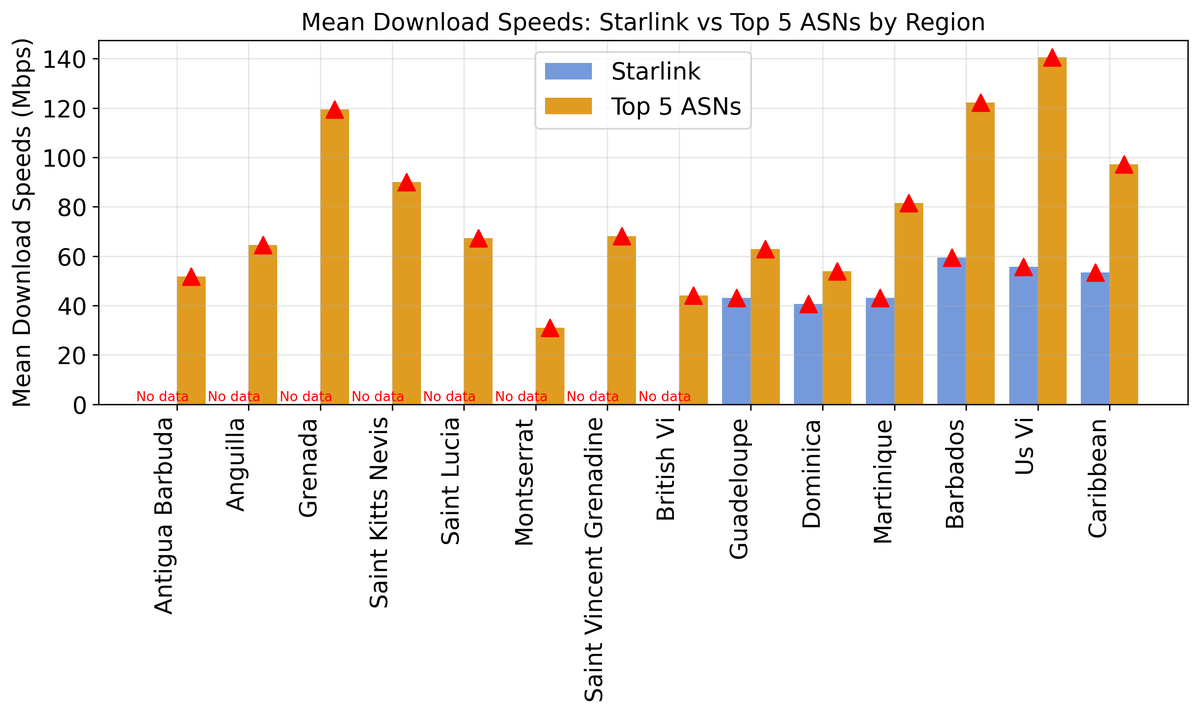
Starlink Struggles in Well-developed Markets
In the Caribbean, African, and Hawaiian islands, where established fiber and cable networks are in place, Starlink consistently underperforms. Average download speeds lag by 50–100 Mbps, and latency is often double that of incumbent providers. In Madagascar and Réunion, Starlink averaged only 25 Mbps compared with 150 Mbps for local ISPs—a significant gap that undermines its competitiveness.
High Latitudes Remain Challenging
Alaska and remote Canada show modest gains from Starlink. While it performs comparably to terrestrial providers, it hasn't delivered the dramatic improvements seen in other regions, partly because Starlink's satellite constellation is concentrated at mid-latitudes, leaving polar regions with sparser coverage.
Starlink's Inter-satellite Routing Adds Complexity
In places like Réunion and Haiti, traffic doesn't exit to the nearest local gateway; instead, it travels via satellite links to distant data centers in Europe or North America, adding delay. This routing decision sometimes backfires—measurements to nearby servers showed higher latency than routing to distant European hubs. In other cases, like Haiti, this same approach kept latencies competitive.
Read: LEO Satellite Internet Latency Varies Dramatically Depending on Where You Are in the World
Looking Forward
Policymakers considering Starlink subsidies should recognize that it works best as a complement to terrestrial broadband, not a replacement for it. In remote islands with no fiber, Starlink is transformative. In competitive markets with existing infrastructure, it offers little advantage. Funding decisions should prioritize regions truly lacking alternatives.
Beyond performance, our analysis revealed a blind spot: crowdsourced measurement platforms (like those run by Google and Cloudflare) often miss critical real-world deployments. During Hawaii's 2023 wildfires, over 500 Starlink terminals were deployed to emergency responders, yet no measurement data were captured, revealing that speed-test data alone cannot assess Starlink's role in disaster recovery.
Read: Are LEO Networks the Future of National Emergency Failovers?
Starlink is still in its early phases, especially in rural areas. Equipment costs remain high, and adoption is modest. As the constellation matures and more ground infrastructure is built, performance may improve.
The immediate takeaway: for rural connectivity decisions, Starlink's value depends entirely on what alternatives exist. Where it's truly a first option, it delivers real gains.
Read our TPRC paper to learn more about our method and results.
Contributor: Arthur Berger
Vasanta Chaganti is an Associate Professor in the Computer Science Department at Swarthmore College. Her interests are in Internet Measurement, LEO Satellites, Internet Policy, and Secure and Private Network Architectures.
The views expressed by the authors of this blog are their own and do not necessarily reflect the views of the Internet Society.