
When Routes Speak Politics: How Geopolitical Tensions Shape the Internet

In short
- A 2025 Pulse Research Fellowship study develops a new framework to systematically measure geopolitical effects on Internet connectivity.
- The framework enables users to understand when the Internet “breaks” due to conflict or sanctions and how countries reconfigure their digital ties in response.
- For governments, regulators, and civil society, these findings underscore the importance of monitoring the Internet as an early-warning system.
The Internet is often described as a borderless network. In practice, however, it reflects the political realities of our world. Wars, sanctions, and international disputes don’t just play out in newspapers and on the battlefield—they also leave visible marks on the way our networks interconnect, route traffic, and access online services.
As part of my 2025 Pulse Research Fellowship, I set out to measure these impacts. By looking at how Internet connections between countries evolve during times of crisis, we found that the “geopolitics of connectivity” can be tracked systematically. This matters not just for engineers, but for anyone concerned with how resilient, open, and secure the Internet remains under political pressure.
From Borders to Routers: How We Measure Geopolitics Online
To understand these effects, we developed a set of indices that captured different dimensions of cross-border connectivity:
- Peering index: measures how many networks from one country are physically present at Internet Exchange Points (IXPs) or facilities in another country. Data is sourced from PeeringDB snapshots enriched with CAIDA’s AS-to-Organization dataset. This shows how operators’ willingness to interconnect shifts over time (TMA study).
- Dependency index: captures how much one country relies on another’s networks to carry its Internet traffic. It is based on AS hegemony metrics from the Internet Health Report. By mapping each AS to a country, we can track how routing dependencies evolve around political events.
- Security index: monitors the frequency of routing incidents, such as hijacks, that occur between countries. It combines results from GRIP (Georgia Tech’s Global Routing Intelligence Platform) and DFOH (a forged-origin detection system). Both rely on route collector data, which is flagged and mapped to countries using CAIDA’s datasets.
- Accessibility index: assesses whether websites (including media and government) hosted in one country remain accessible in another. It uses measurements from the OONI project, which runs probes in volunteer networks worldwide. Visible drops in accessibility often line up with political crises.
- Trade index (contextual): draws on UN Comtrade Plus statistics to measure shifts in import and export flows. While not strictly a network metric, trade volumes provide important economic context that helps interpret technical ruptures.
These measures enable us to see not just when the Internet “breaks” due to conflict or sanctions, but also how countries reconfigure their digital ties in response.
A Case Study: Russia and Ukraine
When Russia invaded Ukraine in February 2022, the negative effects were visible in both the physical and digital worlds.
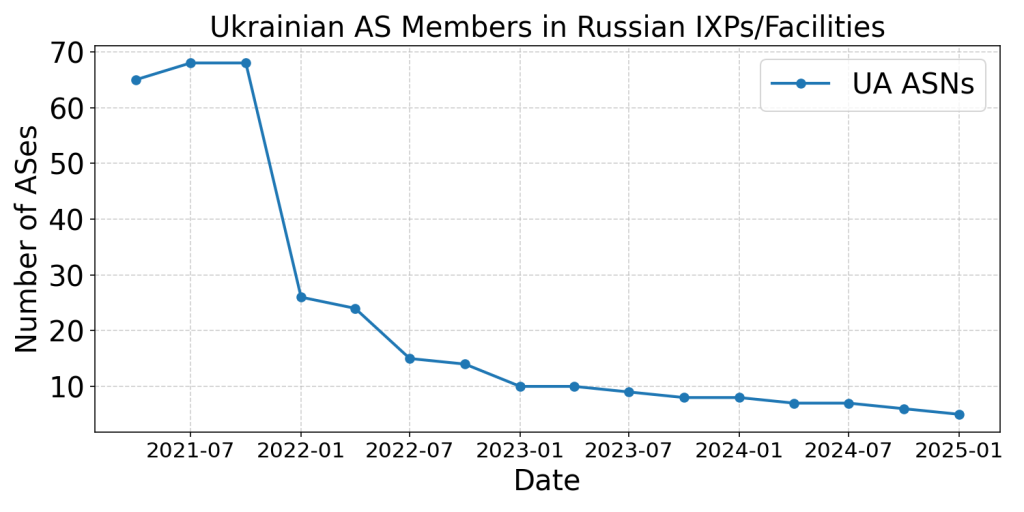
In the peering index, the number of Ukrainian networks participating in Russian IXPs and facilities decreased by approximately 85%, with the decline beginning even before the invasion(Figure 1).
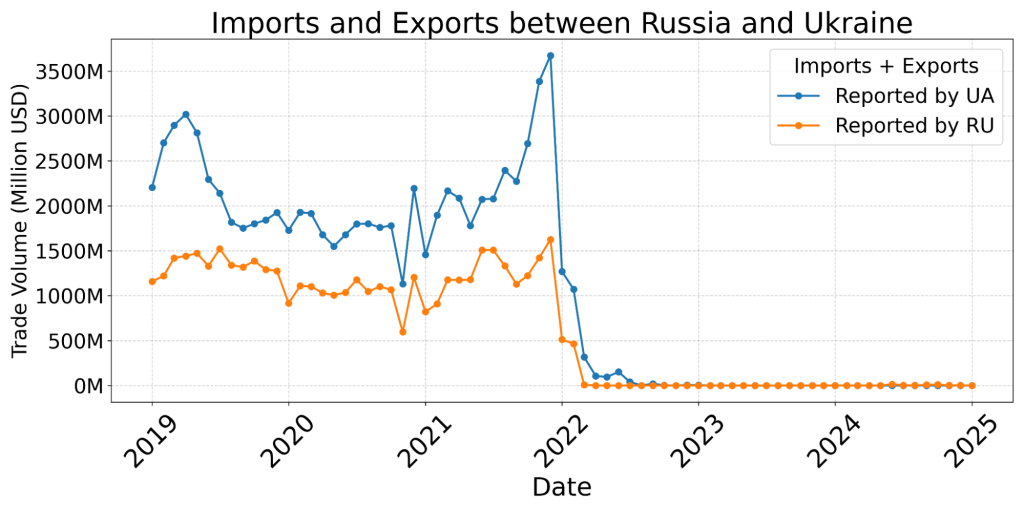
At the same time, reported trade volumes between the two countries collapsed—from roughly €1.2 billion in imports to almost zero (Figure 2).
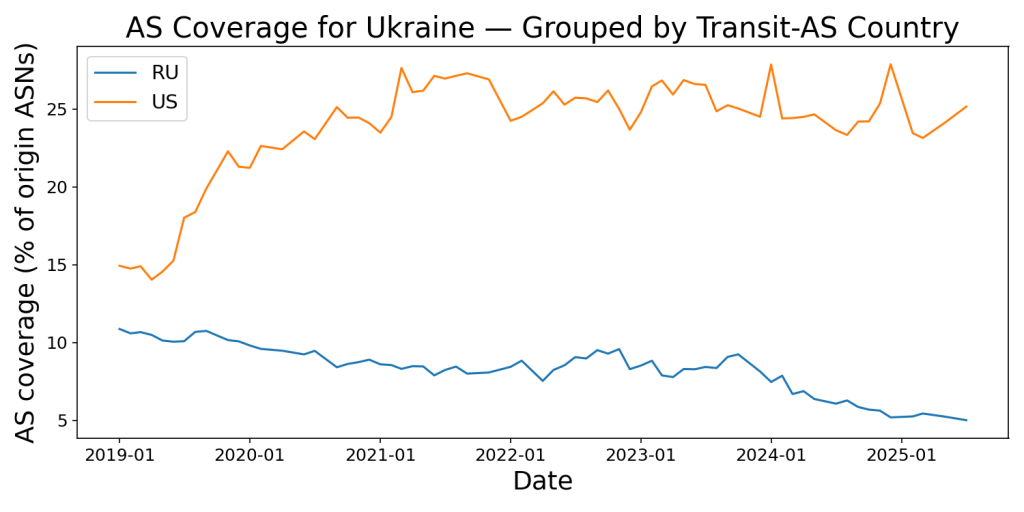
The dependency index (Figure 3) shows limited variation, since Russia and Ukraine were never heavily reliant on each other for international routing. Still, consistent with independent analyses such as Kentik’s report, Ukrainian networks gradually reduced their reliance on Russian transit—from around 10% to 5% over six years—while temporary rerouting during the conflict caused brief fluctuations in connectivity. Together, these patterns reflect both a long-term decoupling and short-term disruptions driven by geopolitical events.
The security and accessibility indices remain under development. Future work will extend these analyses to additional country pairs and case studies to validate how consistently these indices capture geopolitical shocks.
The Internet is not Separate From Politics
The visible parallel drops in Ukraine and Russia illustrate how geopolitical shocks manifest across both technical interconnection and economic exchange. The Internet, in other words, is not separate from politics—it is part of the same system.
Understanding the Internet as a geopolitical space has important policy implications in regards to:
- Resilience: When conflict disrupts cross-border peering, countries may become more dependent on a smaller set of partners, raising questions about security and vulnerability.
- Trust and Security: In times of crisis, hijack attempts and routing instability often rise, showing that technical trust is not immune to political strain.
- Economic Signals: Aligning network metrics with trade data reveals how economic and digital ties rise and fall together.
For governments, regulators, and civil society, these findings underscore the importance of monitoring the Internet as an early-warning system. A sharp drop in cross-border connectivity may be the first visible sign of political escalation—or the quiet outcome of sanctions and diplomatic breakdowns.
Looking Ahead
While our Russia–Ukraine case study offers a vivid example, the same framework can be applied worldwide. By systematically tracking how networks interconnect across borders, we can detect shifts in alliances, vulnerabilities, and points of fragmentation.
The takeaway is simple: the Internet is political, and its resilience depends on how we manage those politics. Keeping it open, reliable, and secure requires not only technical safeguards but also a recognition of its role within the global geopolitical landscape.
Antonis Chatzivasiliou is a 2025 Pulse Research Fellow and PhD candidate at the University of Crete, focusing on Internet measurement, BGP, and AS-level relationships.
The views expressed by the authors of this blog are their own and do not necessarily reflect the views of the Internet Society.