

How Much Mobile Competition Is Just Right?

In short
- Mobile markets with too few or too many operators can leave consumers worse off.
- A new game-theoretic model shows that consumer benefits peak at a sweet spot in the number of firms that depends on market size, spectrum, investment efficiency, and user usage.
- Regulators should weigh price competition against scale-driven quality gains rather than a specific operator count.
Is more competition always better? Classic industrial-organization theory says “yes”, but the real world of mobile networks is messier.
Congestion, spectrum scarcity, and billion-dollar infrastructure costs can flip the script. Our recent study on “The Right Amount of Competition in Mobile Telecommunications” builds a Cournot-style model that lets service providers decide how many customers to serve and how much to invest in capacity. The result: consumer welfare rises with entry... Until it doesn’t.
When “More” Starts to Hurt
Two opposing forces impact mobile competition:
- Price pressure. Extra entrants undercut prices, widening access.
- Quality squeeze. Slimmer margins discourage investment, so latency and service quality suffer, especially once spectrum is sliced too thin.
Our simulations (Figure 1) reveal a tipping point: beyond a critical number of firms (n*), the quality loss from underinvestment and spectrum scarcity outweighs the price gains. Consumer surplus then falls as yet more operators join.
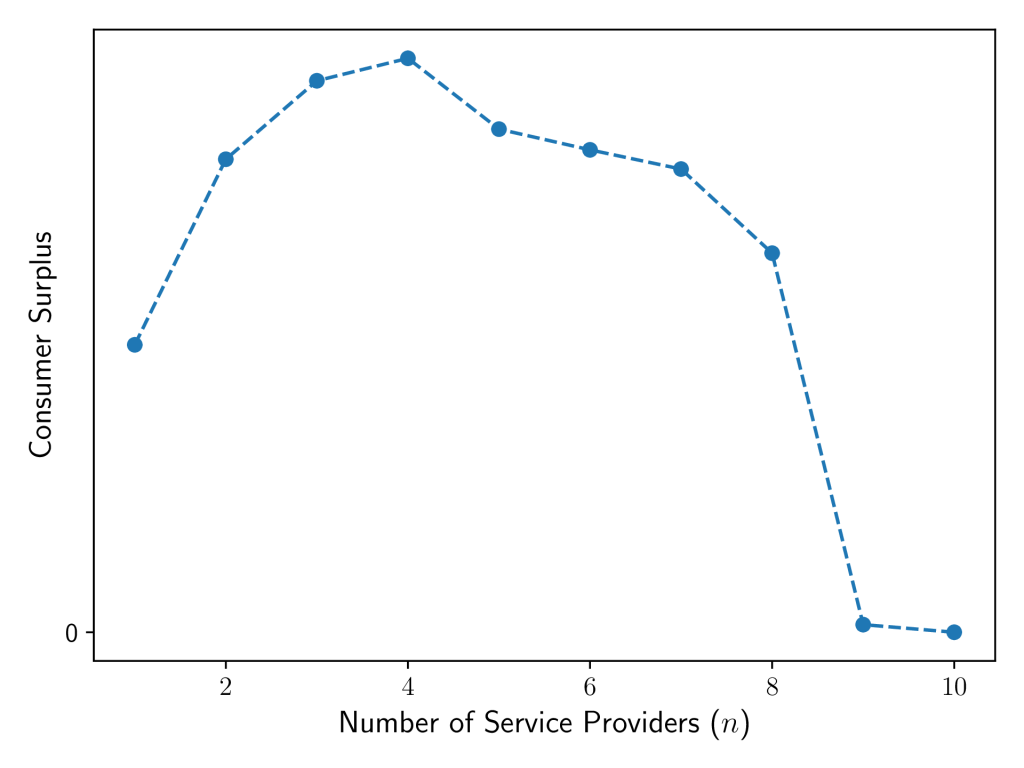
The optimal n* is not one-size-fits-all. It usually rises with:
- Market size. Bigger demand can profitably support more operators.
- Spectrum supply. A larger total MHz pile can be split without creating crippling congestion.
- Investment efficiency. The higher the payoff per dollar spent, the less harmful competitive “over-splitting” becomes.
However, n* tends to decline when the average per-user service demand (S) rises or when spectrum is scarce. Because the model’s parameters interact, bumping up one may push n* higher, or lower, depending on the values of the others.
Implications for Regulators
Regulators play an important role in balancing this competition. Our model can help them in this respect, to:
- Identify rigid caps. Blanket limits on spectrum holdings may block scale economies that translate into improved performance.
- Scrutinize both extremes. In markets crowding past n*, selective mergers or spectrum rebalancing can boost welfare. Where monopolies linger, entry facilitation still matters.
- Use data, not dogma. Our linear and decision-tree surrogates turn complex model outputs into quick “how many firms are enough?” guidelines for case-by-case review.
Pinpointing the Goldilocks Zone is Tricky
Hitting the sweet spot and allocating spectrum sensibly can give consumers lower prices and better service. However, pinpointing that Goldilocks zone is tricky because the optimal number of Service Providers depends on market size, spectrum supply, investment costs, and other market-specific fundamentals.
Our initial work considered a stylized model for competition and investment using generic values for various parameters. Fitting these parameters to actual market settings is an important direction for future work.
Martial Felix is a PhD candidate in the Department of Electrical and Computer Engineering at McCormick School of Engineering at Northwestern University.
Contributors: Randall Berry, Northwestern University.
The views expressed by the authors of this blog are their own and do not necessarily reflect the views of the Internet Society.