

Blast-Off: 3.5 Years of Starlink's Growth (Part 2)

In short
- The Starlink IP geolocation file, offers a fascinating lens into the global expansion and operational shifts of SpaceX's satellite Internet service.
- The data also shows the use of the service in isolated and disputed territories, and even other planets.
- Explore 42 months of Starlink’s IP geolocation data and observing how the entries have grown over time.
In my first post in this two-part series, I examined how Starlink's IP geolocation dataset expanded over 3.5 years — growing from entries in 41 countries to 169. Here, in Part 2, we’ll dig into some of the more intriguing records that have appeared in those files. You’ll also find an interactive visualization of the full dataset at the end of the post.
Before diving in, let’s quickly review the dataset. (If you’ve already read this in Part 1, feel free to skip ahead.)
What is the Starlink IP geolocation file?
An IP geolocation file is simply a CSV file containing the self-reported geolocations of the IP ranges originated by a network, as defined by RFC 8805. Each line represents an entry consisting of four fields: IP prefix range, two-letter country code, region code, and city label.
This is an example line:
129.222.112.0/24,CA,CA-MB,Winnipeg,Which can be interpreted as:
Prefix: 129.222.112.0/24
Country: CA
Region: CA-MB
City: Winnipeg
When Starlink user terminals (also known as Dishy McFlatface antennae) connect to the Internet, they are assigned an IP address (or, in the case of residential users, a CGNAT-Gateway bearing such) that corresponds to their location in the IP geolocation file. This ensures that Starlink users are provided appropriate access to geofenced online media and receive the appropriate language localization for international websites, such as www.google.com.
Starlink users communicate with the Internet by either having their signal relayed back to a ground station within the footprint of the satellite(s) they are connecting to, like traditional bent-pipe satellite Internet, or use optical inter-satellite laser links (OISL) to hop from one satellite to another, traversing space until coming down at a faraway ground station. Starlink is the first large-scale satellite operator to employ OISLs.
Lastly, these entries can also be placeholders for future locations. For example, at the time of this writing, Starlink has not yet been authorized for use in India, yet there have been entries for Mumbai in the IP geolocation file for the entire duration of the analysis period.
2406:2d40:a000::/40,IN,IN-MH,Mumbai,Having said all that, the contents of Starlink’s IP geolocation file tell the story of this singular Internet modality’s evolution over time. Now, more than three and a half years after we began recording this data, it’s time for it to tell us its stories.
Notable IP Geolocation Entries
With definitions out of the way, let’s dive into a few notable highlights we observed in this data set, beginning with the interstellar.
Mars (30 November 2022)
Near the end of November 2022, Starlink suffered a platform-wide outage. Although the outage lasted under two hours, the restoration of service coincided with the publication of a significantly different IP geolocation file, which included numerous new entries.
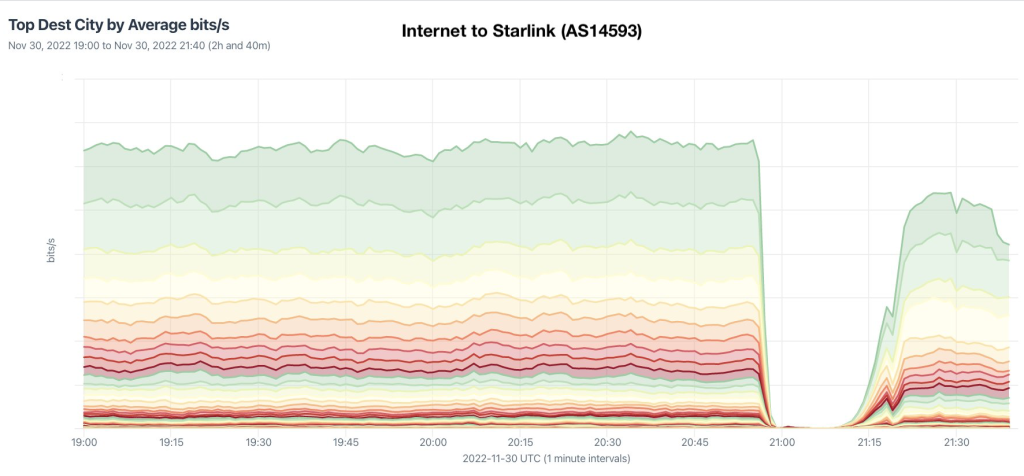
The most eyebrow-raising addition to the file was a new entry for the planet Mars:
98.97.73.224/27,XX,XX-XY,Mars,Sending a human to the red planet has long been a dream of Elon Musk. And to communicate with our future Martian colony, he has proposed creating a satellite-based relay network called Marslink.
Only time will tell if Marslink ends up using one of these IP addresses. The Mars entry was removed when a revised IP geolocation file was published a couple of hours later.
Israel and the Palestinian Territories (first appeared 29 October 2023 and 28 November 2023)
Following the 7 October attacks by Hamas, Israel’s military campaign in Gaza caused extensive damage to the infrastructure of the coastal territory. Communications outages became frequent, leaving many residents disconnected from the outside world.
As calls mounted for help restoring connectivity during one of Gaza’s Internet blackouts, Mr Musk posted on X on 28 October that Starlink would be activated in Gaza for the first time “to support internationally recognized aid organizations in Gaza.”

The offer was met with fierce protestation from the Israeli Minister of Communications, who responded, “Israel will use all means at its disposal to fight this.” The Oslo Accords (see Oslo II, Annex III, Article 36 “Telecommunications”) effectively granted Israel control over core utilities in Gaza, including power, water, and telecommunications. All Internet connections between Gaza and the outside world must run through Israeli infrastructure. Starlink would potentially circumvent that restriction. At that point in time, the Israeli government had not authorized Starlink for use in either Israel or the Palestinian Territories.
The dispute briefly played out on social media but was ultimately resolved behind closed doors after Mr Musk made a trip to Israel to tour Israeli towns that had been attacked. On 29 November 2023, Starlink announced that it had reached an agreement to offer satellite Internet service to Gaza under the supervision of the Israeli government. Service would also become available in Israel.
But before all of that happened—before Musk’s tweet and the Israeli minister’s rebuttal, before the trip to Israel and the Starlink agreement with the Israeli government—the first entries appeared in Starlink’s IP geolocation file for Israel at the beginning of the day on 19 October 2023 (two additional entries were added on 22 May 2025).
216.128.14.0/24,IL,IL-JM,Jerusalem,
216.128.14.0/24,IL,IL-JM,Jerusalem,
2a0d:3344:17c0::/42,IL,IL-JM,Jerusalem,
This may have been in anticipation of a favorable outcome from ongoing discussions with the Israeli government. However, a recent WIRED report noted that a prominent Silicon Valley investor claimed to have personally intervened to secure Starlink access for the Israeli military in the days after the 7 October attacks.
Regardless, on 29 November 2023, early in the day, following the announcement of the agreement with Israel, five new entries appeared, labeled as being located in Ramallah, in the West Bank of the Palestinian territories.
216.128.20.0/25,PS,PS-RBH,Ramallah,
216.128.20.128/25,PS,PS-RBH,Ramallah,
216.128.21.0/26,PS,PS-RBH,Ramallah,
216.128.21.64/26,PS,PS-RBH,Ramallah,
2a0d:3341:b040::/42,PS,PS-RBH,Ramallah,
As of 21 January 2025, the Palestinian Territories are represented by three entries (two IPv4 and one IPv6) after 216.128.21.128/25 was reassigned from Amsterdam to Ramallah.
216.128.20.0/24,PS,PS-RBH,Ramallah,
216.128.21.0/24,PS,PS-RBH,Ramallah,
2a0d:3341:b040::/42,PS,PS-RBH,Ramallah,
According to public reports, Starlink has only been activated at the UAE-funded field hospital in Rafah in the southern part of the strip.
Antarctica (first appeared 30 November 2022)
Antarctica—perhaps the most remote location on planet earth—now has Starlink service. In fact, Starlink has a helpful page on its website explaining how to order service from this polar continent. Entries first appeared in the IP geolocation file on 30 November 2022 at 20:00 UTC (the IPv4 entries were later removed on 29 September 2025).
103.152.127.0/25,AQ,AQ-AQ,Antarctica,
103.152.127.128/26,AQ,AQ-AQ,Antarctica,
103.152.127.192/26,AQ,AQ-AQ,Antarctica,
2406:2d40:4500::/42,AQ,AQ-AQ,Antarctica,
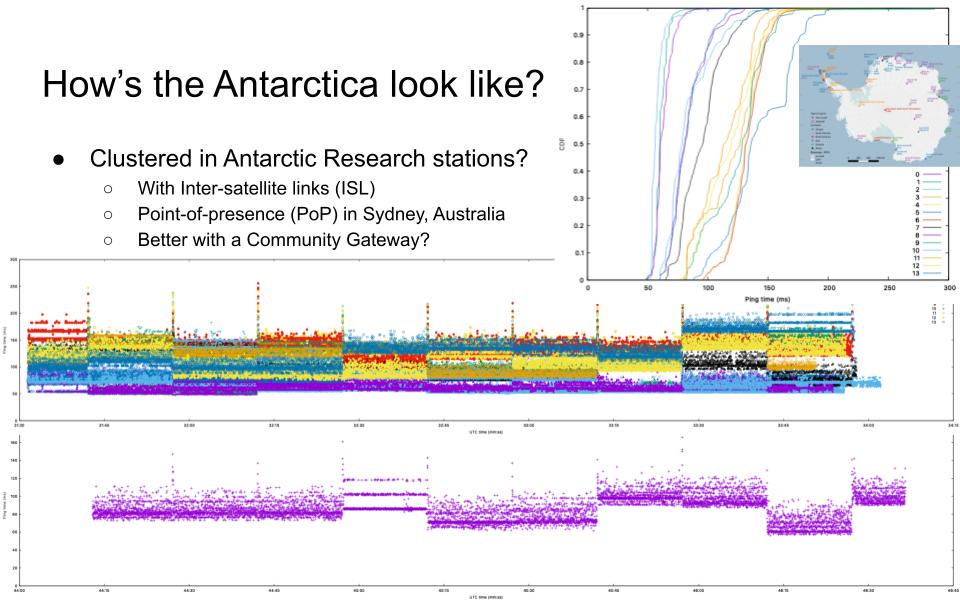
Dr. Jianping Pan at the University of Victoria analyzes low-earth-orbit (LEO) satellite performance and recently published the following slide (Figure 3) on his latency measurements from the frozen continent. Visible in the graphic are the frequent changes in latency as the terminals switch from one satellite to another during an inter-satellite voyage to the Starlink ground station in Sydney, Australia.
Cape Canaveral and Starbase (first seen 25 October 2024 and 31 December 2024)
Located on Florida’s Atlantic coast, Cape Canaveral hosts the Kennedy Space Center, a popular launch site for SpaceX rockets. The SpaceX Starbase is a rocket manufacturing and launch facility that serves as the main testing and production location for the ambitious aerospace company.
As such, these important locations received their own entries in the IP geolocation file last year:
129.224.223.0/24,US,US-FL,Cape Canaveral,
2605:59c7:f082::/48,US,US-FL,Cape Canaveral,
2605:59c7:f009::/48,US,US-TX,Starbase,
Pristina, Kosovo (first appeared 20 October 2024)
Kosovo declared its independence from Serbia in 2008 and enjoys recognition from only 108 out of 193 United Nations member states. Kosovo’s independence is, most notably, not recognized by Serbia, which considers Kosovo to be an autonomous province of its country.
Kosovo first appeared in Starlink’s IP geolocation file in October 2024 using the country code “XK.” Considered to be a “user-assigned” ISO 3166 code for Kosovo, XK doesn’t appear in the official standard.
212.105.144.64/26,XK,XK-XK,Pristina,
212.105.144.128/26,XK,XK-XK,Pristina,
212.105.144.0/27,XK,XK-XK,Pristina,
212.105.144.32/27,XK,XK-XK,Pristina,
212.105.144.192/27,XK,XK-XK,Pristina,
212.105.144.224/27,XK,XK-XK,Pristina,
2a0d:3344:3840::/42,XK,XK-XK,Pristina,
Within a few hours, the country code was changed to be “RS” for the Republic of Serbia and the region code to RS-KM for the Autonomous Province of Kosovo and Metohija (APKM).
212.105.144.64/26,RS,RS-KM,Pristina,
212.105.144.128/26,RS,RS-KM,Pristina,
212.105.144.0/27,RS,RS-KM,Pristina,
212.105.144.32/27,RS,RS-KM,Pristina,
212.105.144.192/27,RS,RS-KM,Pristina,
212.105.144.224/27,RS,RS-KM,Pristina,
2a0d:3344:3840::/42,RS,RS-KM,Pristina,
On 2 October 2025, the IP address space that was assigned to Pristina was reassigned to Kukës, Albania, approximately 100km to the southwest. Perhaps the ethnic Albanians in Kosovo would have been better served by having their Internet connection localized to Albania rather than Serbia.
212.105.144.64/26,AL,AL-07,Kukes,
212.105.144.128/26,AL,AL-07,Kukes,
212.105.144.0/27,AL,AL-07,Kukes,
212.105.144.32/27,AL,AL-07,Kukes,
212.105.144.192/27,AL,AL-07,Kukes,
212.105.144.224/27,AL,AL-07,Kukes,
2a0d:3344:3840::/42,AL,AL-07,Kukes,
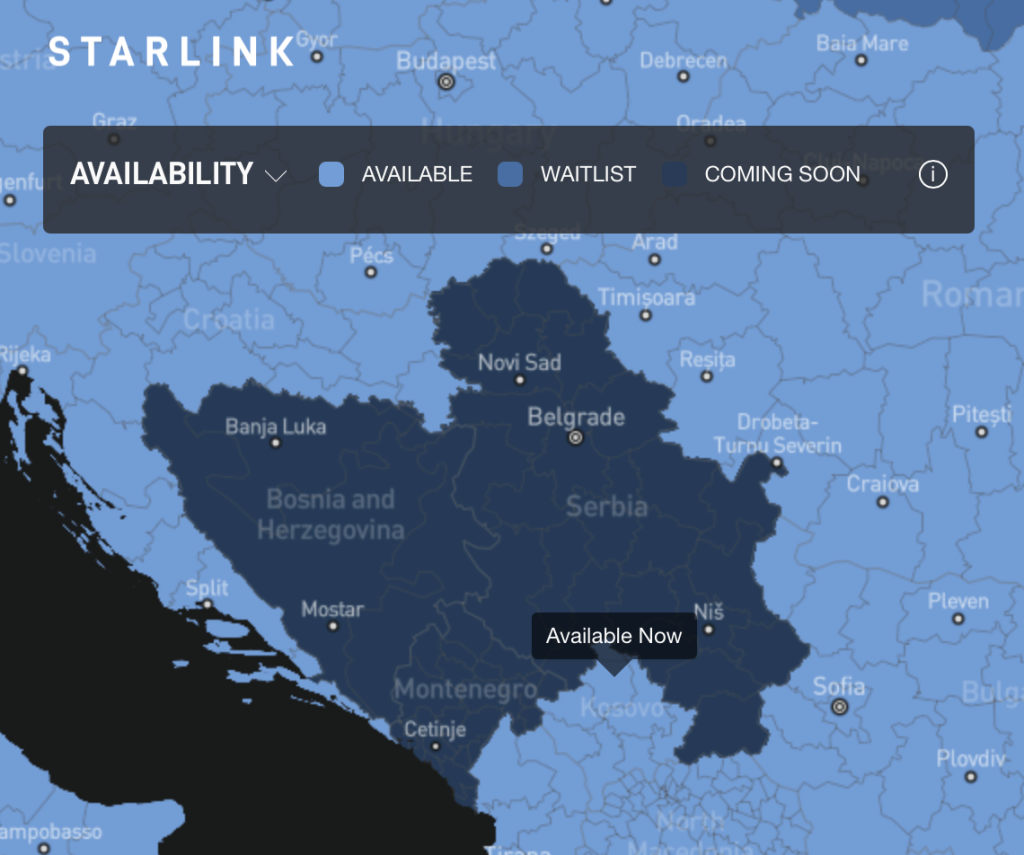
Starlink announced the activation of its service in Kosovo on 21 December 2024. Despite the previous use of the Serbia-friendly “RS-KM” region code, Starlink’s Availability Map differentiates Kosovo (marked as “Available Now”) from Serbia (marked as “Starting in 2025”), as shown in Figure 4.
Nauru (first appeared 6 November 2024)
Back in March, I wrote about the emergence of Starlink’s new Community Gateways—a new configuration of Starlink that allows the service to act as a transit provider to local Internet service providers, typically in remote locations.
In December 2024, the Central Pacific island nation of Nauru unveiled its new Starlink Community Gateway installation. For a cost of $1.25 million (and a monthly recurring fee of $75,000 per Gbps), this new service is expected to begin a new era of high-speed Internet service for the 12,000 residents of the world’s third-smallest country.
As was first reported in January by the Megaconstellations X account, the activation of the new service in Nauru was reflected in BGP when Nauruan state-owned Cenpac Net (AS55722) became Starlink’s first customer AS. The BGP visualization below shows a route originated by AS55722 migrating its transit to Starlink (AS14593) on January 12, 2025, at 02:50 UTC.
The following IP geolocation entries for Nauru appeared in November 2024, weeks ahead of the activation:
116.91.214.0/27,NR,NR-14,Yaren,
116.91.214.128/26,NR,NR-14,Yaren,
116.91.214.192/27,NR,NR-14,Yaren,
116.91.214.224/27,NR,NR-14,Yaren,
116.91.214.32/27,NR,NR-14,Yaren,
116.91.214.64/26,NR,NR-14,Yaren,
2406:2d40:4c80::/42,NR,NR-14,Yaren,
2406:2d40:75c0::/42,NR,NR-14,Yaren,
Myanmar, Sudan, and Venezuela (first seen April 2025)
The countries of Myanmar, Sudan, and Venezuela each appeared in the Starlink IP geolocation file around the same time in April 2025. Venezuela first appeared on 14 April, and Myanmar and Sudan simultaneously on 18 April. A curious development, as the latter countries are locked in protracted civil wars and all three are subject to varying degrees of international sanctions. According to its availability map, Starlink isn't yet available in any of these countries.
143.105.146.0/24,VE,VE-A,Caracas,
143.105.147.0/24,VE,VE-A,Caracas,
2803:9810:5600::/40,VE,VE-A,Caracas,

129.224.202.0/24,MM,MM-06,Yangon,
129.224.203.0/24,MM,MM-06,Yangon,
135.129.126.0/25,MM,MM-06,Yangon,
135.129.126.128/25,MM,MM-06,Yangon,
143.105.55.0/25,MM,MM-06,Yangon,
143.105.55.128/25,MM,MM-06,Yangon,
2406:2d40:8180::/41,MM,MM-06,Yangon,
2406:2d40:3540::/42,MM,MM-06,Yangon,

98.97.77.0/25,SD,SD-KH,Khartoum,
98.97.77.128/25,SD,SD-KH,Khartoum,
98.97.158.0/25,SD,SD-KH,Khartoum,
98.97.158.128/25,SD,SD-KH,Khartoum,
98.97.183.0/25,SD,SD-KH,Khartoum,
98.97.183.128/25,SD,SD-KH,Khartoum,
98.97.191.0/25,SD,SD-KH,Khartoum,
98.97.191.128/25,SD,SD-KH,Khartoum,
143.105.75.0/25,SD,SD-KH,Khartoum,
143.105.75.128/25,SD,SD-KH,Khartoum,
2a0d:3341:e000::/40,SD,SD-KH,Khartoum,
2a0d:3344:1300::/40,SD,SD-KH,Khartoum,
2c0f:2a80:3000::/40,SD,SD-KH,Khartoum,
Additionally, the IPv4 address space assigned to Sudan was previously assigned to Togo. The IPv4 address space assigned to Myanmar was previously assigned to Tanzania. There are presently no IPv4 entries for either Togo or Tanzania.
What More Can We And You Learn: Explore the Data
The Starlink IP geolocation file, a seemingly simple CSV document, offers a fascinating lens into the global expansion and operational shifts of SpaceX's satellite Internet service.
Our three and a half years of diligently collecting and analyzing these snapshots have revealed a dynamic narrative, from the critical role Starlink played in Ukraine's Internet resilience to its cautious yet persistent expansion into politically sensitive regions, such as the Palestinian Territories, Kosovo, Myanmar, and Sudan. The ephemeral appearance of "Mars" and the strategic establishment of "Community Gateways" further underscore Starlink's ambitious vision and its evolving service model.
The growth in both IPv4 and IPv6 entries, coupled with the changing prefix sizes, clearly indicates Starlink's increasing network sophistication and its efforts to accommodate a rapidly expanding user base across diverse geographical locations. The distinct daily patterns of file updates also suggest a centralized and orchestrated approach to network management.
This initial exploration has highlighted several key events and trends embedded within the IP geolocation data. However, the true depth of its story lies in a more comprehensive, ongoing analysis. As we continue to track these changes, future installments of this series will delve deeper into specific regional developments, geopolitical implications, and the technical evolution of Starlink, offering a richer understanding of this groundbreaking Internet modality and its impact on global connectivity.
Until then, use the visualization below to explore 42 months of Starlink’s IP geolocation data by clicking on a region of the world and observing how the entries have grown over time. Each region includes a set of graphs for unique IPv4 hosts and total IPv6 entries, a description of the data, as well as a table comparing the date when the first entry was observed for each country with the date when service was announced, based on the best available information.
Doug Madory is an Internet infrastructure analyst known for his detailed research into global network connectivity, BGP routing behavior, and large-scale Internet disruptions.
The views expressed by the authors of this blog are their own and do not necessarily reflect the views of the Internet Society.
Photo of Starlink antenna deployed at a research facility in Allan Hills, Antarctica, Via X.