Service blocking
Discord, Facebook, Facebook Messenger, Instagram, LinkedIn, Reddit, Signal, Snapchat, Telegram, Threads, Twitter (X), WeChat, WhatsApp, YouTube
The Nepal Ministry for Communication and Information Technology (MoCIT) ordered the Nepal Telecommunication Authority (NTA) to make unregistered social media sites inactive until they are registered in Nepal under the Social Media Directives 2080.
- Total Duration 5 days, 6 hours
 Nepal
Nepal
- Population
- 29,651,054
- UN Classification
-
- Least Developed Country
- Land Locked Developing Country
Local impact
The directive follows the MoCIT's setting a seven-day deadline for 26 foreign and domestic platforms to register, which expired at midnight on Thursday, 4 September. The platforms included: Facebook, Facebook Messenger, Instagram, YouTube, WhatsApp, Twitter (X), LinkedIn, Snapchat, Reddit, Discord, Pinterest, Signal, Threads, WeChat, Quora, Tumblr, Clubhouse, Mastodon, Rumble, MeWe, VK, Line, IMO, Zalo, Soul, and Hamro Patro.
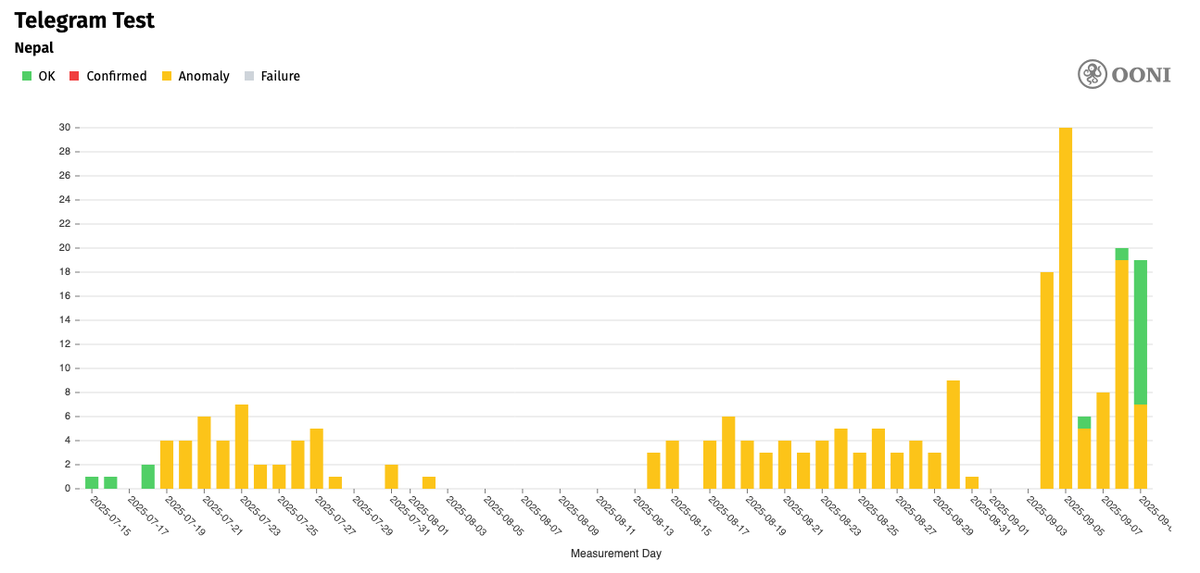
The government had previously ordered the NTA to instruct local Internet service providers to block Telegram (18 July 2025).
According to reports, of the 26 social media platforms that were issued the orders, TikTok, Viber, Nimbuzz, WeTalk, and Poppo Live were the only ones to complete the registration, and Telegram and GlobalLink were still in the registration process.
Protests Lead to Government Suspending Ban
Protestors took to the streets of Kathmandu on Monday, 8 September, to voice their opposition to the bans and anger towards the government over “corruption and a weak economy.” The resulting unrest and letters of petition from the community led the Ministry to backtrack on its orders on Tuesday, 9 September.
Related documentation
The Ministry of Communication and Information Technology under the Government of Nepal introduced Directives for Managing the Use of Social Media, 2080 (2023) (“Social Media Directives”) through publication in the Nepal Gazette dated 27 November 2023. The Social Media Directives establish a regulatory framework for the operation, oversight, and compliance of social media platforms within Nepal.
Any individual, company, or organization intending to operate a social media platform must enlist with the Ministry of Communication and Information Technology (“Ministry”). If the social media platform fails to enlist, the Ministry can prohibit such platforms from operating within Nepal. Learn more.
After nearly two years of asking social media platorfms to register, the Ministry ordered the Nepal Telecommunication Authority to issue the following directive on 28 August 2025 to register before midnight 4 September 2025 or else be banned from being accessed in the country.
🚨BIG: Nepal Telecommunications Authority has issued a directive requiring nearly all major social media platforms including Facebook, Instagram, WhatsApp, YouTube, X (Twitter), LinkedIn, Snapchat, Reddit, Discord and more to register locally in #Nepal. pic.twitter.com/o0t6btJMwu
— VAISHNAV 🇮🇳 (@VaishnavSharan7) September 5, 2025
Other supporting information
OONI's Web Connectivity Test shows anomalies connecting to the most popular banned social media services.
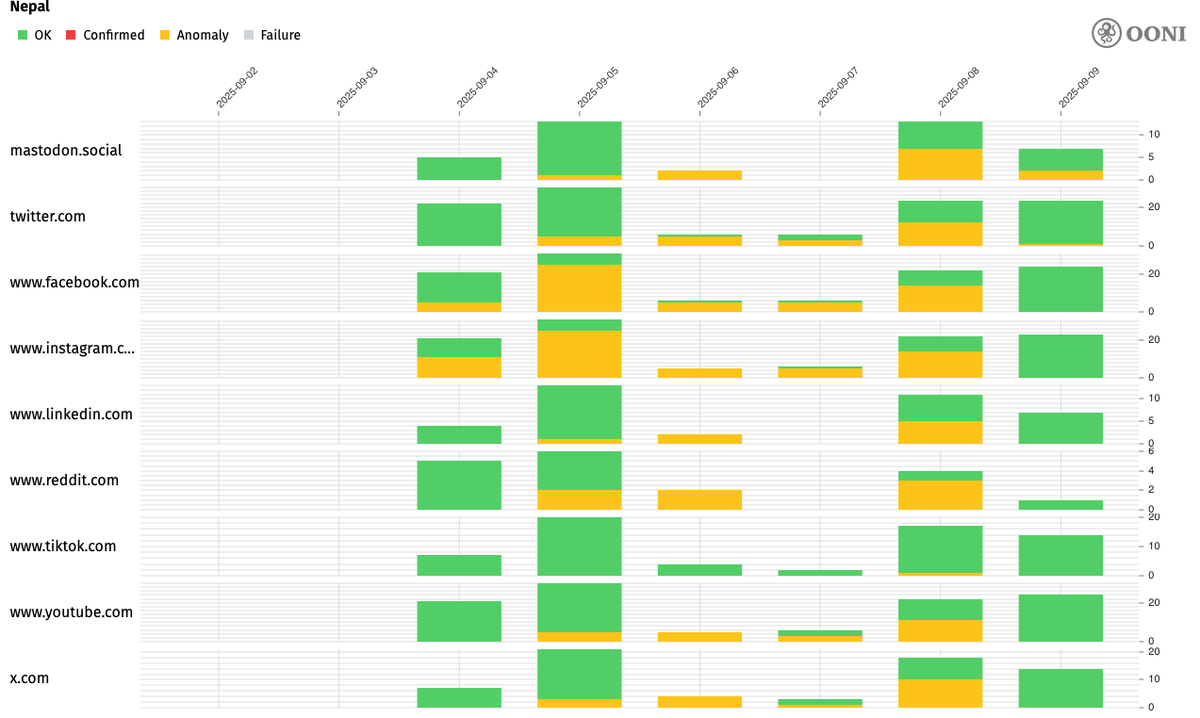
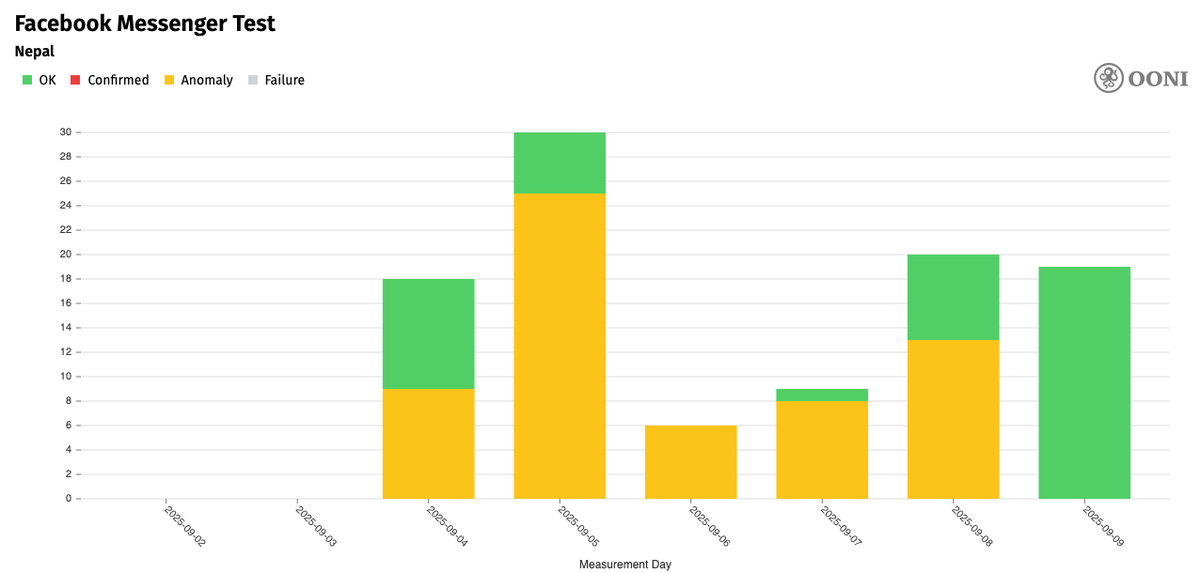
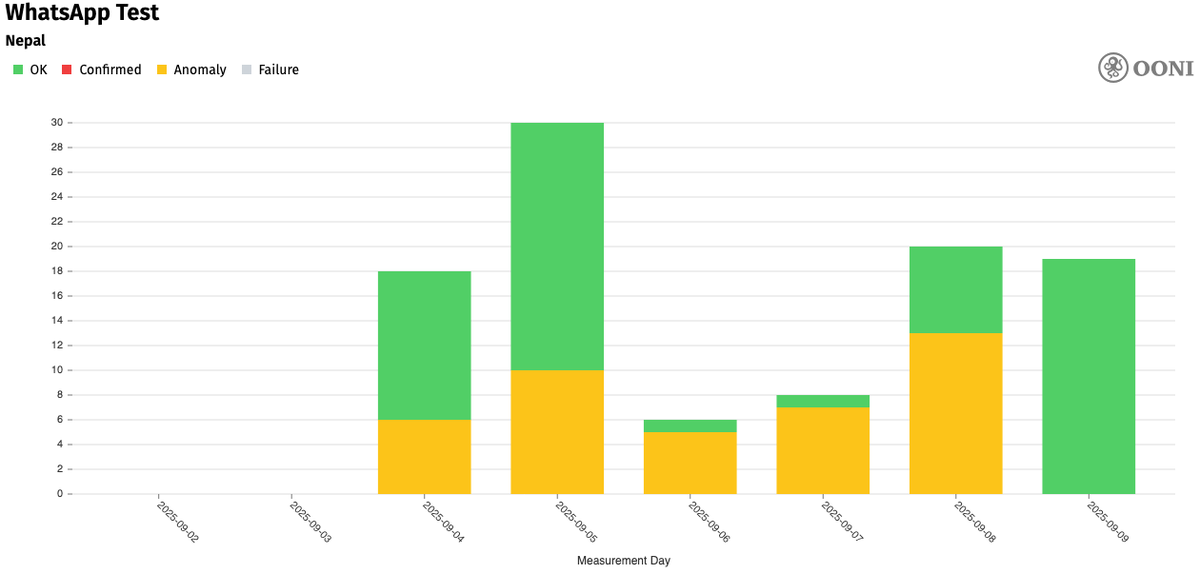
Note that tests for Telegram have been showing similar results since mid-July.
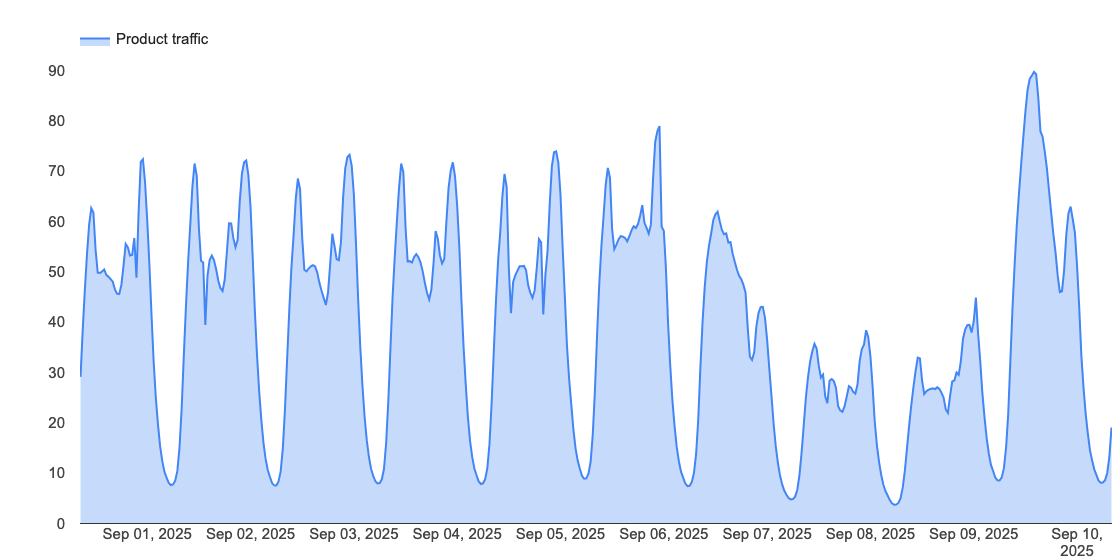
Google Transparency Report also shows a drop in traffic to YouTube from 6 to 9 September.
Social media
What’s happening in Nepal mirrors “this broader pattern of controlling the narrative and controlling of stories emerging from the ground,” said Aditya Vashistha, an assistant professor of information science at Cornell University. “This has happened several times in the neighboring countries India, Pakistan, Bangladesh. So this is nothing new — in fact, I would say this is taken from the playbook, which is now very established, of trying to control social media narratives.”
“Governments absolutely have a valid interest in seeking to regulate social media platforms. This is such a daily part of our lives and in our business. And it is certainly reasonable for authorities to sit down and say we want to develop rules for the road,” said Kian Vesteinsson, senior research analyst for technology and democracy at the Washington-based nonprofit Freedom House.
“But what we see in Nepal is that wholesale blocks as a means of enforcing a set of rules for social media companies results in wildly disproportionate harms. These measures that were put in place in Nepal (cut) tens of millions of people off from platforms that they used to express themselves, to conduct daily business, to speak with their families, to go to school, to get healthcare information.” — Associated Press