
Service blocking
Facebook, X (Twitter), WhatsApp
The disruption occurred in Ecuador on Monday, October 7, 2019, amidst a spiraling political crisis and widespread public protests against government austerity measures. The interference was a form of service blocking primarily targeting social media and messaging platforms, including Facebook, Twitter, and WhatsApp, executed via the state-run telecommunications operator, Corporación Nacional de Telecomunicaciones (CNT).
- Total Duration 0 minutes
 Ecuador
- Population
- 18,289,896
Freedom House rates Internet freedom as Partly Free
Local impact
Temporary disruptions were observed on the state-run telecommunication network, Corporación Nacional de Telecomunicaciones (CNT), amid the political crisis and widespread protests on October 7, 2019. This service restriction targeted the backend image and Content Delivery Network (CDN) servers used by major platforms like Facebook, Twitter, and WhatsApp. The technical effect of this measure was significant: it prevented users from posting or viewing multimedia content, such as audio clips, photos, and videos, despite being able to access the basic text functionality of the applications. Users began reporting the restrictions at the time when information about military deployments in the capital, Quito, was circulating online.
Other supporting information
Social media and messaging services, including Whatsapp and Twitter, were reportedly disrupted on Ecuador’s state-run telecommunication network, Corporación Nacional de Telecomunicaciones, amidst street demonstrations against the government’s austerity measures.
The block appears to have prevented access to servers that stored multimedia content of social networks, hindering users from posting audio clips, photos and videos. Users began to notice the restriction around the same time that posts about military deployments in the capital Quito started to circulate online.
OONI data collected from Ecuador signals potential WhatsApp interference, but no signs of Facebook or Twitter blocking.
The following chart aggregates OONI measurement coverage from the testing of WhatsApp in Ecuador in October 2019.

Chart: OONI Probe testing of WhatsApp in Ecuador in October 2019 (source: OONI MAT).
As is evident, WhatsApp was found accessible most times tested in Ecuador in October 2019, only presenting anomalies (signs of blocking) on 3rd and 7th October 2019. This is interesting because 3rd October 2019 is when the protests started, while 7th October 2019 is the date of the reported block. However, these anomalies only occurred on two ASNs, as illustrated below.

Chart: ASN measurement coverage of WhatsApp in Ecuador in October 2019 (source: OONI MAT).
Meanwhile, OONI data does not show any signs of Facebook Messenger interference in Ecuador in October 2019, as illustrated by the following per-ASN breakdown of measurement coverage.
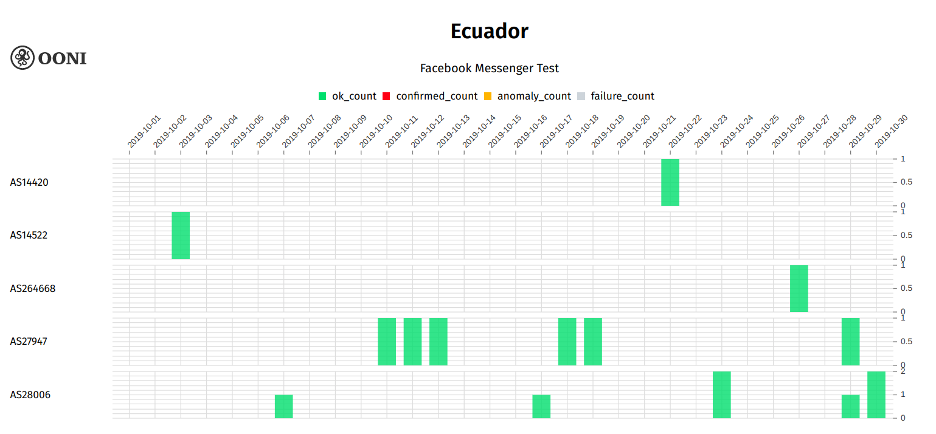
Chart: ASN measurement coverage of Facebook Messenger in Ecuador in October 2019 (source: OONI MAT).
Similarly, the OONI Probe testing of the Twitter and Facebook websites in Ecuador did not present any signs of blocking throughout October 2019, as illustrated below.
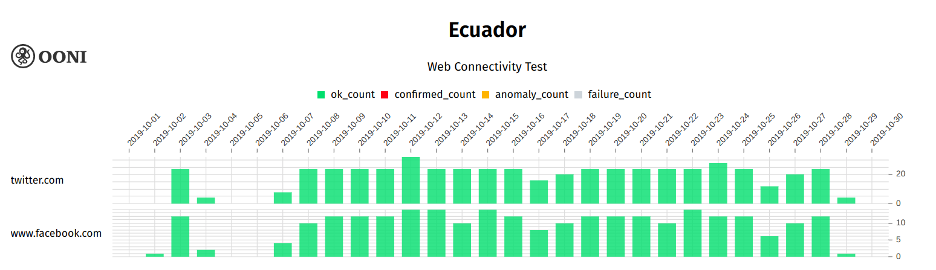
Chart: OONI Probe testing of the Twitter and Facebook websites in Ecuador in October 2019 (source: OONI MAT).
However, it is possible that the services may have not been tested by OONI Probe users in Ecuador in the moments when they experienced blocking (if they were short-lived), or that tests were run on networks that didn’t implement the blocks.
Overall, OONI data only presents a few signs of potential WhatsApp interference on 3rd and 7th October 2019, though the limited measurement volume is an important limitation to the findings.