

Why IP Geolocation Can't Be Trusted for Mobile Networks and the Global South

In short:
- Researchers, policymakers, and companies use IP geolocation tools to locate Internet users based on their IP addresses for targeted advertising, broadband research, and policy decisions.
- Research shows that mobile network geolocation errors are more than 10 times worse than fixed broadband, with Africa and Asia seeing failure rates of 66–72% and 53–61% respectively, compared to under 20% in Europe.
- The problem is structural and provider-independent: geolocation prefixes covering mobile networks span vast geographic areas, coarser address blocks are two to three times more prevalent in the Global South than in the Global North, and all four providers fail at nearly identical rates.
Imagine you are a researcher studying broadband access in rural Kenya. You run an Internet speed test, note the IP address, and look it up in a geolocation database to confirm the location and assess the broadband connection. The database places the connection in Nairobi, 400 kilometers away. You have no way of knowing this unless you manually note the actual location of your speed test. As a result, the wrong location gets attached to your speed test, and your analysis of rural connectivity becomes misleading.
The example is hypothetical, but the pattern is not. My colleagues and I at Virginia Tech have found this happening systematically across four of the most widely used IP geolocation databases worldwide.
What Is IP Geolocation — and Why Does It Matter?
Every device connected to the Internet has an IP address that defines its location on the Internet, but this logical location doesn’t necessarily reflect the device’s physical location. Many Internet stakeholders care about understanding the physical locations of users and devices on the Internet, including content providers (for targeting or restricting content based on location), researchers studying the digital divide, and policymakers seeking to understand broadband coverage.
IP geolocation databases aim to address the challenging problem of mapping IP addresses to physical locations to support these use cases. When these databases are wrong, they can misplace users on the map, leading to misguided research, poorly targeted services, and policy decisions based on inaccurate assumptions.
Our research shows that when these geolocation databases are wrong, the burden falls disproportionately on the communities that can least afford it – those in the global south and those reliant only on mobile Internet.
Mobile Networks Show Geolocation Errors More Than 10 Times Higher Than Fixed Networks
We evaluated four major IP geolocation providers — MaxMind GeoLite2, IPinfo, IP2Location, and DB-IP — against over 37,000 real-world georeferenced measurements across 175 countries, drawing on data from RIPE Atlas and UNICEF Giga school connectivity measurements.
The results were consistent and striking.
Geolocation Accuracy is Significantly Worse on Mobile Networks
Mobile networks, by design, decouple a user’s physical location from their IP address to support mobility, so we expect geolocation accuracy to be worse on mobile networks than in fixed networks; what is unclear is how significant this difference might be. Median geolocation error on mobile networks ranges from 179 to 207 km across all four providers (Figure 1).
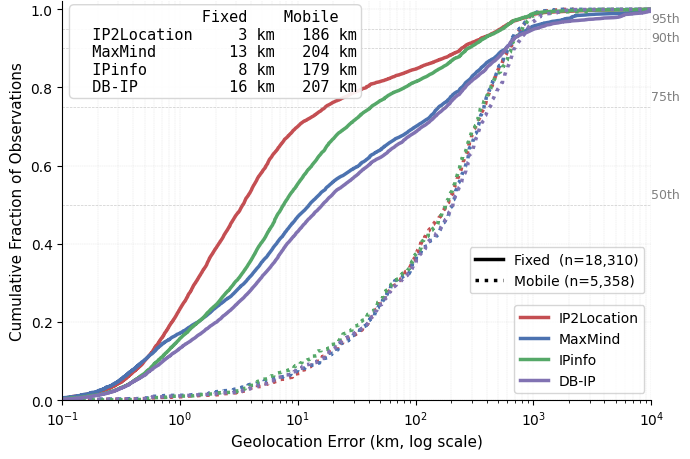
On fixed broadband networks, the same providers achieve error margins of 3 to 16 km. That means in at least half of the cases, a mobile user is placed hundreds of kilometers from their actual location, an order-of-magnitude gap that holds across every provider we tested.
The Global South has Substantial Errors More Frequently
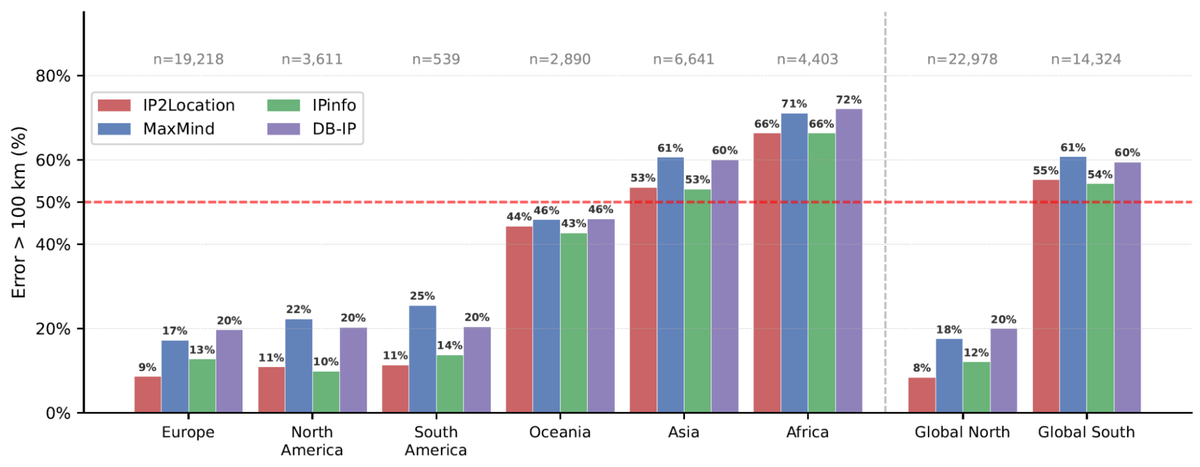
Geolocation errors exceed 100 km for more than two-thirds of observations in Africa and more than half in Asia (Figure 2). In contrast, these significant error rates remain below 25% in Europe and North America. This disparity holds across all four providers.
Switching IP Geolocation Providers Does Not Help
All four providers perform similarly across mobile networks and in the Global South, despite each provider using independent methodologies.
What Limits Accuracy?
The consistency of failure across all four providers points to a structural cause, not a single fixable database error. Our analysis identifies two compounding factors.
Geolocation Prefixes Covering Mobile Networks Span Vast Geographic Areas
Each geolocation database assigns one predicted location to a range of IP addresses, which we refer to as a geolocation prefix. We directly measured the geographic spread of these prefixes: approximately 70% covering mobile networks span more than 100 km, compared to 22–34% for fixed networks.
The same problem is worse in the Global South, where wide prefixes are two to three times more prevalent than in the Global North, with median geographic spread reaching 315–413 km compared to 186–269 km.
A database can only be as accurate as the prefix granularity it uses, and most mobile and Global South prefixes are too coarse to support sub-national location estimates.
Why are These Prefixes so Coarse?
In mobile networks, carrier-grade NAT (CGNAT) assigns a single shared public IP address to many subscribers spread across large geographic areas [Richter et al., IMC 2016]. Prior work has further shown that Africa and Asia have the highest user-to-IP ratios globally, meaning more subscribers share fewer public addresses in precisely the regions where geolocation already struggles most.
Our analysis finds that geolocation providers often aggregate across border gateway protocol (BGP) routing boundaries, using address blocks coarser than those used by the global routing infrastructure.
While it may seem that simply using smaller prefixes would improve accuracy, this is not always the case. Smaller announced BGP prefixes do not necessarily correspond to finer geographic regions (for example, they may exist for routing or security purposes rather than representing distinct physical areas), and providers sometimes consolidate prefixes to reduce database size.
Nevertheless, we find that these coarser prefixes are associated with higher geolocation errors than smaller or equal-sized prefixes, and this pattern is two to three times more common in the Global South than in the Global North.
Together, these factors help explain why improving accuracy in these contexts is not simply a matter of updating a database.
Recommendations For Using IP Geolocation Responsibly
The following recommendations have direct implications for anyone who uses IP geolocation in research or policy.
- Use caution when making sub-national geographic claims for mobile IPs or IPs in the Global South. Our results suggest that the data does not reliably support such claims in many cases, across all four providers we evaluated, spanning 175 countries.
- Treat geolocation prefix size as a signal of potential uncertainty in location estimates. Larger geolocation prefixes are associated with greater accuracy variability and may indicate cases where location estimates should be interpreted with additional caution or appropriate weighting, depending on the analysis.
- Policymakers and funders should scrutinize geolocation-dependent data. Broadband maps, digital equity assessments, and connectivity research that rely on IP geolocation may misrepresent certain regions, particularly where prefix granularity is coarse and mobile networks dominate.
Read our full methodology and findings in our paper, Lost in the Prefix: Revisiting IP Geolocation Accuracy Across Networks and Geographies.
Syed Tauhidun Nabi is a PhD candidate in Computer Science at Virginia Tech, advised by Dr. Shaddi Hasan, and a 2026 Internet Society Pulse Research Fellow.
The views expressed by the authors of this blog post are their own and do not necessarily reflect the views of the Internet Society.
by marianne bos on Unsplash