

Less is More: Why SLIM Offers a More Resilient Internet

In short:
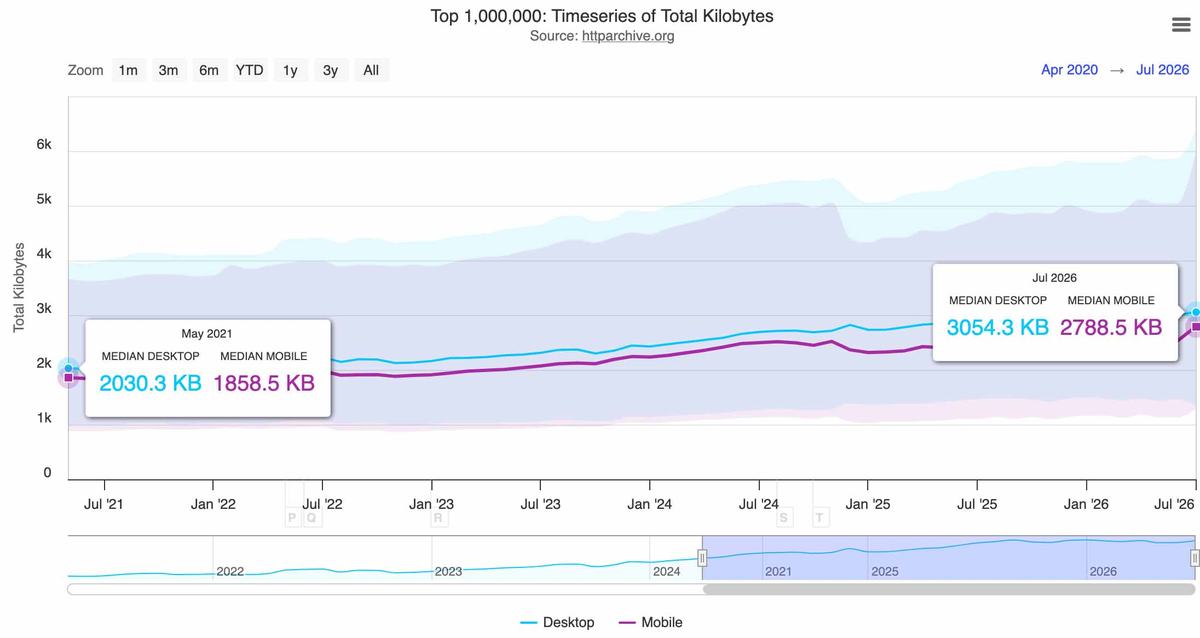
- Since 2021, the median website loading data on a mobile device has increased by 34%
- Accessing large pages when networks are under stress is frustrating and adds more stress to the network.
- Structured Low-bandwidth Information Markup (SLIM) is an opinionated, unofficial standard that reduces the data required to load a page by 99%.
Networks are commonly put under stress not of their own accord. Perhaps thieves seeking copper have damaged telecommunications infrastructure, or conflict has damaged a data center or a subsea cable. Maybe inclement weather destroyed the network and restoration is still underway, as in the case of Hurricane Helene. Or, as remains widespread across much of the planet, the tragedy wasn’t a physical insult to the network: robust connectivity never existed to begin with, and the local network infrastructure struggles to deliver modern web content to users.
Unfortunately, most web developers do not optimize for deliverability in such scenarios. Most websites keep getting bigger over time, requiring more data to load in the browser. According to data from the HTTP Archive, the median website load time on a mobile device was just under 1,900 KB in May 2021. Five years later, in May 2026, that number was approximately 2,550 KB, an increase of 34%!
It does not help that too many web developers fail to take advantage of free, widely available technologies that would reduce the bytes needed to load a page in a user’s browser. The 2025 update to the Web Almanac found that “over 25% of pages across all devices and page types still fail to use efficient compression,” which “leads to faster page loads, especially when the network is the biggest bottleneck”. Whatever the root cause, these metrics suggest little empathy for those without reliable broadband or hardware. Alex Russell’s research has documented this sad, reliably unreliable phenomenon for years.
Austere Network Conditions Make the Web Time-Consuming, Frustrating, and Less Usable
To be clear, the impact of such conditions goes beyond costing users more time. When bandwidth is scarce and latency increases, the users may not know whether the form they submitted online went through. They may not know whether their online payment was accepted, or whether the page they requested is loading, broken, or waiting on some third-party service. Will refreshing the page help? Make things worse? Austere network conditions make the web time-consuming, frustrating, and less usable.
In true emergencies where quick access to important information is required, austere network conditions may mean the difference between life and death.
While technical standards abound for delivering media-rich, modern web experiences, there is little guidance on “what good looks like” for high latency and or low bandwidth browsing conditions. Inspiration may be drawn from sites like text.npr.org and lite.cnn.com, where it’s clear engineers gave forethought to delivering timely information without heavy page weights and with few requests between the browser and the server.
SLIM Reduces the Data Required to Load a Page by 99%
To add to the dialogue on the matter and save work for others, I drafted Structured Low-bandwidth Information Markup (SLIM).
SLIM is an opinionated, unofficial standard that, in my testing, reduces the data required to load a page by 99%. You can visit GitHub to read the detailed requirements. For our sake here, suffice to say that SLIM is primarily text-based, requires the entire page to load in a single request from the browser, and may guarantee the web page loads under austere network conditions.
SLIM content may be published in parallel with a website’s normal content so webmasters can redirect traffic to the SLIM version in an emergency. For the approximately 40% of websites running WordPress, according to W3Tech, the website can be quickly toggled to a SLIM version using the SLIM Low Bandwidth Mode WordPress plugin. It’s worth noting that more than 3,000 .gov websites run WordPress, which may make it especially important to reliably deliver critical information to citizens during a crisis.
Not every website or web application should consider SLIM. Those in critical infrastructure sectors are good candidates, however. And no matter the industry, it’s probably worthwhile for any large organization to examine how well its most important applications would fare if bandwidth were massively constrained. I like to use “5% of the bandwidth you’re accustomed to for two weeks” as a starting point.
However it’s deployed, SLIM is available to help website administrators strategize the right approach for their site and its users. The right time to prepare for austere network conditions is now, before network conditions impose more unnecessary financial or human costs.
Caleb Queern is a cybersecurity expert at KPMG. The views here are his own and are in no way representative of KPMG.
The views expressed by the authors of this blog post are their own and do not necessarily reflect the views of the Internet Society.