

Is Your Internet Slower Because of the IP Version Your Connection Is Using?

In short:
- Given that the Internet is a hybrid of IPv4, IPv6, and dual-stack (both IPv4 and IPv6) networks, it is important to understand performance in each IP version.
- A recent study in Chicago, USA, shows that connection speeds differ systematically.
- This indicates that certain providers, subscription tiers, and speed-testing tools themselves are better provisioned on one IP version than the other.
Every device on the Internet has an IP address—IPv4 or IPv6—that tells routers where to send each packet. IPv4 came first and uses 32-bit addresses, which results in 4.2 billion addresses. While this seems like a lot, it wasn’t enough for every device on the Internet, and we have since run out. The solution? IPv6, with 128-bit addresses and 340 trillion trillion trillion unique addresses.
Given that the Internet is a hybrid of IPv4, IPv6, and dual-stack (both IPv4 and IPv6) networks, it is important to understand performance in each IP version.
To answer this, my colleagues and I recently conducted 80,000 Ookla and NDT7 speed tests from homes across Chicago, USA using the FLOTO platform.
Speeds Can Differ Significantly Due to Various Factors
We found that in nearly 20% of tests, speeds differ significantly (>5%), by up to 100 Mbps in high-speed tiers.
Several factors contribute to this, including the speed tests themselves, which can be biased towards faster speeds in one IP version. Moreover, we found that specific speed test servers are more likely to report slower results in a single IP version, suggesting either server-side bottlenecks or in the path between the server and the home network.
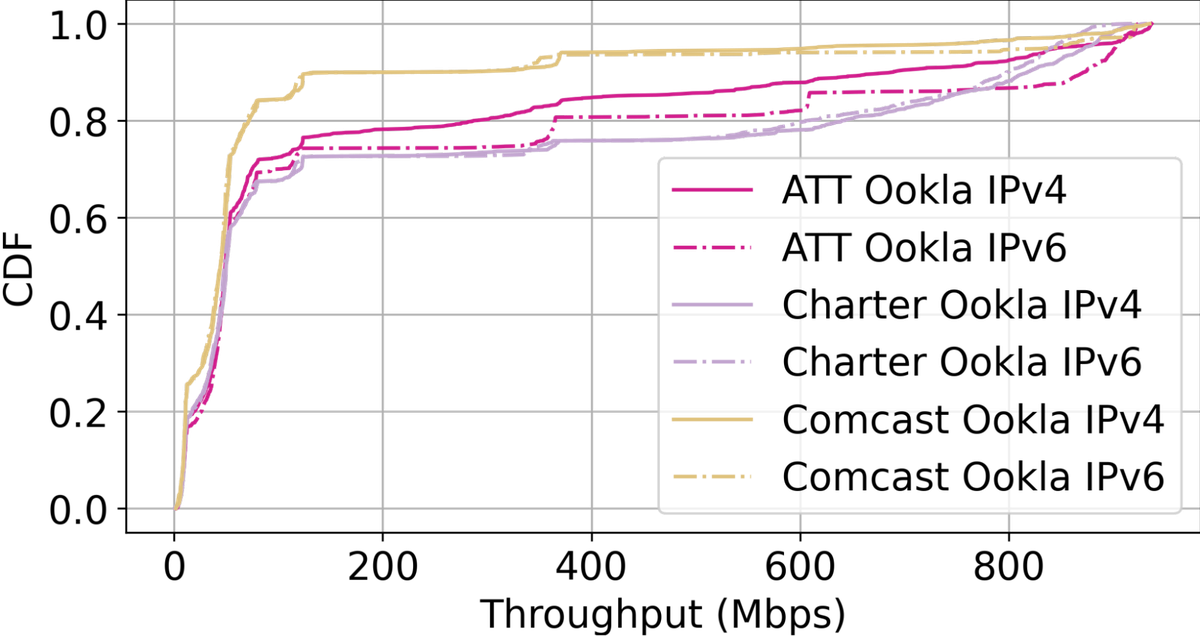
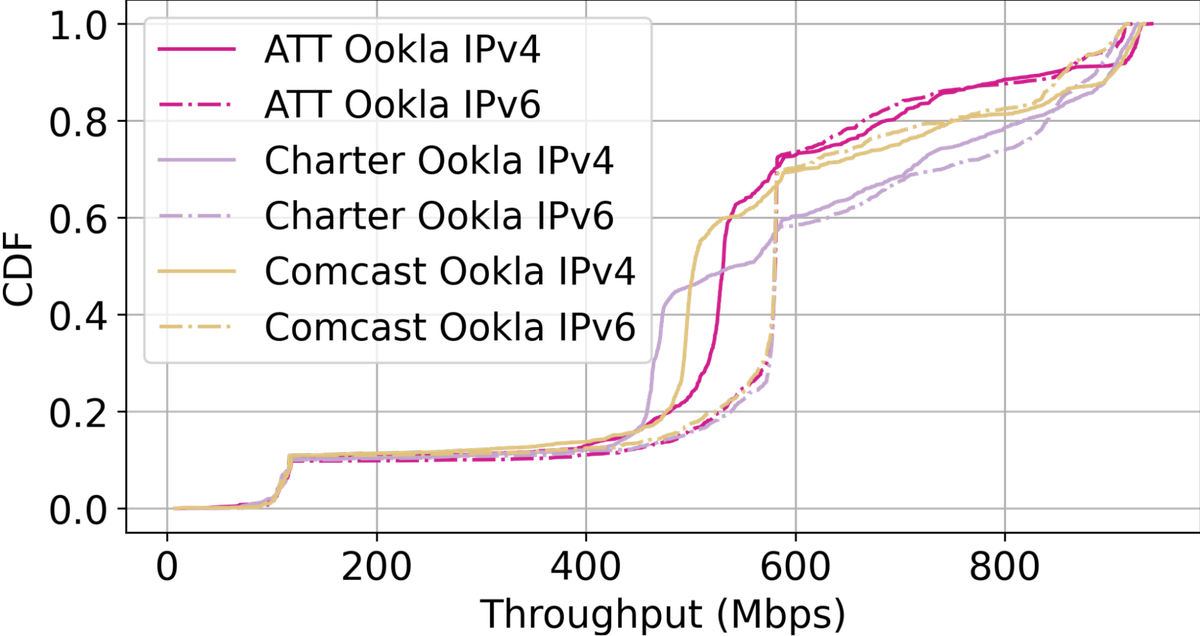
We also identified patterns across specific Internet service providers (ISPs) and speed tiers in which one IP version is faster than the other, particularly at speeds above 400 Mbps. Finally, we identified several households that are consistently faster on a single IP version, potentially due to local factors such as a faulty router or network congestion.
Typical Users See Minimal Impact
Although these findings are significant and illustrate systematic differences in performance, speeds are commonly similar across IP versions. In 80% of tests, speeds differed by 2.5% or less. Broadly, this is good news, indicating that most users are not significantly impacted by the IP version of their connection.
Measuring Performance in Each IP Version Leads to More Meaningful Understanding of Internet Deployment
These results have implications in understanding broadband access and quality, where the IP version is usually ignored as a factor, or only IPv4 is studied.
Moreover, because IPv4 and IPv6 deployment varies regionally, certain groups are left out of Internet performance studies that only study IPv4.
This leaves Internet users, regulators, and policymakers in the dark about how networks perform, especially as IPv6 deployment continues to grow.
For more information about our methods and results, check out our paper, which will appear in SIGMETRICS 2026.
Amanda Hsu is a PhD student at Georgia Institute of Technology, where she is advised by Frank Li and Paul Pearce. She is interested in various facets of Internet measurement, particularly IPv6, broadband, AI and other emerging technologies.
The views expressed by the authors of this blog post are their own and do not necessarily reflect the views of the Internet Society.