
Blackouts and Byteouts: What happens to Internet hubs when the grid stumbles?

In short:
- Understanding how much of our Internet operations is susceptible to failures in the power distribution network is critical for measuring the Internet's resilience.
- A recent study shows that many IXPs, and the networks they serve, are co-located in the same physical buildings. This means a failure that takes out a small number of critical power nodes can knock out multiple IXPs at once.
- Understanding which facilities are at risk is only half the picture. The other half is what happens to traffic when they go down.
Last year, a widespread power outage hit parts of Spain, lasting several hours and cascading into Portugal and Southern France. In the affected areas, and even in some neighbouring ones, people reported losing both connectivity and basic services: no cellular service for hours, no Internet, and even difficulty withdrawing cash. The outage also coincided with a sharp drop in Internet traffic, higher latencies, and overload on communication apps.
A different kind of reminder came a few days later, when a fault at Milan’s Internet Exchange (MiX) disrupted the reachability of multiple services, with effects that rippled far beyond a single building. It was a very public demonstration of what network engineers already know: some facilities matter disproportionately more for connectivity
These incidents aren’t rare occurrences. As we move towards a digitized world, the question is no longer whether electricity and Internet infrastructure are coupled. The question is whether we understand where the coupling is tightest, and what we can do about it.
Where “the Internet” Physically Happens
Most people imagine the Internet as cables under streets and wireless signals in the air. That’s true, but it’s incomplete. A large fraction of daily online life depends on physical facilities:
- Data centers are the buildings where compute and storage live (your apps, your enterprise services, your cloud workloads).
- Internet Exchange Points (IXPs) are locations where networks interconnect and exchange traffic locally, rather than hauling it across borders or through a small set of transit providers.
These are not abstract facilities. They are physical sites with power feeds, cooling systems, backup generators, and (often) a dependence on nearby power grid assets.
As part of my 2025 Pulse Research Fellowship, my colleagues and I set out to understand the dependencies of critical Internet infrastructure, such as data centers and IXPs on nearby power substations with a view to understanding how much of our Internet operations is susceptible to failures in the power distribution network, at both country/zonal and city/local levels. Even the location of power stations is fragmented across countries, formats, and levels of detail.
Mapping Critical Infrastructure facilities to the Grid
There is no publicly available, standardized dataset that says “this facility is powered by that specific substation.” Even the locations of power stations are fragmented across countries, formats, and levels of detail. Public data sources exist, but they’re noisy.
We mapped the locations of IXP facilities and data centres to their nearest high-voltage substations using proximity-based assignment. Rather than claiming to know exact supply contracts (which are not public), we used a risk lens: if a substation fails, which nearby facilities are plausibly at risk?
The scatter plot (Figure 1) shows the distance relative to the impact (denoted by the number of IXPs hosted in a facility).
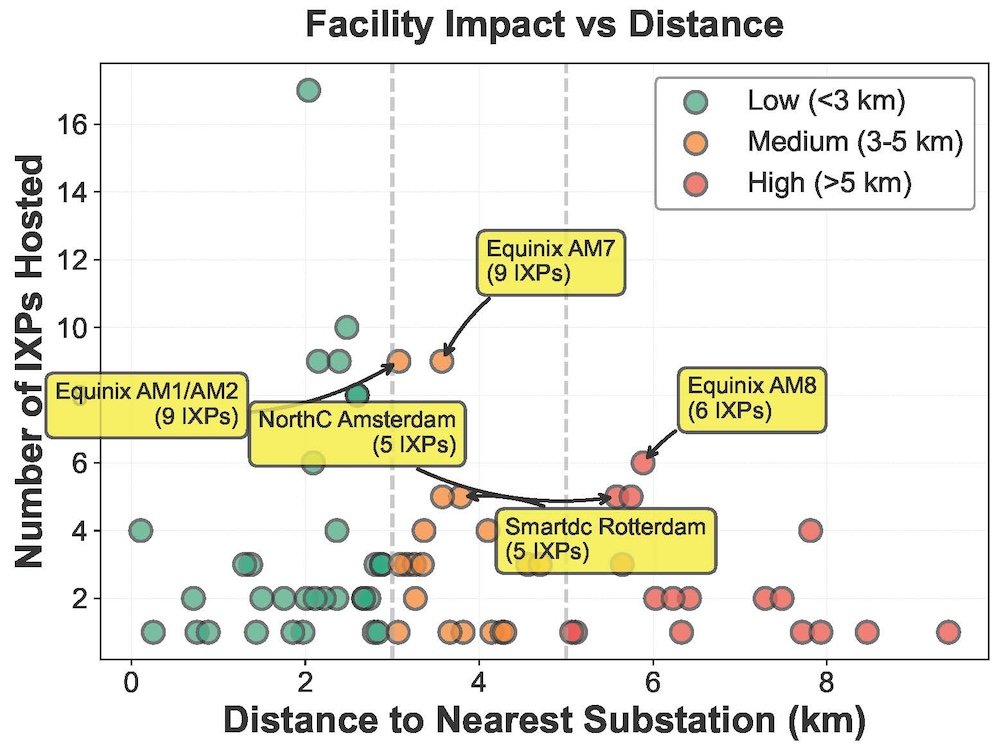
The larger facilities will have a greater impact (on affected IXPs, ASes, and traffic) if the power station supplying them fails. The plot also shows the top 5 critical facilities by IXP and distance, highlighting that high-impact facilities are not necessarily placed with the power grid infrastructure in mind, and that this should be considered when adding new facilities. If a power event affects the Amsterdam area (where many facilities cluster), multiple high-impact IXPs could fail simultaneously, as geographic and distance-based risk compounds.
Cascaded Failure Risk is Real and is Amplified by Co-location
To model resilience, we constructed a bipartite graph connecting each IXP facility to its k nearest substations (with k = 3). In this model, a facility is considered failed only if all of its connected substations are lost, reflecting the idea that facilities with access to multiple nearby substations have some redundancy.
Even with this generous assumption, the results are sobering. Many IXPs, and the networks they serve, are co-located in the same physical buildings. This means a failure that takes out a small number of critical power nodes can knock out multiple IXPs at once.
When running a substation failure simulation using the above framework, we found that ~70% of the IXPs can fail per ~20% substation failure rate (Figure 2). This is mainly due to the co-location of these digital facilities.
So while a city can look “well-connected” on paper (many facilities!), it may be non-resilient, as those facilities may share the same underlying power dependence and be vulnerable to similar risks (like an outage or a natural disaster, like a flood).
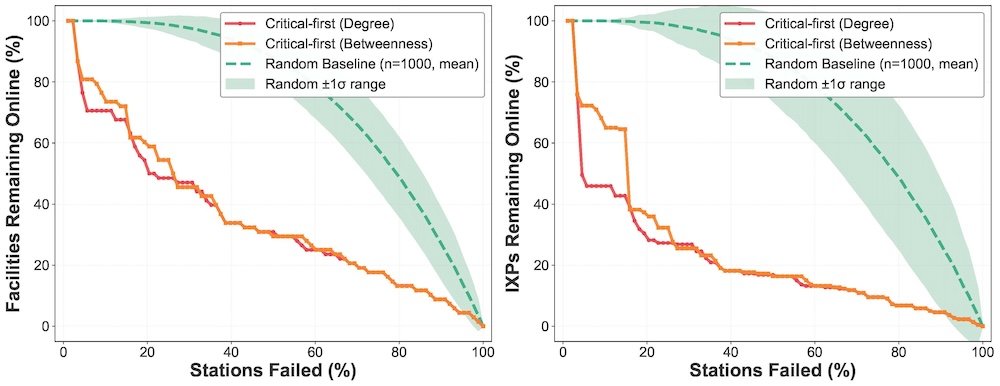
We ran these simulations using three failure strategies: random substation failures (modelled as equipment faults or weather events), degree-centrality-based failures (targeting the most connected substations first), and betweenness-centrality-based failures (targeting substations that lie on the most paths through the network). The targeted strategies, which approximate deliberate attacks or correlated failures in critical grid segments, are significantly more damaging than random failures at the same scale.
When a Major Hub Fails, Where Does the Traffic Go?
Understanding which facilities are at risk is only half the picture. The other half is: what happens to traffic when they go down?
This is an important question to answer to better understand the system's resilience. To answer this, we used the PEERING Testbed to emulate failure scenarios and evaluate the impact of power-outage-induced infrastructure failure for Amsterdam (Figure 3).
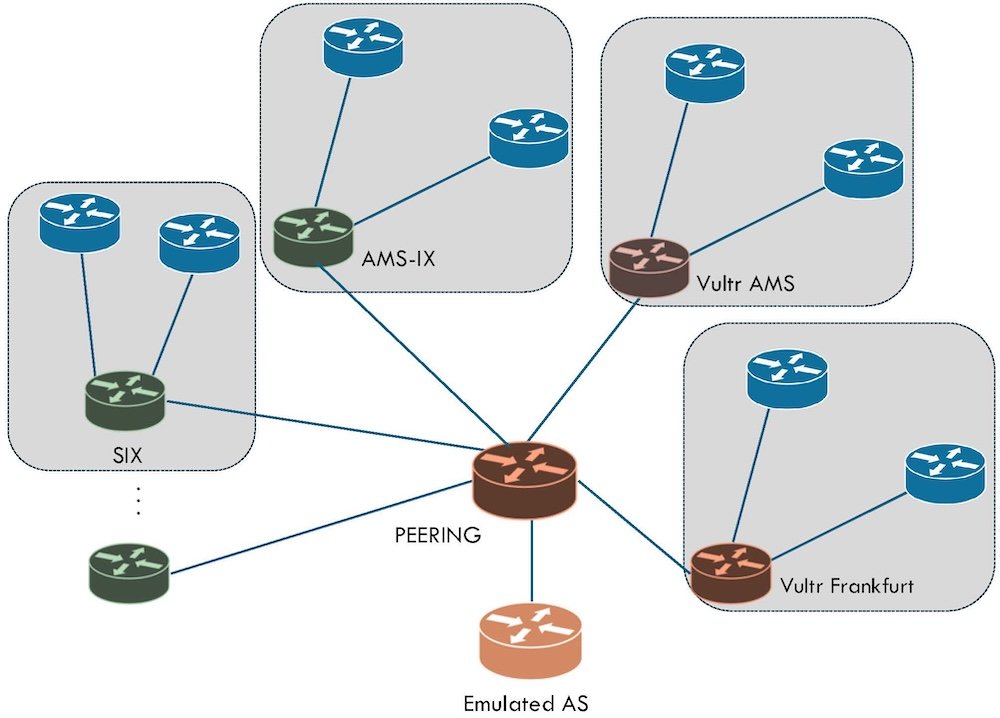
Our intuition is that “geography matters”: if Amsterdam fails and PEERING links are available at both Frankfurt, Germany, and Seattle, US, the traffic would likely be rerouted via Frankfurt rather than via SIX (Seattle). Our experiments tested whether this intuition holds in practice.
We also performed failure experiments for pairs and triples of sites to understand the primary, secondary, and tertiary preferred rerouting paths. These results reveal not just where traffic can go, but where it does go when the routing system adapts to a failure. And depending on those rerouting outcomes, we can begin to capture interdependencies that cross national boundaries
The results so far paint a clear picture: geographic concentration of Internet infrastructure creates hidden fragility through shared power dependencies, and the co-location patterns common in major Internet hubs amplify the risk considerably.
Watch my presentation at Pulse Internet Measurement Forum, Spain or contact [email protected] to learn more about our methodology and results.
Tanya Shreedhar was a 2025 Pulse Research Fellow and a postdoctoral researcher at TU Delft in the Netherlands. Her research spans transport protocols, Internet measurements, and infrastructure resilience.
The views expressed by the authors of this blog are their own and do not necessarily reflect the views of the Internet Society.