

Are LEO Networks the Future of National Emergency Failovers?

In short:
- Low Earth Orbit (LEO) satellite-bassed Internet constellations have been immensely helpful during national connectivity disruptions, but evidence of their effectiveness remains largely anecdotal, with no systematic national-scale studies.
- Researchers simulated and evaluated their performance as a backup system for six nations and observed that capacity is limited by spectrum limitations.
- Failover capacity depends not only on technical constraints, but also on deployment choices and coordination between national governments and satellite operators, underscoring the need for combined technical and policy solutions.
When a subsea volcanic eruption damaged Tonga’s only submarine cable in 2022, the island nation lost connectivity almost instantly. For weeks, satellite networks, including Starlink, Kacific, and SES, filled the gap during the prolonged repair effort.
Similar situations have unfolded elsewhere, from Ukraine’s wartime disruptions to restoration efforts in Jamaica after Hurricane Beryl, showing how satellite networks are increasingly called upon when terrestrial systems fail.
These recent events have brought satellite systems to the forefront of national resilience planning. Governments, including those of Italy, Israel, Ghana, and Taiwan, as well as international organizations such as the European Union and NATO, are exploring how Low Earth Orbit (LEO) satellite constellations could serve as proactive backups for national connectivity.
While LEO networks have clearly demonstrated their effectiveness during emergency deployments, whether their capacity can scale to support an entire nation remains unclear. Unlike terrestrial infrastructure, which has been studied and planned for decades, LEO networks lack systematic frameworks for evaluating their capacity during national-scale connectivity disruptions.
My colleagues and I recently sought to fill this gap by studying how a modern LEO satellite network would perform as a national backup during large-scale disruptions to connectivity. We adopted a national perspective because, unlike local governments and municipalities, national governments can influence the operation of satellite networks through spectrum licensing and regulation.
We used submarine cable outages as a reference point for capacity planning. Submarine cables are a natural reference as they carry a substantial fraction of a nation’s Internet traffic, so their failure provides a concrete baseline for measuring how much capacity is lost.
We grounded this analysis in six nations with recent submarine cable disruptions, spanning distinct sizes, geographies, and demographic and infrastructural characteristics: Ghana, Haiti, Lithuania, South Africa, Tonga, and the United Kingdom.
Nation Size Matters
Our analysis revealed that LEO networks can replace only a small fraction of the capacity lost during submarine cable outages in these six nations, with four of the six nations recovering less than 15 percent of that experienced recent submarine cable disruptions, spanning diverse capacity. This limitation is not confined to today’s deployments alone, but also persists when we simulate substantially larger constellations, indicating that the satellite count is often not the primary bottleneck.
In practice, the failover capacity is strongly shaped by a nation’s geographic area: smaller nations exhaust the available spectrum under current deployments, while larger nations exhaust the satellites available to serve them. Adding more satellites yields early gains, but these gains quickly plateau as spectrum constraints dominate.
As Does Terminal Deployment and Spectrum Management
This limited capacity is further shaped by how user terminals are deployed (often by the national government) and how satellite operators manage the allotted spectrum during the outage. When the terminal deployment and spectrum management are misaligned, network capacity is underused. In contrast, proactive coordination can nearly double the failover capacity compared to an unplanned deployment.
Impact Beyond National Borders
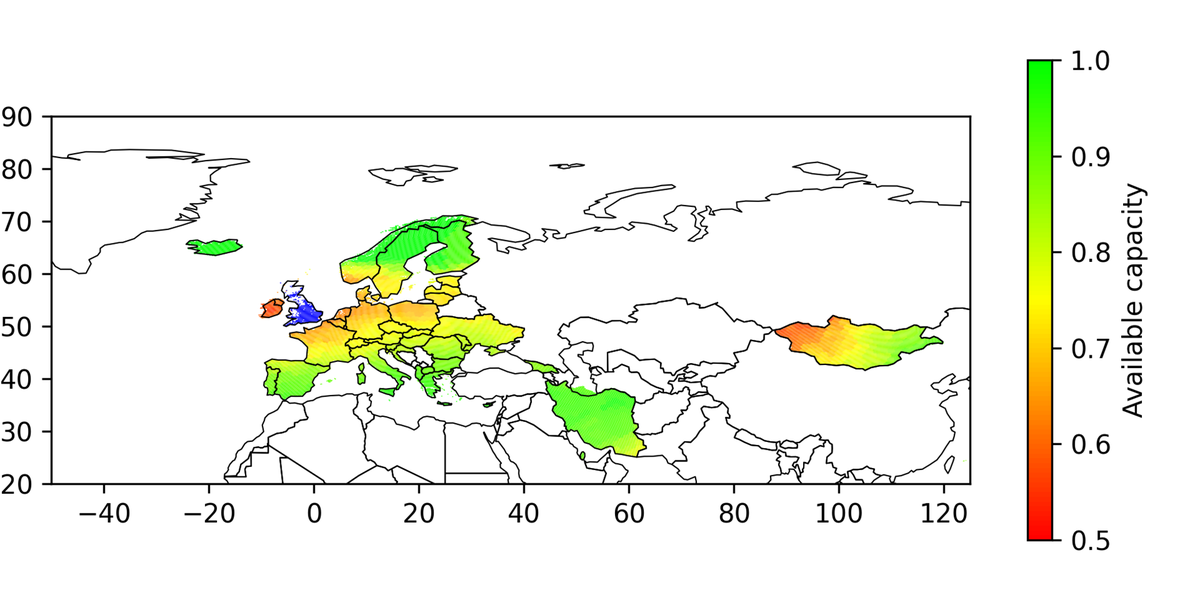
As LEO networks operate as a globally shared infrastructure, the failover traffic of one nation can significantly affect network performance well beyond national borders. For example, Figure 1 illustrates that when Great Britain relies on LEO networks for failover, the resulting load can reduce available capacity across Europe, including how satellite operators manage the spectrum allotted regions as distant as Mongolia. This highlights that LEO networks operate as a shared global resource and that effective failover requires international policy coordination.
Simulate and Visualize for Yourself
Taken together, these results demonstrate how governments and operators can plan and coordinate to greatly enhance the effectiveness of LEO networks in supporting national-scale emergency failover. For readers interested in a more in-depth treatment of these questions, we have published two companion papers discussing the policy and technical analyses.
We also released CosmoSim as an open-source simulator and provided an interactive web application to visualize geographically detailed failover capacity for all six nations.
Vaibhav Bhosale is a final-year Computer Science PhD student at Georgia Institute of Technology.
The views expressed by the authors of this blog are their own and do not necessarily reflect the views of the Internet Society.