

The Web Looks IPv6-Ready Until You Look Beneath the Surface

In short:
- Checking whether an initial domain has an IPv6 address is not enough to evaluate IPv6 progress.
- Pulse Research shows that the further you move from the initial domain into the dependency chain, the less likely you are to find IPv6 support.
- Policies mandating that government services be IPv6-capable have varying effects on real-world adoption.
The Internet is in the middle of a long transition. IPv6, the protocol designed to replace the aging IPv4 address space, has been rolling out for over a decade. Tracking that rollout matters because IPv6 is essential to the Internet's continued growth, and governments, network operators, and content providers have all invested in making the switch. But how do we know if the web is actually ready?
Two-thirds of websites now support IPv6 at their initial domain, that is, the domain you type into your browser or click on in a search result, such as example.com. But our recent multi-country (28) Pulse Research Fellowship study of 8,500 websites reveals that this number hides a much messier reality. The web's true IPv6 readiness drops sharply once you move past the initial domain and into the dependencies, the dozens of third-party domains behind the initial that your browser contacts to load scripts, fonts, images, and other resources needed to fully render a page. These dependencies are what make a modern web page work.
Initial Domains vs. Dependencies
When you visit a website, your browser doesn't just connect to one server. It pulls in dozens of additional resources from many third-party domains: JavaScript files that power interactivity, stylesheets that control layout, fonts that render text, and data from analytics and advertising services. These are the page-load dependencies. They are invisible to you but essential for the page to work correctly.
We found that while 67% of initial domains support IPv6, only 47% of third-party dependency domains do. That 20-percentage point gap means that even when an initial domain is IPv6-ready, the dependencies behind it often are not. In practical terms, this means a site can appear fully IPv6-capable when you check its initial domain record, yet still require IPv4 to finish loading.
The gap is especially significant because modern websites commonly rely on many third-party domains during a single page load. Each IPv6-lacking service is a potential point of failure for users on IPv6-only networks.
Our study observed roughly 25,000 unique domains contacted during page loads across 8,500 websites, and the pattern was consistent: the further you move from the initial domain into the dependency chain, the less likely you are to find IPv6 support.
Render-Critical Resources Are the Least Ready
Not all dependencies are equal. Some are render-critical, meaning that without them, the page simply cannot display properly. JavaScript and CSS stylesheets fall into this category: if they fail to load, the page may show a blank screen or a broken layout.
These are precisely the resources with the weakest IPv6 support. Only about 32% of stylesheet requests and 37% of script requests come from IPv6-capable domains. Fonts sit at just 35%. For someone on an IPv6-only connection, this translates to broken pages and degraded experiences, even when the initial domain technically "supports" IPv6.
Government Websites: High Adoption, Uneven Results
Government websites are a particularly important case because they often provide access to essential public services, and many countries have set explicit IPv6 transition targets for their public sector.
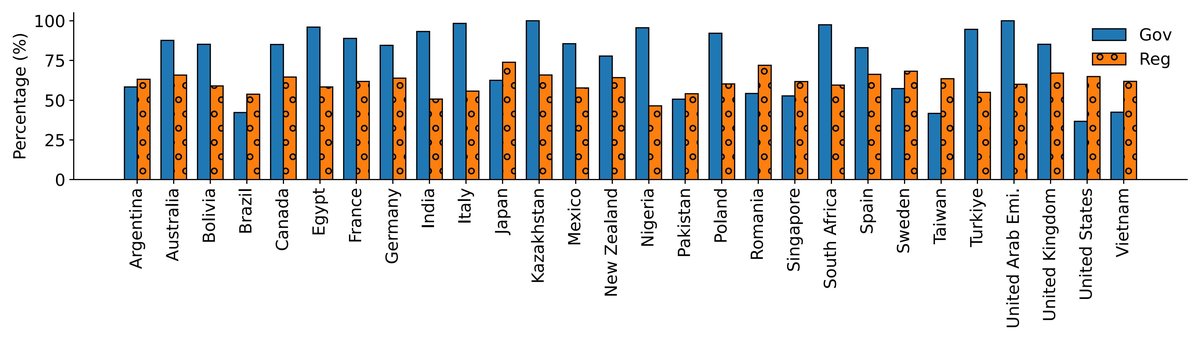
Across our dataset, government websites show the highest IPv6 adoption of any category we studied, at 76% at the initial domain. But that average masks enormous country-level variation (Figure 1). The United Arab Emirates and Kazakhstan government websites are 100% IPv6 capable, while the United States sits at 37% and Viet Nam at 42%.
We also examined whether national IPv6 policies make a difference.
Countries like India, which mandated that government agencies adopt IPv6 by 2012, show 93% adoption. Egypt, with a recent national strategy targeting full public and private IPv6 readiness within three years, has reached 96%. Australia, which pursued a whole-of-government IPv6 transition strategy, shows 87%.
But other countries with explicit targets lag well behind their own goals. The U.S. aimed to reach 80% of federal assets using IPv6-only by fiscal year 2025, yet we observed only 37% of federal assets using IPv6-only. Viet Nam targeted 90—100% IPv6 adoption for government portals by the end of 2024, but currently sits at 42% in our data. Policy clearly matters, but setting a target does not guarantee hitting it.
And even where government initial domains have strong IPv6 adoption, the story changes at the dependency level. Figure 2 shows that IPv6 availability across dependencies is both wide and uneven.
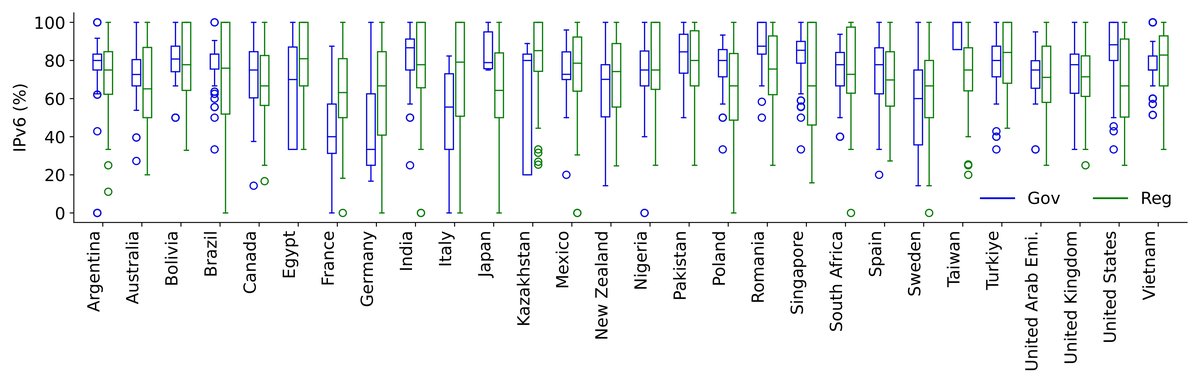
Some countries approach full dependency on IPv4-only resources, while others remain heavily reliant on IPv4-only resources beneath the surface. France and Germany, despite high levels of general Internet penetration, rank among the lowest in the dataset for government dependency readiness, at 42% and 47%, respectively. Taiwan, by contrast, reaches nearly 95% in terms of dependency coverage.
The gap between initial domain adoption and dependency readiness reinforces the central finding: looking only at the initial domain overstates the extent to which a country's government web presence is truly prepared for IPv6.
IPv6 Adoption Still Has A Ways To Go
Checking whether an initial domain has an IPv6 address is not enough to evaluate IPv6 progress. The real question is whether the entire chain of dependencies behind that page works over IPv6, and right now, it often does not.
Enabling IPv6 on the initial domain is a necessary first step, but the third-party services embedded in modern web pages, from analytics and CDNs to font providers, need to keep pace.
The web's IPv6 transition is not failing, but it is uneven in ways that simple adoption metrics do not capture. Progress in the initial domain is real, but a larger gap exists in the dependencies beneath it.
Sachin Kumar Singh is a PhD candidate in the Kahlert School of Computing at the University of Utah and was a 2025 Pulse Research Fellow.
The views expressed by the authors of this blog post are their own and do not necessarily reflect the views of the Internet Society.