
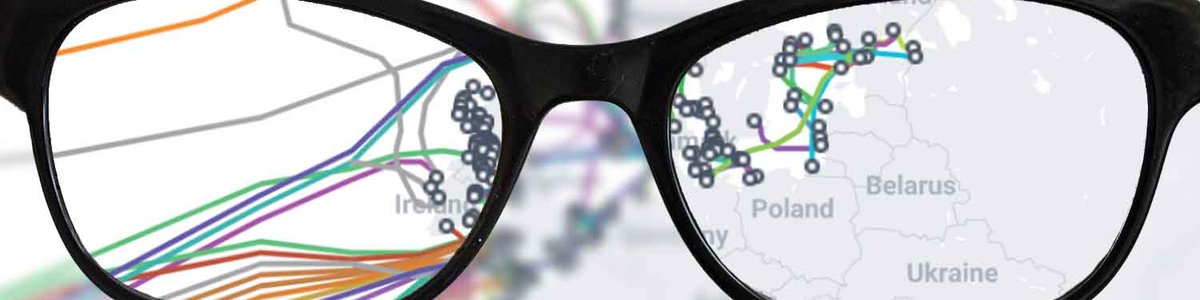
Increasing the Resolution of Submarine Cable Network Performance

In short:
- The need for the research community and policymakers to better understand the behavior of the Submarine Cable Network has never been more urgent.
- Current ways to monitor it are not as well-tuned to delivering its performance metrics.
- Researchers have developed a new methodology using publicly available infrastructure that captures more accurate profiles of their behavior.
The Submarine Cable Network (SCN) is a massive, critical, and shockingly opaque portion of the Internet.
Comprising more than 600 submarine cable systems, this backbone Internet infrastructure carries around 99% of all intercontinental Internet traffic and spans more than 1 million kilometers.
Despite its scale and importance, the SCN is treated like a “mysterious black box.” Cable ownership is private, and operators rarely publish performance data. Yet outages can disrupt entire regions, and repairs are often slow and costly. Furthermore, tech giants such as Amazon, Google, Meta, and Microsoft are rushing to invest billions in expanding the SCN.
In short, the need for the research community and policymakers to better understand this infrastructure’s behavior has never been more urgent.
The Current Challenges With Monitoring Submarine Cables
Publicly available “tool kits” for monitoring Internet paths do exist, but they pose their own technical challenges.
A common way to monitor the Internet is to use traceroute, which sends a probe toward a destination and returns the round‑trip time (RTT), or the latency of the journey there and back. Sending a traceroute between routers on different continents seems like it would reveal the latency of the submarine cable in between, but it is far messier.
Measurement platforms like RIPE Atlas deploy dedicated measurement hosts around the world that can launch traceroute probes, but many of these routers are located further inland, far from submarine cable landing points. This extra distance can introduce noise: terrestrial fibers may appear to be part of the underwater portion of a measurement, and intermediary routers may handle probes more slowly than standard traffic. Worse, a probe can take a completely different reverse path through the network, perhaps even crossing a different submarine cable, making the RTT nearly impossible to interpret.
Before measurement can even start, there is also the fundamental problem of identifying which measurement sources are best suited to monitoring which cables. Submarine cables often share landing points and belong to the same operator networks, leaving us the difficult task of untangling the mesh.
Given these challenges, we require not just better measurement techniques but also a better method for choosing where to measure from and for extracting meaningful information from noisy data.
Measuring Closer to the Source…
To identify ideal routers or vantage points for launching measurements, we first referenced public data detailing submarine cable ownership, landing point locations, and the locations of nearby coastal points-of-presence (PoPs).
PoPs can be thought of as the international airports of the Internet, where various networks come together to exchange traffic. We found that vantage points closest to a coastal PoP offer quicker access to submarine cables and minimize additive noise to our measurements. To monitor a cable in a specific network, we looked for a vantage point that is operated by, or exchanges traffic with, that same network.
Validation of our findings against ground-truth datasets provided by colleagues at ESNet revealed that no single vantage point gives a perfect view of a submarine cable. Each one “sees” the cable through its own unique mix of routing quirks and local congestion.
To cancel individual biases, we calculated the average signal over all vantage points and used this as an estimate of the submarine cable’s true minimum latency.
…Increases the Resolution of Results by up to 88%
We identified vantage points for monitoring 64 submarine cable segments across more than 32 service‑provider networks spanning all major world regions (Figure 1). On average, we found more than seven vantage points per cable.
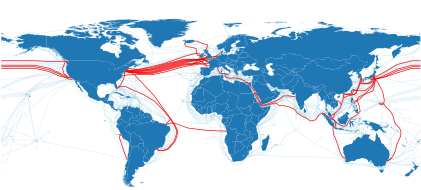
Our estimation technique generated values within 9.5% of the six ground-truth data sets, improving upon the naïve method by up to 88%. More crucially, our method of averaging across vantage points is highly robust to transient congestion and changing reverse paths.
With this methodology, we can capture accurate profiles of submarine cable behavior using publicly available infrastructure, making the once‑hidden properties of the SCN visible to researchers and policymakers without relying on proprietary data or specialized measurement deployments.
Read more about our research in our NINES paper.
Mia Weaver is a PhD student at the University of Wisconsin-Madison, advised by Professor Paul Barford. Her research focuses on Internet measurement and congestion control algorithms.