

Understanding Partial Reachability

In Short:
- Measuring Internet connectivity requires a new definition to accommodate the growing number of partially reachable networks of the Internet.
- Researchers have proposed a new definition that suggests that for a network to be considered within the "Internet core," it needs to be reachable by at least 50% of the rest of the active Internet
- The same group has developed an algorithm, Taitao, to detect the networks within this core and those outside.
For decades, we’ve treated the Internet like a light switch: it’s either on or it’s off. If you can send an email to a friend across the globe, you’re "on." If a government turns off the fiber during a protest, you’re "off."
But as the digital world becomes a battleground for geopolitical influence and corporate tugs-of-war, this binary view is failing us. In our recent paper, "Understanding Partial Reachability in the Internet Core," my colleagues and I argue that we need a fundamentally new definition of what "The Internet" actually is.
It turns out, the Internet isn’t a single, monolithic entity—it’s a consensus. And that consensus is starting to fracture.
The Identity Crisis of the Interconnection
Traditionally, the Internet was defined as a "network of networks" where everyone could, in theory, talk to everyone else. But what happens if a country sanctions another and requires all of its Internet Service Providers (ISPs) to de-peer with ISPs from those countries? Or when two massive ISPs cannot agree on business terms, stop exchanging traffic?
In these cases, a network isn't "down"—people using that network can still browse parts of the Internet—but it isn't fully "on" the global Internet either. It exists in a twilight zone of partial reachability.
To address this uncertainty, our research proposes a bold new technical definition. We argue that "The Internet core" is the strongly-connected component of more than 50% of active, public IP addresses that can bidirectionally route to each other.
How do we decide who is in this "core" and who is an outsider? We propose the 50% Rule.
The 50% Rule: A New Digital Border
Under this definition, the "Internet core" is the largest group of networks, with every member reachable by at least 50% of the rest of the active Internet. This 50% is a threshold that forces one answer—one Internet. If there are two conflicting definitions of 50%, they must overlap. Each party can present its evidence and identify overlap, or where their measurements disagree.
This definition means that no single entity defines what "is" the Internet. Not the U.S., nor China, nor any of the Regional Internet Registries in charge of assigning IP addresses. The Internet is simply the place where the majority of us can still meet.
This definition of the Internet depends only on observations of the Internet itself, not on some authority. That neutrality means that the definition may help resolve disputes over when networks are or are not part of the Internet, a topic of interest to journalists, policymakers, and researchers.
Policymakers sometimes consider sanctions, and network operators must consider how such decisions affect the Internet. Journalists sometimes characterize the risk here of a "splinternet"—the idea that the Internet may break into national silos. Our definition helps ground these ideas in a measurable fact—it allows anyone to measure what they can reach and compare their results with others to determine an Internet core reachable by a majority, and then determine the status of that core. This measurement allows us to hold policymakers to account—if actions succeed in expelling others from peering, causing the Internet to lack a 50%-reachable core, those actions have broken the Internet.
Mapping the Future
Our definition also encompasses partial reachability, where two parties can each reach the core, but not each other. Partial reachability is particularly vexing to Internet users, when they find they can reach some websites but not others.
We define an algorithm, Taitao, to detect these peninsulas, and we show that partial reachability today is as common as network outages. Understanding partial reachability is a new research and business challenge to understand and sell to all the Internet.
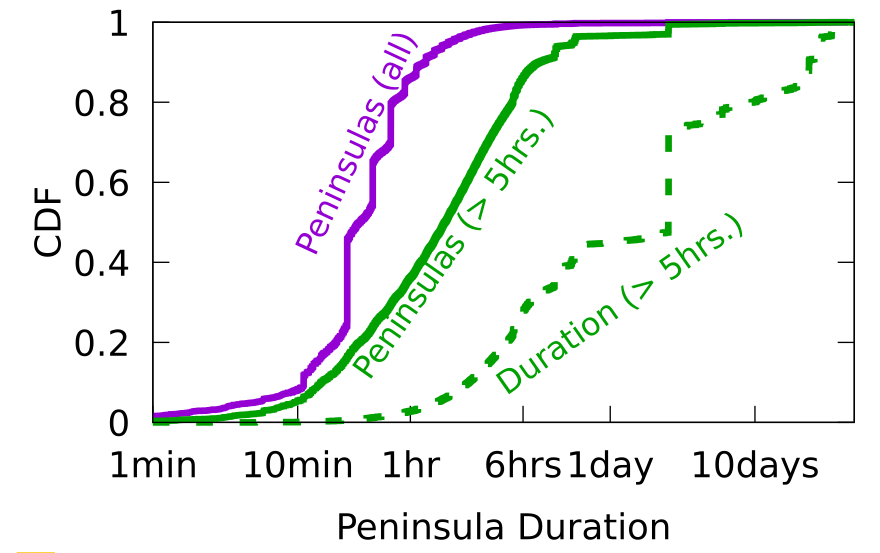
By defining the Internet as a core of mutual reachability, we make it possible to start measuring this aspect of the Internet's health.
We can see where cracks are forming in reachability and help guide policymakers in the implications of their choices and the opportunities for investments to improve network resilience.
Guillermo Baltra is a Network Researcher in Chile studying the intrinsic nature of the Internet.
The views expressed by the authors of this blog are their own and do not necessarily reflect the views of the Internet Society.