
Keeping Gaza Connected: Building Crisis-Resilient Internet Access

In short
- Gaza's Internet infrastructure is highly vulnerable and controlled.
- Proposed technical solutions are currently difficult or untenable due to geopolitical restrictions.
- Developing a National Emergency Telecommunications Plan (NETP) is one practical and immediate solution towards greater connectivity autonomy and resilience.
The Internet is crucial to conflict zones like Gaza. It provides life-saving information to civilians and keeps them connected to family and loved ones, assists the coordination efforts of emergency and aid services, and documents and advocates against human rights violations.
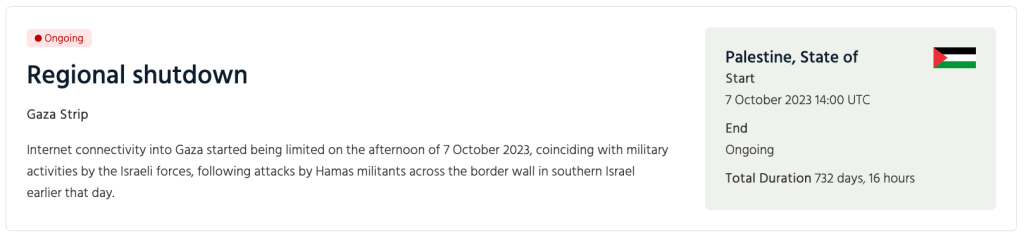
Unfortunately, Internet connectivity is often one of the first things to be destroyed or blocked in such contexts. According to the Internet Society Pulse, Gaza has been suffering a regional shutdown since October 2023, with the most recent blackout happening in September 2025.
Understanding the Landscape
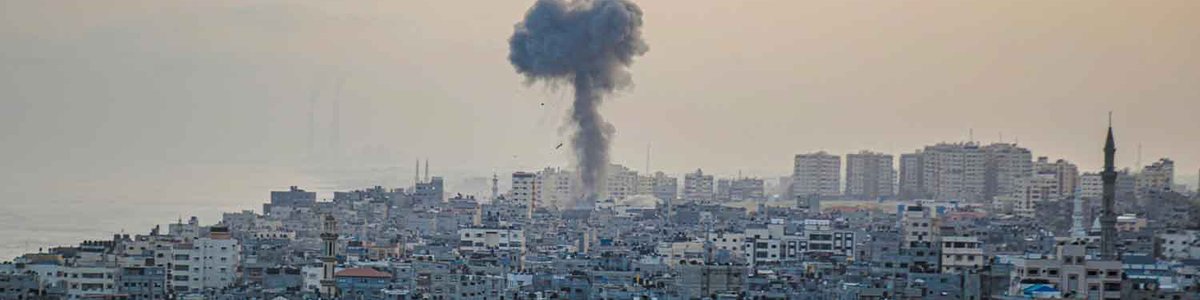
Aggravating the situation in Gaza is a fragile telecommunications infrastructure weakened by constant bombardment and an ongoing Israeli blockade that restricts the import of ICT equipment, access to the full telecommunications spectrum (only outdated 2G networks are available), and the development of Internet infrastructure.
Review the Palestine Pulse Country Report
Moreover, this infrastructure is connected to the broader Internet by fibre-optic cables that are fully under Israeli control, making it highly susceptible to full digital disconnection.
Under the best of circumstances, Internet connectivity is restricted, and during times of conflict, it can completely break down. More resilient and decentralized solutions are needed to provide essential connectivity in such a volatile environment, which is something my colleagues, Ange Royall-Kahin and Leon Gwaka, and I explored during our case study for the Internet Society Mid-Career Fellowship in 2024.
Solutions for Emergency Connectivity: Initial Proposals
It should be noted that any suggested solutions to bolster resilient connectivity in Gaza face the constraints highlighted above. So, while our research has proposed solutions that could potentially improve Gaza’s Internet resilience, especially in emergency scenarios, most were hindered by obstacles born of the region’s unique restrictions and geopolitical factors. Initial solutions included:
- Deploying LEO satellite systems such as Starlink to provide decentralized and resilient Internet connectivity, which can bypass terrestrial infrastructure prone to damage and destruction. Importing the necessary satellite equipment under the Israeli blockade, however, makes this difficult to implement.
- Advocating for greater Palestinian autonomy over their telecommunications network would enable ownership of networks, spectrum allocation, and advanced technologies like 4G and 5G. Israeli control over the Palestinian networks also makes this option likely untenable.
- Proposing the recognition of Internet access as a human right during conflict and safeguarding telecommunications infrastructure under the Law of Armed Conflict. The length and complexity of such a lawmaking process make it unsuitable for immediate implementation.
The most feasible solution, although also not without its difficulties, is the development of a National Emergency Telecommunications Plan (NETP) as suggested in the ITU Guidelines for national emergency telecommunication plans. According to Target 3.5 of the ITU Strategic Plan 2020-2023:
"By 2023, all countries should have a National Emergency Telecommunication Plan as part of their national and local disaster risk reduction strategies."
This is especially relevant to environments such as Gaza that frequently experience emergency situations requiring contingency plans for Internet connectivity. The NETP can be tailored to the realities of Palestine and can ultimately act as a framework for local and international partners to better coordinate and respond faster in times of crisis.
The plan would outline protocols for deploying emergency connectivity during crises, covering areas such as:
- assessing ICT capabilities and vulnerabilities
- creating disaster risk management plans
- establishing early warning systems
- delivering diverse ICT tools to support marginalized and special needs groups.
Developing and Implementing a Palestinian NETP
While the ITU’s guidelines and targets for universal adoption of NETPs can provide a good foundation for developing a Palestinian plan, implementing the plan entails working with local and global actors who have a direct stake in or impact on the creation of a Palestinian NETP, and who will require time and effort to convene and motivate.
These include a diverse set of internal and external stakeholders, spanning policymakers and government entities, Internet service providers, mobile network operators, development agencies, civil society, and international organizations.
Assembling and driving the support of this complex network of stakeholders is an intricate process that will necessitate impressing on them a sense of urgency and need for change, and communicating a clear and compelling vision for the future that this NETP could provide for Palestine.
Drawing on other countries’ successful NETP adoption can help inform the process for Palestine and implement best practices. Somalia is one such case, among several others, where the country’s National Communications Authority launched its NETP during a national workshop in 2023 that brought together key stakeholders.
A Path Forward
The persistent connectivity crisis in Gaza demonstrates a need to rethink how we can provide resilient and accessible Internet access in conflict zones.
This proposed solution does come with political and logistical challenges, but it can provide a starting point for the development of resilient Internet connectivity in Gaza (and Palestine as a whole). It requires the support and coordination of multiple stakeholders—from governments to civil society, technology providers, and international organizations—to ensure that Internet connectivity during times of conflict is treated as a critical lifeline and a fundamental right.
Racha Mourtada is a Program Director at the International Advisory Group and Internet Society 2024 Mid-Career Fellow.
The views expressed by the authors of this blog are their own and do not necessarily reflect the views of the Internet Society.
Photo by Mohammed Ibrahim on Unsplash