

Japan’s Broadband Paradox: Bridging the Transparency Gap

In short
- Japan ranks among the best globally for fixed broadband infrastructure, but its network performance is not up to the same standard.
- In the fixed broadband market, there is little incentive for Internet Service Providers to share details of performance shortcomings.
- By developing better measurement tools and stronger incentives for disclosure, Japan can shift from a competition based on theoretical claims to one based on real, verified quality.
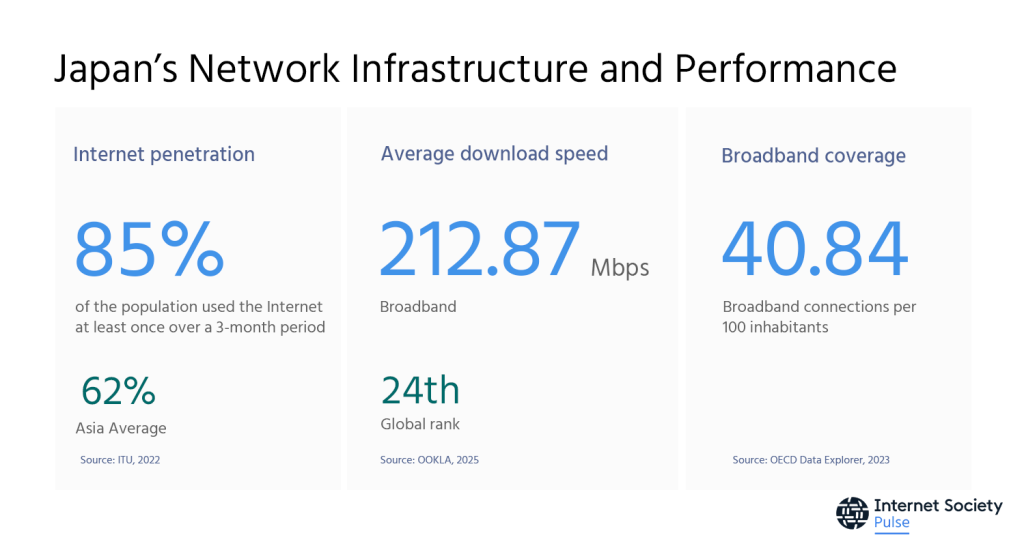
Japan is known for having some of the world's most advanced broadband infrastructure. With fiber coverage reaching nearly 100% of households and high rankings in OECD broadband penetration statistics, it appears to be a digital leader.
Yet a closer look reveals a surprising contradiction. In Ookla's speed test ranking, Japan ranked only 24th for fixed broadband as of June 2025. This mismatch between advertised speeds and actual performance defines Japan's 'broadband paradox.' Behind the impressive infrastructure lies a transparency gap that frustrates users and distorts market incentives.
Why Transparency Gap Persists
My recent online survey of 640 broadband users highlights the scope of this issue.
Most respondents prioritize monthly fees and advertised speeds when choosing an Internet service provider (ISP). However, over 25% could not recall their plan's speed, and nearly 60% were unfamiliar with the meaning of 'best-effort'—a disclaimer that actual speeds may vary widely. Notably, respondents on higher-priced plans received smaller fractions of the promised speeds, suggesting a pattern of 'excessive advertising.' Overall, 65% of respondents said they wanted compensation for poor performance if possible.
Japan's regulatory model is part of the problem. While Japan's general consumer protection relies on laws like the Act against Unjustifiable Premiums and Misleading Representations, its fixed broadband market is governed by soft-law guidelines. These guidelines allow providers to advertise maximum 'theoretical' speeds with only a 'best-effort' disclaimer. This approach starkly contrasts the legally binding rules in the US and EU that require disclosing actual, measured service performance. This creates a classic 'prisoner's dilemma': if one provider reports honestly while others exaggerate, the honest one risks losing business. As a result, no one has the incentive to lead on transparency, and consumers are left in the dark.
To solve this, we need to reframe transparency not as a regulatory burden, but as a competitive strategy.
A Framework for Trust and Transparency
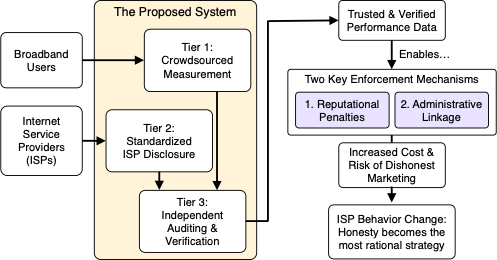
A trusted, multilayered system for monitoring broadband quality can realign incentives and help Japan deliver its digital promise. The proposed approach includes:
- Crowdsourced performance data: Empowering users to test and report their actual speeds using free online tools.
- Standardized provider disclosures: Requiring all providers to self-report performance data using consistent formats.
- Independent auditing and verification: Validating user and provider data through neutral third-party audits.
This structure has several benefits.
First, it empowers consumers: verified data on discrepancies between advertised and measured speeds can serve as admissible evidence for complaints under Japan's consumer protection laws.
Second, it creates reputational pressure on providers. Providers are strongly incentivized to align their claims with reality if third-party institutions regularly publish comparative performance data. Over time, this observability makes honest disclosure the most rational strategy.
Delivering on the Promise
Japan's broadband market is stuck in a low-trust equilibrium where exaggerated promises go unchallenged and actual performance lags. But this can change.
With better measurement tools and stronger incentives for disclosure, Japan can shift from a competition based on theoretical claims to one based on real, verified quality. This would empower consumers to make better choices and reward providers who deliver on their promises.
The infrastructure is in place. Now it's time to match it with transparency.
Toshiya Jitsuzumi is a professor at Chuo University in Tokyo, specializing in telecommunications policy, AI governance, and digital platform regulation. Drawing on over 15 years of experience at Japan's Ministry of Internal Affairs and Communications, he researches broadband transparency, sustainable market design, and the global governance of emerging technologies.
The views expressed by the authors of this blog are their own and do not necessarily reflect the views of the Internet Society.
Photo by Brett Jordan VIA Flickr