
Developing Resilience Among Community Networks in Kenya

In short
- Kenya is one of many countries that have embraced community networks as sustainable connectivity solution for connecting the unconnected.
- The Association for Community Networks in Kenya is targeting is to have 100 community networks by 2030.
- Many of these networks are now deploying fiber networks as a means to sustain their growing user base, develop resilience against climate challenges, and attract new supporters.
For more than a century, the urban-rural divide has grown wider globally, as more people move from rural towns to cities for education and job opportunities.
Although the Internet has the means to slow or reverse this trend, the geographic, demographic, and economic limitations of rural regions have also created a similar divide in the connectivity options available. Of the estimated 2.6 billion people offline in 2024, 1.8 billion live in rural areas.
Community networks are one of many community-centered connectivity solutions to help connect these underserved communities. These solutions are not imposed from outside, but instead designed with direct involvement from the people who will use and maintain them. They rely on local governance, use affordable and appropriate technology, and are sustained through flexible models that reflect community priorities.
Kenya is one of many countries that have embraced community networks as sustainable connectivity solutions. In 2021, the Communications Authority of Kenya developed a framework to enable community-based organizations and small social groups to establish and operate small-scale networks and provide Internet services to their local communities.
Since then, the Internet Society has supported 11 community networks in Kenya, many of which Barrack Otieno has helped establish and grow through the Africa Higher Education Research Institute (AHERI).
“In 2019, we built the third community network in the country,” recalls Barrack. “It started as a wireless network with three hotspot nodes that provided 3 MB packages to around 300 people.
Within two years, the network grew to over 400 nodes, and it currently offers a minimum 10 MB package to around 3,000 paying customers, comparable to a Tier 3 Internet Service Provider.
Read: Announcing a new group of 9 grantee partners to connect the unconnected worldwide
“I’ve been involved in building around a third of the 20 community networks that have popped up since then,” says Barrack. “We’ve also established the Association for Community Networks in Kenya [ACNKe] to represent their interests. Our target is to have 100 community networks by 2030.”
Future-proofing Connectivity
These efforts complement the government’s Digital Super Highway project to establish 25,000 WiFi hotspots, 1,450 village digital hubs, and 100,000 kilometres of fiber.
Barrack is most pleased with this last initiative, as it overcomes a spectrum challenge that wireless networks face globally as 5G is rolled out.
“When Kenya started introducing 5G in 2023, some of the frequencies given to mobile network operators had initially been allocated to Tier 3 network facility and infrastructure providers. They all moved back to the 5.8 gigahertz band that falls under the Industria, Scientific, and Medical band that is set aside for research purposes, which most community networks were using for transmission, while they used the 2.4 Gigahertz band for last-mile connectivity,” explains Barrack.
“Unfortunately, it caused a lot of noise, meaning that our networks were almost rendered unusable. We had to consider using more high-end devices, which would still cause issues with having to jump from frequency to frequency or switch to fiber.
Satellites are becoming an option in some of Kenya’s most isolated communities. For example through an Internet Society Kenya Chapter partnership with Help NGO and the Red Cross, a number of Starlink kits that were initially used for a project monitoring areas affected by flash floods in 2024 were repurposed and used to establish five community networks that are serving over 20,000 community members in Nyatike, Ugunja, Kajiado, Laikipia and Marsabit counties.
While fiber was the most expensive option, Barrack said it was the most future-proof in terms of increasing performance, providing greater redundancy, and strengthening resilience. To lessen the cost, ACNKe also brokered an MoU with the Government, allowing community networks to use the national optic fiber infrastructure for free, provided they connect schools and government spaces.
“We are providing free connectivity to schools, faith-based and public institutions, and public spaces,” says Barrack. “This furthers our contribution to ensuring that the unserved and underserved are actually brought online.”
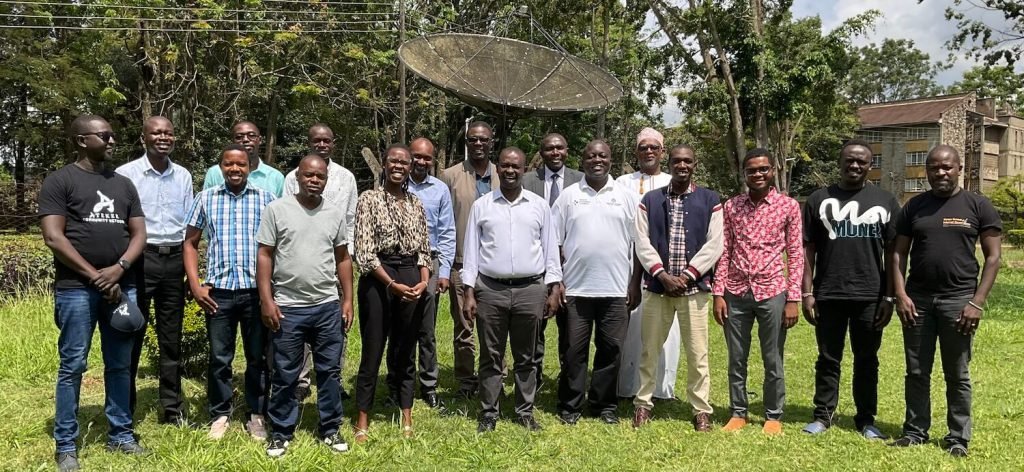
“We are also doing a lot of capacity building. I'm an instructor for the Internet Society’s Community Network Readiness Assessment and Building Wireless Community Networks courses, which help institutions that want to establish community networks to determine how ready they are to establish one. Other colleagues have initiated a fiber optic training to help networks transition and maintain their new infrastructure.”
Connectivity That Coexists With Nature
Another benefit of fiber that some communities have reported is reducing the need to increase the height of wireless receivers or continually prune trees that some villages have been growing more of to reduce the impact of strong winds on power cables.
“One community was experiencing five to ten power blackouts a day because winds were causing the power cables to touch each other, which automatically switches off the electricity supply as a safety feature,” explains Barrack.
“So, they decided to grow rows of trees parallel to the cables to form wind breaks. However, the side effect of this was that the trees were growing so high, forcing them to raise their wireless radio transmission and receiving equipment, as it works on a line of sight.
“In many ways, this is making us more aware of the need for connectivity to coexist with nature.”
“So this was another reason why we decided to go the fiber optic way: so that connectivity can coexist with nature.
Solar Offers Power Resilience
Like many countries worldwide, Kenya has been grappling with an aging power network and increased demand for several years, leading to a drop in reliability and an increase in interruptions. Between 2021 and 2023, Kenya’s System Average Interruption Frequency Index (SAIFI)—a measure of the average number of interruptions a customer experiences— increased from 29.29 to 44.9.
These power outages have resulted in significant Internet outages in the country and revealed how dependent the Internet is on power utilities.
Read: Electricity and Internet Resilience
Barrack notes that these limitations, as well as the fact that only 76% of Kenya’s population has access to electricity, contributed to almost all community networks in the country using solar and batteries as the main source of power.
“Based on our isolation and the demand that we have now, we are compelled to build redundant networks,” says Barrack. “We have a standard operating procedure, which says that we cannot entertain an Internet outage for more than four hours.”
Hosting Content Locally
As more community networks deploy fiber, Barrack expects demand on the network to increase exponentially, as their users start to access data-intensive content, such as video streaming and AI services.
As Barrack explains, “it takes approximately $150 to connect a single community member. Yet the community members say they can only afford to pay $10 to $20. So we are trying to find a balance that will ensure we lower the cost from $150 to $10.
“Much of this cost is in transiting data. It costs us, on average, maybe one to two dollars to transport 1MB of data from data centers in the city to rural areas. So we spend roughly $500 to $1,000 a month on backhaul. Then add another $1,000 for typical operating costs. So it’s approximately $1,500 to $2,000 per month for a service that you’re expected to provide for free.”
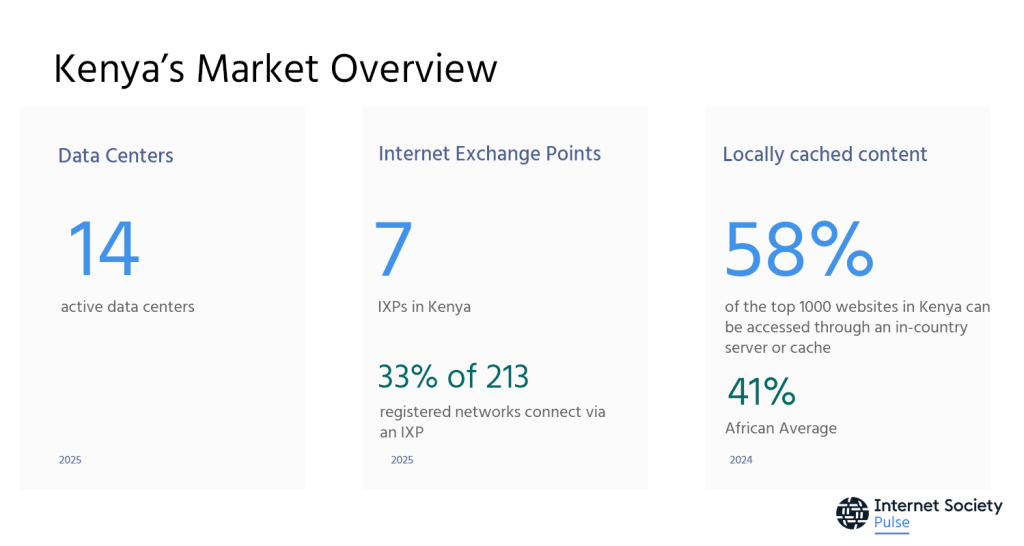
Through the Internet Society and Kenya Network Operators Group, Barrack and other ACNKe members have been developing relationships with Internet Exchange Points (IXPs) and data centers, discussing the potential of setting up nodes in rural areas.
“If they come closer to us, it means we can cut our connectivity costs by close to 80%!” says Barrack.
“Our commitment to fiber means their infrastructure will be well-connected. We’re also proposing expanding our networks and giving them access in exchange for their service. It’s not cheap, but it makes sense to invest in it, because that's where the future lies in localized content.”
Learn how the Internet Society is working to keep half of all traffic local in selected economies.